TJ THELEN'S COLLECTION
The Thelen Reserve

Learning Library

Find a guide to print, a history to read, or a kit for your next tasting.

Resources

Illustrated guideAging & maturation

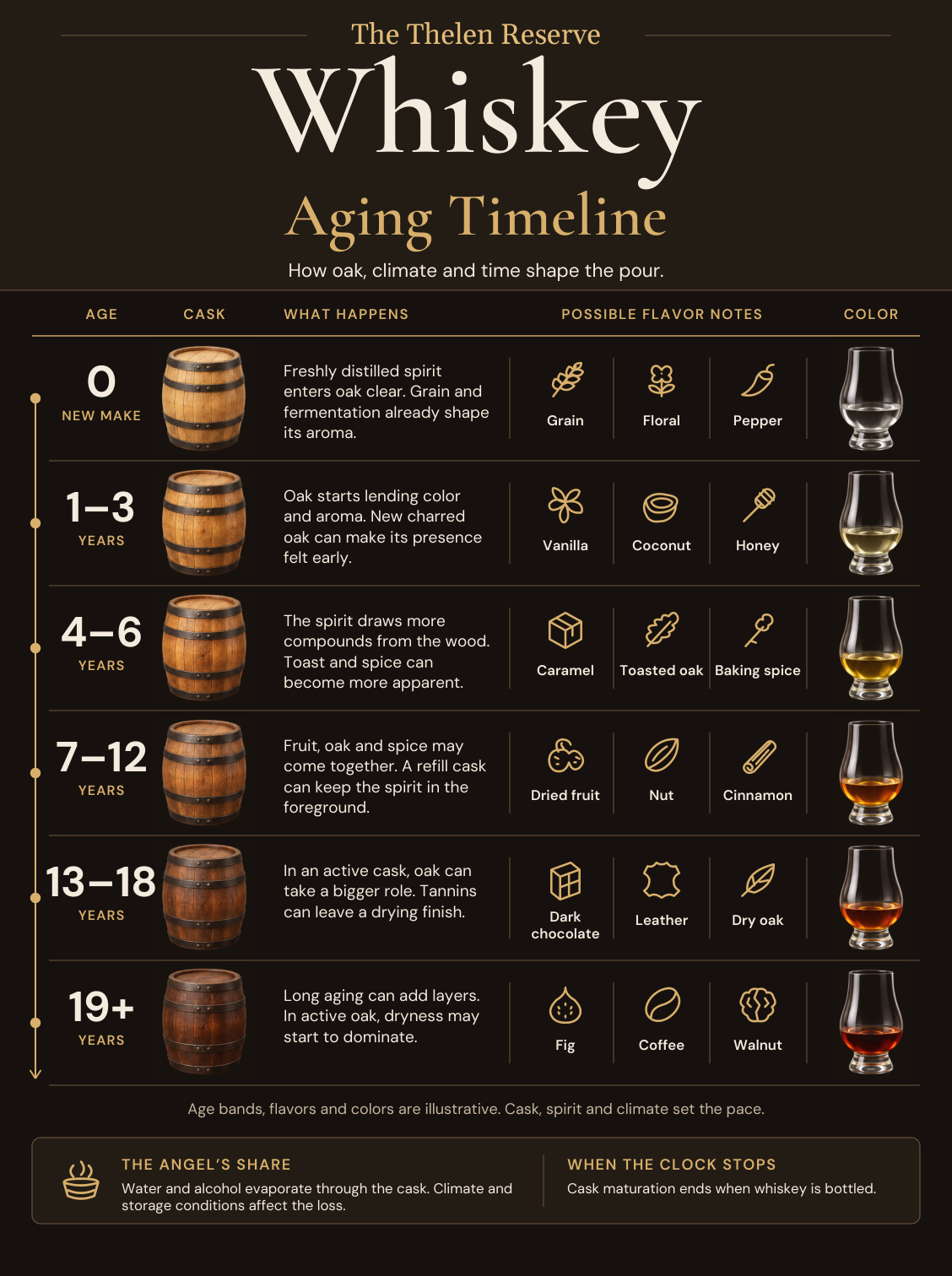
Whiskey Aging Timeline

Follow six stages from new make to 19+ years, with examples of what can change in the cask.

Open guide
Formats and reading options

Viewing copy and US Letter Home Print · Print Shop posters

Read as text

Tasting notes, colors, and age bands illustrate one possible progression. Cask, spirit, and warehouse conditions shape each release.

  • New make, 0 years. Freshly distilled spirit enters oak clear. Possible notes include grain, floral, and pepper.
  • 1–3 years. Oak starts adding color and aroma. Possible notes include vanilla, coconut, and honey.
  • 4–6 years. The spirit draws more compounds from the wood. Possible notes include caramel, toasted oak, and baking spice.
  • 7–12 years. Fruit, oak, and spice may come together. Possible notes include dried fruit, nut, and cinnamon.
  • 13–18 years. Active oak can lend a drying finish. Possible notes include dark chocolate, leather, and dry oak.
  • 19+ years. Long aging can add layers, and active oak can bring greater dryness. Possible notes include fig, coffee, and walnut.

The angel’s share is the water and alcohol that evaporate through the cask. Cask maturation ends at bottling. The US Letter PDF includes the full reading copy and sources.

Illustrated guideTasting & glassware

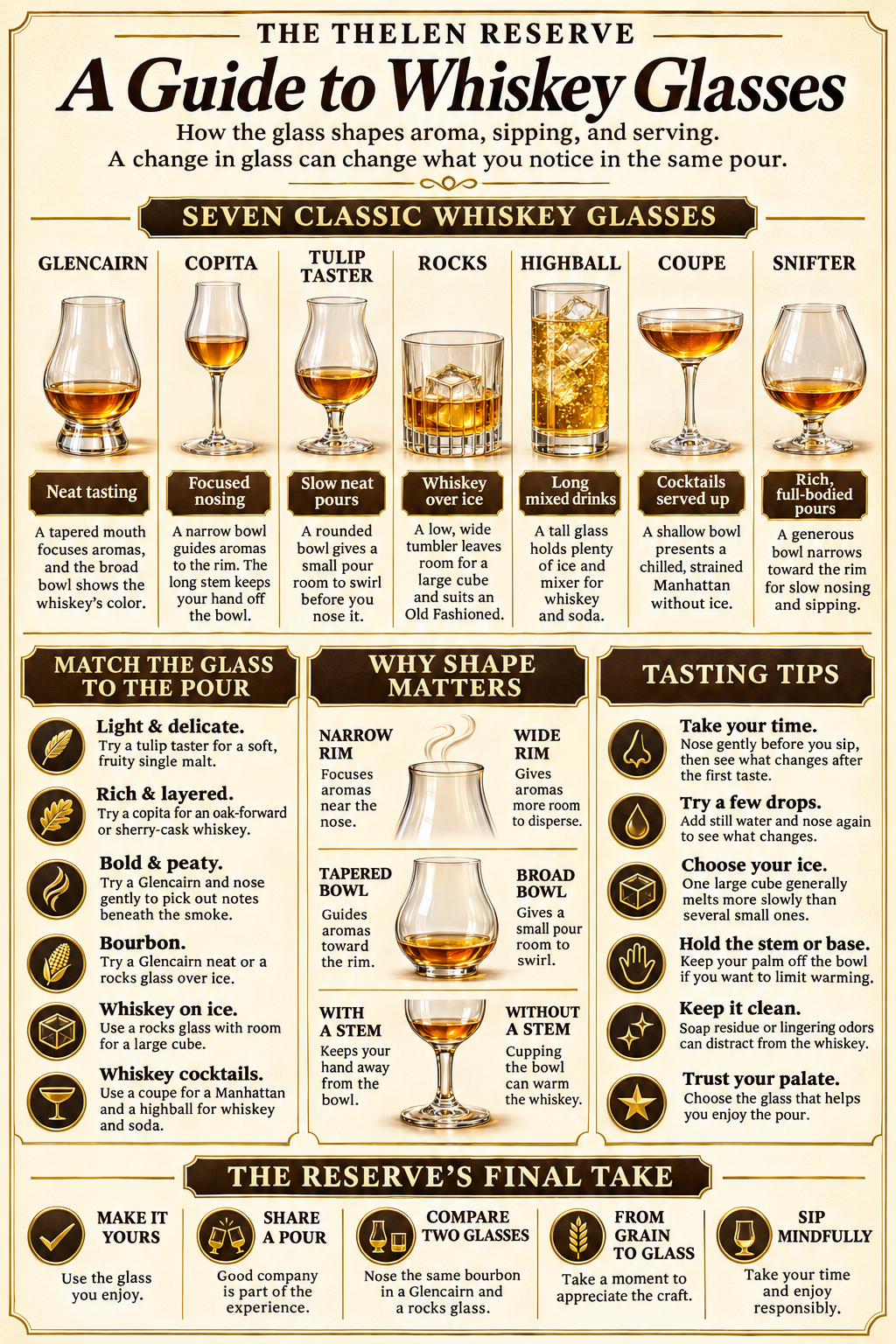
A Guide to Whiskey Glasses

Seven glass shapes, when to use them, and how to compare the same pour in two glasses.

Open guide
Formats and reading options

Viewing copy and US Letter Home Print · Print Shop posters

Read as text

Seven glasses and when to use them

  • Glencairn: A tapered mouth focuses aroma for neat tasting.
  • Copita: A narrow bowl guides aromas to the rim. A long stem keeps your hand off the bowl.
  • Tulip taster: A rounded bowl gives a small neat pour room to swirl.
  • Rocks: A wide tumbler fits a large cube and suits an Old Fashioned.
  • Highball: The tall shape fits ice and mixer for drinks such as whiskey and soda.
  • Coupe: A shallow bowl suits chilled, strained cocktails such as a Manhattan.
  • Snifter: A broad bowl narrows to the rim for slow nosing and sipping.

Match the glass to the pour

Try a tulip taster with a delicate single malt, a copita with an oak-forward or sherry-cask whiskey, and a Glencairn with a peaty whisky. For bourbon, try a Glencairn neat or a rocks glass over ice.

What shape changes

A narrow rim focuses aromas and a wide rim gives them room to disperse. A tapered bowl directs aromas toward the rim and a broad bowl gives you room to swirl. A stem keeps hand warmth away from the bowl.

Tasting tips

Use a clean glass. Nose gently before you sip, then try a few drops of still water and smell again. If using ice, a large cube generally melts more slowly than several small pieces. Hold the stem or base to limit warming. Compare the same bourbon in a Glencairn and a rocks glass and use the one you enjoy.

Illustrated guideTasting & glassware

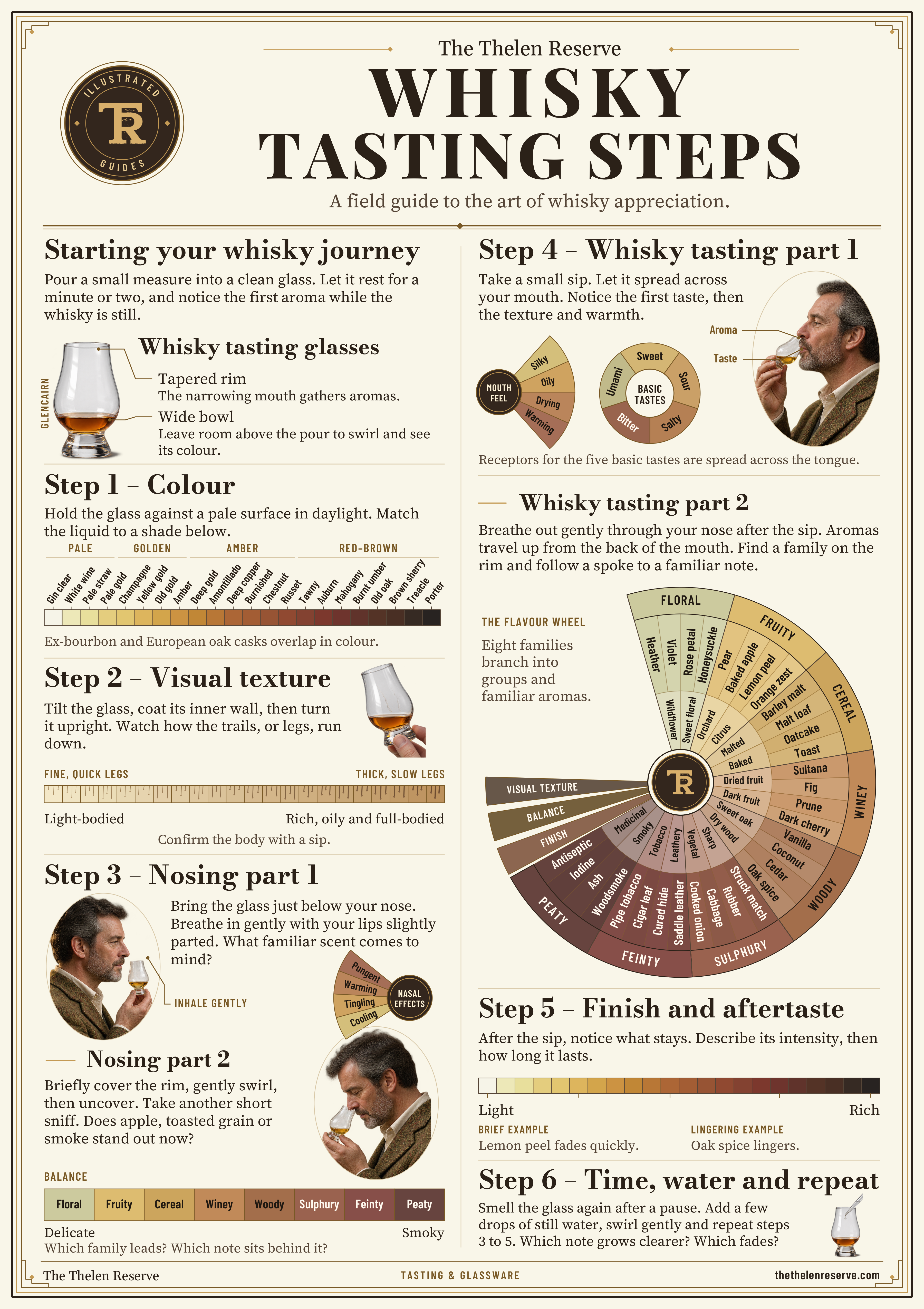
Whisky Tasting Steps

Follow a pour from colour and aroma to palate and finish. Use the flavour wheel to name what you notice, then try a few drops of water.

Open guide
Formats and reading options

Viewing PNG, Home Print, 8 × 10 Print Shop and two poster sizes

Compare a Reserve bottle’s tasting notes and flavour wheel
Read as text

Starting your whisky journey

Pour a small measure into a clean glass. Let it rest for a minute or two, and notice the first aroma while the whisky is still.

Whisky tasting glasses

A Glencairn glass has a short, sturdy foot and a tulip-shaped bowl.

Tapered rim
The narrowing mouth gathers aromas.
Wide bowl
Leave room above the pour to swirl and see its colour.

Step 1 · Colour

Hold the glass against a pale surface in daylight. Match the liquid to a shade below.

The four broad bands are pale, golden, amber and red–brown.

The colour strip, from light to dark, reads gin clear, white wine, pale straw, pale gold, champagne, yellow gold, old gold, amber, deep gold, amontillado, deep copper, burnished, chestnut, russet, tawny, auburn, mahogany, burnt umber, old oak, brown sherry, treacle, porter.

Ex-bourbon and European oak casks overlap in colour. A shade alone cannot establish how long a whisky matured or identify a specific cask.

Step 2 · Visual texture

Tilt the glass, coat its inner wall, then turn it upright. Watch how the trails, or legs, run down.

The ruler runs from fine, quick legs to thick, slow legs. On the palate, describe the body as light, rich, oily or full-bodied. Confirm the body with a sip.

Step 3 · Nosing part 1

Bring the glass just below your nose. Breathe in gently with your lips slightly parted. What familiar scent comes to mind?

The nasal-effects fan names four sensations: cooling, tingling, warming, pungent.

Nosing part 2

Briefly cover the rim, gently swirl, then uncover. Take another short sniff. Does apple, toasted grain or smoke stand out now?

Balance

Which family leads? Which note sits behind it?

The balance strip places floral, fruity, cereal, winey, woody, sulphury, feinty and peaty in order. Delicate and smoky are two possible impressions. Families can appear together in any combination.

Step 4 · Whisky tasting part 1

Take a small sip. Let it spread across your mouth. Notice the first taste, then the texture and warmth.

Basic tastes: sweet, sour, salty, bitter, umami. Receptors for the five basic tastes are spread across the tongue.

Mouthfeel examples: silky, oily, drying, warming.

Whisky tasting part 2

Breathe out gently through your nose after the sip. Aromas travel up from the back of the mouth. Find a family on the rim and follow a spoke to a familiar note.

The flavour wheel

The outer rim names a family. In each sector, the inner ring names two groups. The middle ring gives a familiar example on each spoke.

FamilyGroup and aroma examples
FloralWildflower · Heather, Violet
Sweet floral · Rose petal, Honeysuckle
FruityOrchard · Pear, Baked apple
Citrus · Lemon peel, Orange zest
CerealMalted · Barley malt, Malt loaf
Baked · Oatcake, Toast
WineyDried fruit · Sultana, Fig
Dark fruit · Prune, Dark cherry
WoodySweet oak · Vanilla, Coconut
Dry wood · Cedar, Oak spice
SulphurySharp · Struck match, Rubber
Vegetal · Cabbage, Cooked onion
FeintyLeathery · Saddle leather, Cured hide
Tobacco · Cigar leaf, Pipe tobacco
PeatySmoky · Woodsmoke, Ash
Medicinal · Iodine, Antiseptic

Winey recalls wine or wine-cask aromas. Feinty is a traditional whisky term that includes leathery and tobacco-like aromas. Sulphury includes aromas such as a struck match. The three narrow spokes remind you to revisit finish, balance and visual texture.

Step 5 · Finish and aftertaste

After the sip, notice what stays. Describe its intensity, then how long it lasts.

The intensity scale runs from light to rich. Keep duration separate. An example of a brief finish is lemon peel fading quickly. An example of a lingering finish is oak spice that stays with you.

Step 6 · Time, water and repeat

Smell the glass again after a pause. Add a few drops of still water, swirl gently and repeat steps 3 to 5. Which note grows clearer? Which fades?

Sources and credits

Photographic tasting vignettes were made for this Reserve guide. The taster is illustrative.
Illustrated guideTasting & glassware

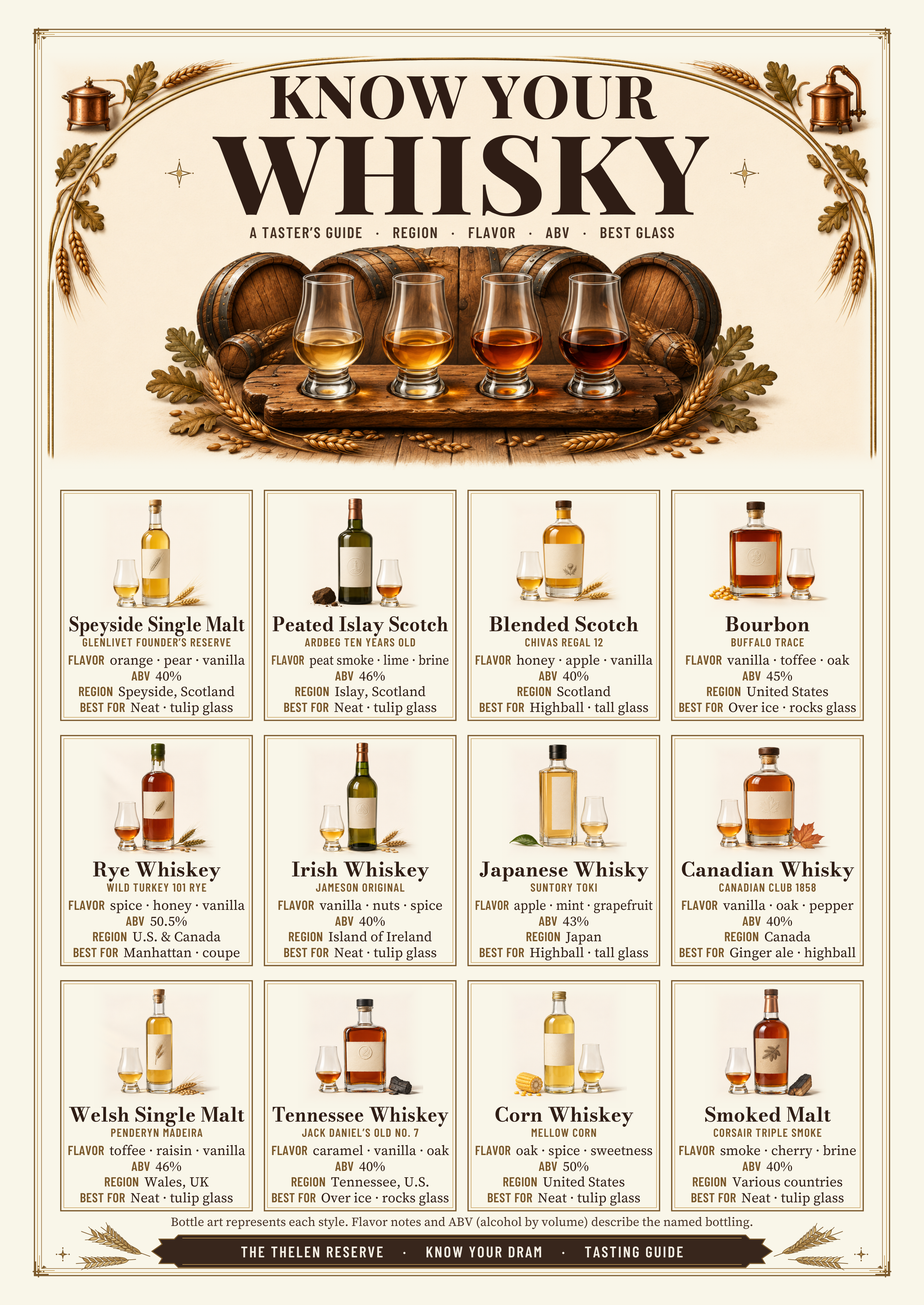
Know Your Whisky

Compare twelve whisky styles by flavor, region, bottling strength and glassware, from Speyside single malt to Tennessee whiskey.

Open guide
Formats and reading options

Viewing PNG, Home Print, 8 × 10 Print Shop and two poster sizes

Explore a Reserve bottle’s tasting notes and flavor wheel
Read as text

Find a flavor you enjoy, then try a second whisky in the same glass. Each of these twelve styles has a bottle you can look up, three tasting cues, a place and a suggested serve.

ABV means alcohol by volume. Each strength belongs to the named bottling and can vary by market or edition. The cards compare regions, production styles and flavor traditions, so a whisky can fit more than one card.

The poster shows a four-glass flight above twelve illustrative bottle-and-glass portraits. Each bottle illustration represents its style.

Speyside Single Malt

The Glenlivet Founder’s Reserve

Flavor
orange, pear, vanilla
Bottle ABV
40%
Region
Speyside, Scotland
Try it
Neat in a tulip glass

Orchard fruit is a good place to start with this Speyside malt. Smell for ripe pear first, then take a sip and look for orange and vanilla.

Sources for this card

Peated Islay Scotch

Ardbeg Ten Years Old

Flavor
peat smoke, lime, brine
Bottle ABV
46%
Region
Islay, Scotland
Try it
Neat in a tulip glass

Ardbeg Ten pairs peat smoke with a bright citrus edge. Islay names the island. The word peated tells you something different about what you may smell in the glass.

Sources for this card

Blended Scotch

Chivas Regal 12

Flavor
honey, apple, vanilla
Bottle ABV
40%
Region
Scotland
Try it
A whisky and soda in a tall highball glass

A blended Scotch combines single malt and single grain Scotch whiskies. Chivas 12 has Speyside malt at its heart. Try soda and ice in a tall glass to bring out the fruit.

Sources for this card

Bourbon

Buffalo Trace

Flavor
vanilla, toffee, oak
Bottle ABV
45%
Region
United States
Try it
Over ice in a rocks glass

Buffalo Trace makes this 90-proof bourbon in Kentucky. Bourbon can be made elsewhere in the United States. A little melting ice lets you follow the change from sweet to oaky.

Sources for this card

Rye Whiskey

Wild Turkey 101 Rye

Flavor
spice, honey, vanilla
Bottle ABV
50.5%
Region
U.S. & Canada
Try it
A Manhattan served in a coupe

This Kentucky straight rye gives a Manhattan enough spice to stand up to sweet vermouth. The U.S. rye standard calls for at least 51% rye in the mash. Canada has its own rye whisky rules.

Sources for this card

Irish Whiskey

Jameson Original

Flavor
vanilla, nuts, spice
Bottle ABV
40%
Region
Island of Ireland
Try it
Neat in a tulip glass

Jameson Original blends pot still and grain whiskeys. Start by looking for the nutty character, then see whether vanilla or spice lasts longer on the finish.

Sources for this card

Japanese Whisky

Suntory Toki

Flavor
apple, mint, grapefruit
Bottle ABV
43%
Region
Japan
Try it
A whisky and soda in a tall highball glass

Toki shows green apple on the nose and a grapefruit and peppermint note on the palate. A cold highball with soda gives those lighter aromas room to open up.

Sources for this card

Canadian Whisky

Canadian Club 1858

Flavor
vanilla, oak, pepper
Bottle ABV
40%
Region
Canada
Try it
With ginger ale in a tall highball glass

Canadian Club’s classic blend has a peppery, oaky edge under its vanilla sweetness. Try it long with ginger ale in a tall highball glass.

Sources for this card

Welsh Single Malt

Penderyn Madeira

Flavor
toffee, raisin, vanilla
Bottle ABV
46%
Region
Wales, UK
Try it
Neat in a tulip glass

Penderyn finishes this Welsh single malt in Madeira wine casks. The producer describes cream toffee and raisins on the nose and vanilla on the finish.

Sources for this card

Tennessee Whiskey

Jack Daniel’s Old No. 7

Flavor
caramel, vanilla, oak
Bottle ABV
40%
Region
Tennessee, U.S.
Try it
Over ice in a rocks glass

Jack Daniel’s mellows Old No. 7 through charcoal before aging it in new charred oak. Compare its caramel and vanilla notes with the bourbon in the top-right card.

Sources for this card

Corn Whiskey

Mellow Corn

Flavor
oak, spice, sweetness
Bottle ABV
50%
Region
United States
Try it
Neat in a tulip glass

Mellow Corn spends four years in a used bourbon barrel. It is pale in the glass despite its 100 proof. Color alone tells you little about strength.

Sources for this card

Smoked Malt

Corsair Triple Smoke

Flavor
smoke, cherry, brine
Bottle ABV
40%
Region
Various countries
Try it
Neat in a tulip glass

Smoked malt is a flavor and production description used in several countries. For this U.S. example, Corsair combines malts smoked with cherrywood, beechwood and peat. The featured 750 mL distillery-shop bottling is 80 proof.

Sources for this card

Illustrated guideBourbon

The Kentucky Bourbon Trail

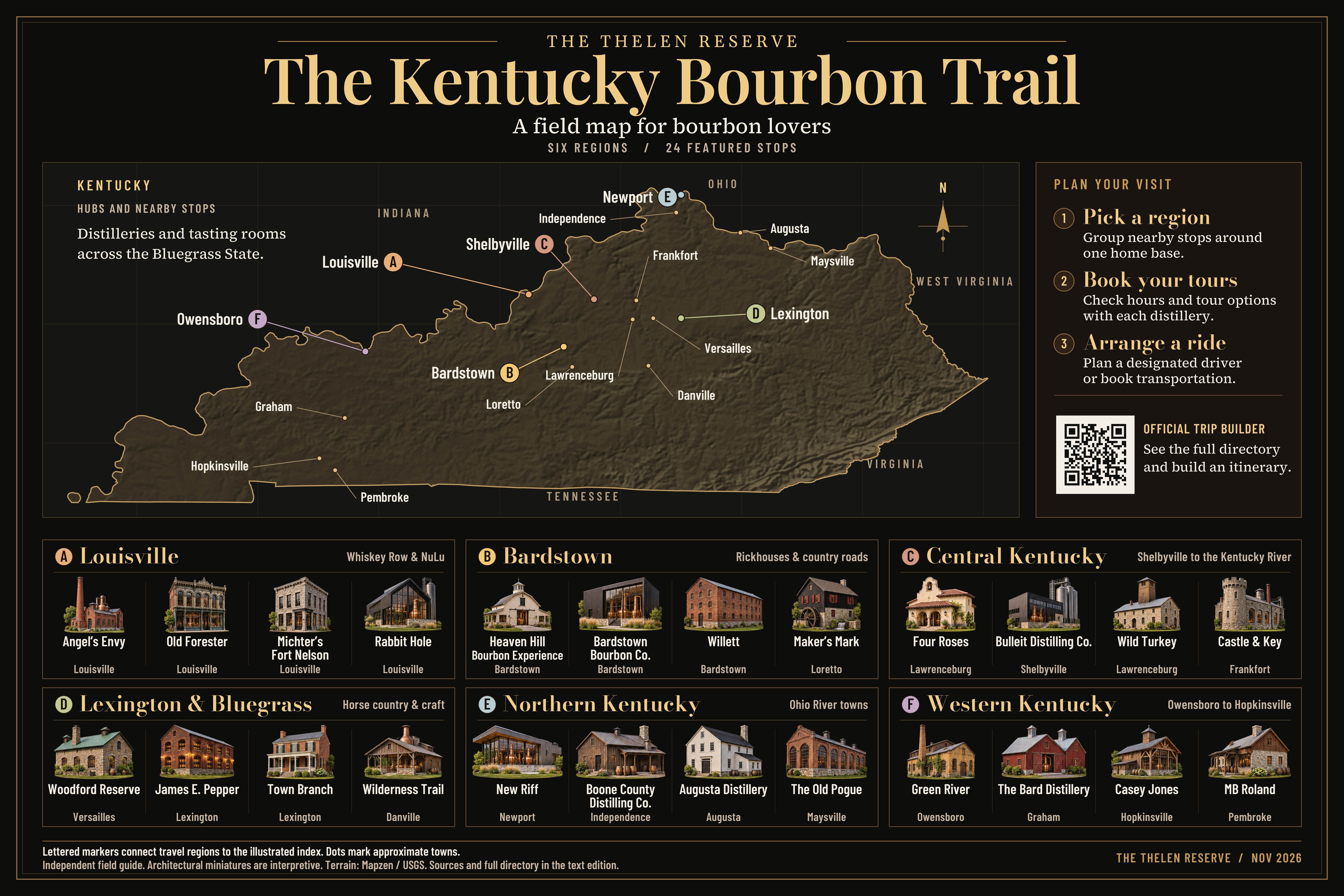
Explore 24 illustrated bourbon stops across six Kentucky regions and use the official Trip Builder to plan your visit.

Open guide
Formats and reading options

Viewing PNG, Home Print, 8 × 10 Print Shop and two poster sizes

Follow the Bourbon Grain to Glass journey
Read as text

The Kentucky Distillers’ Association’s trail is a statewide collection of visitor experiences. The map features 24 stops grouped into six travel regions. It uses approximate town locations and interpretive architectural miniatures.

Use the official Trip Builder for the complete directory. The KDA reported 74 participating experiences in July 2026. Pick a region, book your tours ahead and arrange transportation.

A. Louisville

Whiskey Row & NuLu

  • Angel’s Envy · Louisville
  • Old Forester · Louisville
  • Michter’s Fort Nelson · Louisville
  • Rabbit Hole · Louisville

B. Bardstown

Rickhouses & country roads

  • Heaven Hill Bourbon Experience · Bardstown
  • Bardstown Bourbon Co. · Bardstown
  • Willett · Bardstown
  • Maker’s Mark · Loretto

C. Central Kentucky

Shelbyville to the Kentucky River

  • Four Roses · Lawrenceburg
  • Bulleit Distilling Co. · Shelbyville
  • Wild Turkey · Lawrenceburg
  • Castle & Key · Frankfort

D. Lexington & Bluegrass

Horse country & craft

  • Woodford Reserve · Versailles
  • James E. Pepper · Lexington
  • Town Branch · Lexington
  • Wilderness Trail · Danville

E. Northern Kentucky

Ohio River towns

  • New Riff · Newport
  • Boone County Distilling Co. · Independence
  • Augusta Distillery · Augusta
  • The Old Pogue · Maysville

F. Western Kentucky

Owensboro to Hopkinsville

  • Green River · Owensboro
  • The Bard Distillery · Graham
  • Casey Jones · Hopkinsville
  • MB Roland · Pembroke

Sources

Independent field guide by The Thelen Reserve. Kentucky Bourbon Trail® is a trademark of the Kentucky Distillers’ Association.

Illustrated guideBourbon

Bourbon Cocktail Guide

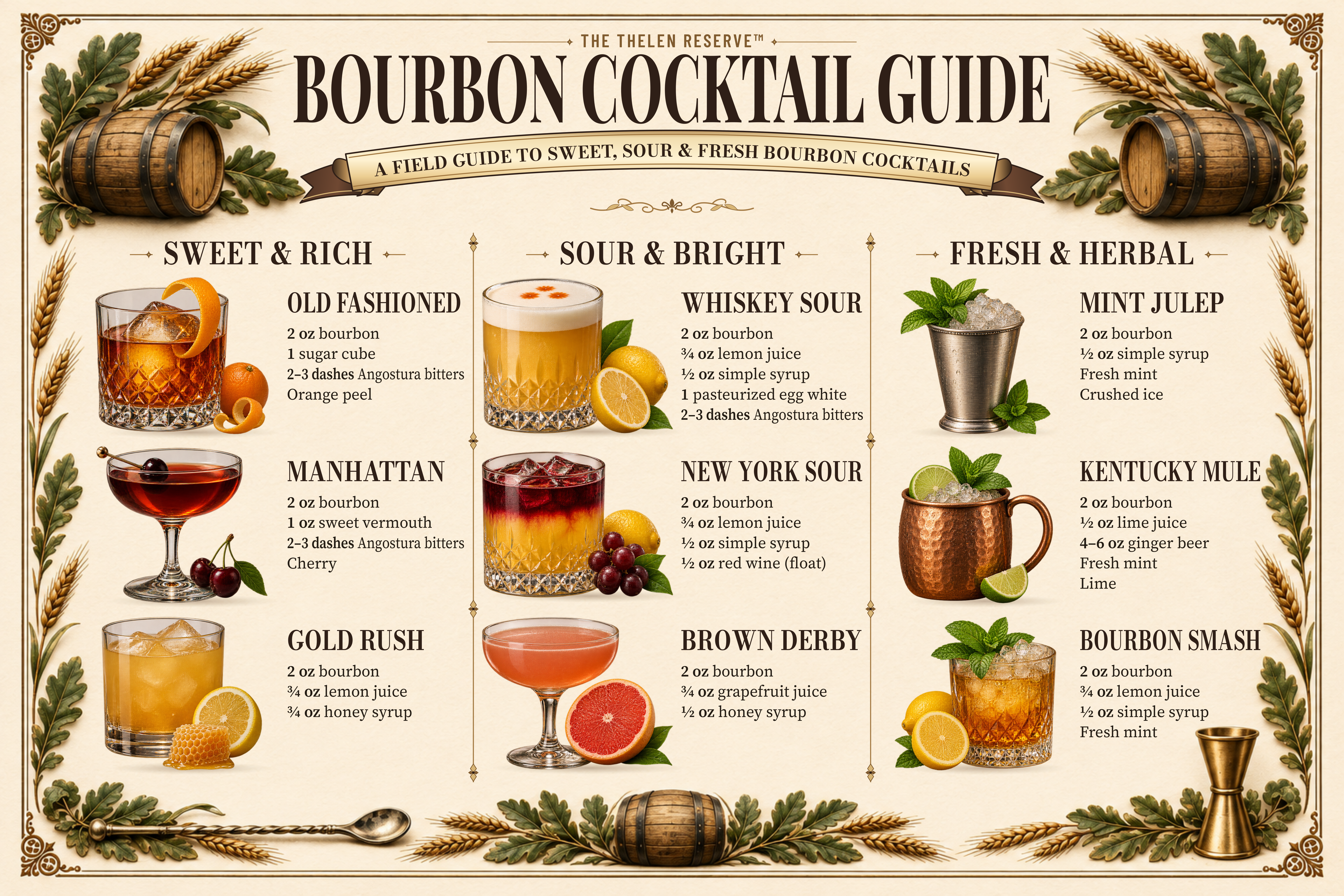
Choose among nine bourbon cocktails in three flavor families, with measures, glassware and garnishes for each drink.

Open guide
Formats and reading options

Viewing PNG, Home Print, 8 × 10 Print Shop and two landscape poster sizes

Explore the finished pour in Bourbon Grain to Glass
Read as text

Choose a flavor family, then mix one drink using the measures below. All ounces are US fluid ounces.

Sweet & Rich

Old Fashioned

  • 2 oz bourbon
  • 1 sugar cube
  • 2–3 dashes Angostura bitters
  • Orange peel

Wet the sugar cube with the bitters and a splash of water. Crush and stir to dissolve. Add the bourbon and ice, stir to chill, then squeeze the orange peel over the glass.

Manhattan

  • 2 oz bourbon
  • 1 oz sweet vermouth
  • 2–3 dashes Angostura bitters
  • Cherry

Stir the bourbon, vermouth and bitters with ice. Strain into a chilled coupe and garnish with the cherry.

Gold Rush

  • 2 oz bourbon
  • ¾ oz lemon juice
  • ¾ oz honey syrup

Shake the bourbon, lemon juice and honey syrup with ice. Strain into a rocks glass over fresh ice.

Sour & Bright

Whiskey Sour

  • 2 oz bourbon
  • ¾ oz lemon juice
  • ½ oz simple syrup
  • 1 pasteurized egg white
  • 2–3 dashes Angostura bitters

Shake the bourbon, lemon juice, syrup and pasteurized egg white without ice to build the foam. Add ice, shake again, strain and dot the foam with the bitters.

New York Sour

  • 2 oz bourbon
  • ¾ oz lemon juice
  • ½ oz simple syrup
  • ½ oz red wine (float)

Shake the bourbon, lemon juice and syrup with ice. Strain over fresh ice. Hold a spoon just above the surface and slowly pour the wine over its back to form the red top layer.

Brown Derby

  • 2 oz bourbon
  • ¾ oz grapefruit juice
  • ½ oz honey syrup

Shake all three ingredients with ice. Strain into a chilled coupe.

Fresh & Herbal

Mint Julep

  • 2 oz bourbon
  • ½ oz simple syrup
  • Fresh mint
  • Crushed ice

Gently press the mint into the syrup in a julep cup. Add bourbon and crushed ice, stir until the cup frosts, then crown it with more ice and a mint sprig.

Kentucky Mule

  • 2 oz bourbon
  • ½ oz lime juice
  • 4–6 oz ginger beer
  • Fresh mint
  • Lime

Add the bourbon and lime juice to an ice-filled mug. Top with ginger beer, stir gently, and garnish with mint and lime.

Bourbon Smash

  • 2 oz bourbon
  • ¾ oz lemon juice
  • ½ oz simple syrup
  • Fresh mint

Gently press the mint with the syrup, add the bourbon and lemon juice, then shake with ice. Strain over fresh crushed ice and tuck a mint sprig into the glass.

Recipe notes

The measures follow the supplied field guide. The mixing techniques draw on these cocktail references.

The Whiskey Sour uses a pasteurized egg white. FDA guidance on uncooked eggs in drinks

Open the standalone reading edition

Illustrated guideBourbon

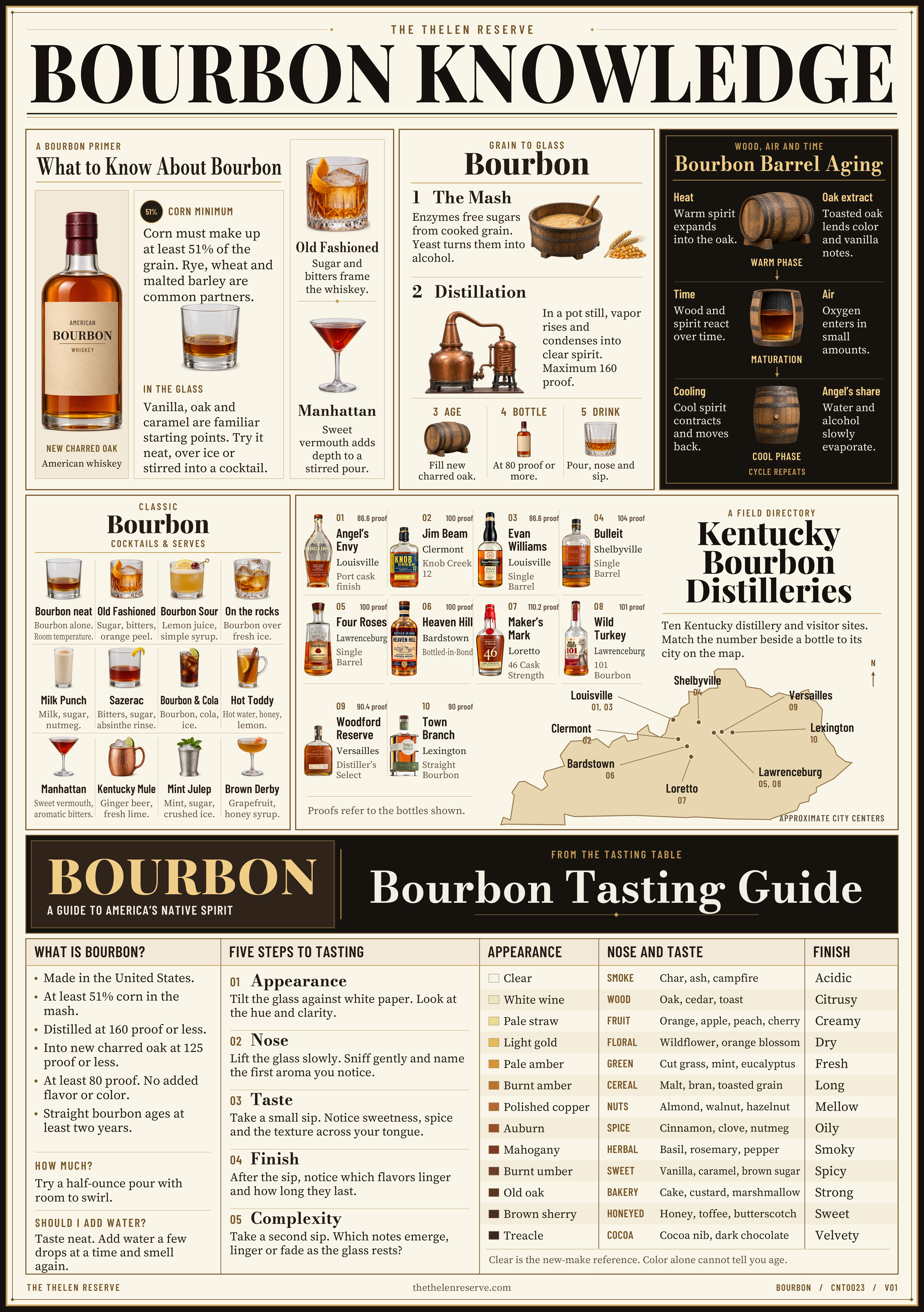
Bourbon Knowledge

Follow bourbon from grain to barrel, find ten Kentucky distilleries and explore twelve classic cocktails and serves alongside a tasting guide.

Open guide
Formats and reading options

Viewing PNG, Home Print, 8 × 10 Print Shop and two poster sizes

Follow the Bourbon Grain to Glass journey
Read as text

What to know about bourbon

The mash bill
Corn must make up at least 51% of the grain. Rye, wheat and malted barley are common partners.
In the glass
Vanilla, oak and caramel are familiar starting points. Try it neat, over ice or stirred into a cocktail.
Old Fashioned
Sugar and bitters frame the whiskey.
Manhattan
Sweet vermouth adds depth to a stirred pour.

Bourbon, from grain to glass

  1. The mash Enzymes free sugars from cooked grain. Yeast turns them into alcohol.
  2. Distillation In a pot still, vapor rises and condenses into clear spirit. Maximum 160 proof.
  3. Age Fill new charred oak.
  4. Bottle At 80 proof or more.
  5. Drink Pour, nose and sip.

The pictured pot still is one way to distill bourbon. Column stills with a second distillation are common. Proof in the United States is twice the percentage of alcohol by volume.

Bourbon barrel aging

Warm phase

Warm spirit expands into the oak. Toasted oak lends color and vanilla notes.

Maturation

Wood and spirit react over time. Oxygen enters in small amounts.

Cool phase

Cool spirit contracts and moves back. Water and alcohol slowly evaporate.

Temperature cycles repeat during storage. Chemistry and evaporation continue across seasons. Barrel location, the oak and the warehouse climate all influence the outcome. The cutaway is a conceptual illustration.

Classic bourbon cocktails and serves

These twelve entries follow the reference grid from left to right, starting at the top. The cocktail directions give one bourbon version of each drink.

Bourbon neat

Pour a small measure into a clean glass and serve at room temperature.

Old Fashioned

Stir 2 oz bourbon with 1 tsp rich syrup and 2 dashes aromatic bitters over ice. Finish with orange peel.

Bourbon Sour

Shake 2 oz bourbon, ¾ oz fresh lemon juice and ¾ oz simple syrup with ice. Strain and garnish with lemon.

On the rocks

Pour bourbon over fresh ice. As the ice melts, taste how the drink changes.

Milk Punch

Shake 2 oz bourbon, 3 oz milk and ½ oz simple syrup with ice. Strain and grate nutmeg over the top.

Sazerac

For a bourbon variation, stir 2 oz bourbon, a small spoonful of sugar syrup and 3 dashes Peychaud’s bitters. Strain into an absinthe-rinsed glass and express lemon oil over it.

Bourbon & Cola

Build bourbon and chilled cola over ice. Add cola to taste and a wedge of lime if desired.

Hot Toddy

Stir 1½ oz bourbon, 2 tsp honey and a squeeze of lemon into about 4 oz hot water. Garnish with a cinnamon stick.

Manhattan

Stir 2 oz bourbon, 1 oz sweet vermouth and 2 dashes aromatic bitters with ice. Strain into a stemmed glass.

Kentucky Mule

Pour 2 oz bourbon and ½ oz lime juice over ice. Top with ginger beer and garnish with lime.

Mint Julep

Press fresh mint gently with a little sugar syrup. Add 2 oz bourbon, fill the cup with crushed ice and garnish with mint.

Brown Derby

Shake 1½ oz bourbon, 1 oz grapefruit juice and ½ oz honey syrup with ice. Strain into a chilled coupe.

Kentucky bourbon distilleries

The map identifies approximate city centers. Each entry gives the distillery or visitor home represented by the selected bottle. It does not assign a distillation site to an individual batch.

  1. Angel’s Envy · Louisville. Kentucky straight bourbon finished in port wine barrels. 86.6 U.S. proof.
  2. Jim Beam · Clermont. Knob Creek 12 Year Bourbon, shown for the James B. Beam Distilling Co.. 100 U.S. proof.
  3. Evan Williams · Louisville. Single Barrel Vintage 2012, shown for the Evan Williams Bourbon Experience in downtown Louisville. 86.6 U.S. proof.
  4. Bulleit · Shelbyville. Bulleit Single Barrel Bourbon, a Reserve collection selection. 104 U.S. proof.
  5. Four Roses · Lawrenceburg. Four Roses Single Barrel. 100 U.S. proof.
  6. Heaven Hill · Bardstown. Heaven Hill Bottled-in-Bond 7 Year. 100 U.S. proof.
  7. Maker’s Mark · Loretto. Maker’s Mark 46 Cask Strength. 110.2 U.S. proof.
  8. Wild Turkey · Lawrenceburg. Wild Turkey 101 Bourbon. 101 U.S. proof.
  9. Woodford Reserve · Versailles. Woodford Reserve Distiller’s Select Kentucky Straight Bourbon. 90.4 U.S. proof.
  10. Town Branch · Lexington. Town Branch Kentucky Straight Bourbon Whiskey, shown from the producer’s product photograph. 90 U.S. proof.

Bourbon tasting guide

What is bourbon?

  • Made in the United States.
  • At least 51% corn in the mash.
  • Distilled at 160 proof or less.
  • Into new charred oak at 125 proof or less.
  • At least 80 proof. No added flavor or color.
  • Straight bourbon ages at least two years.

Bourbon has no general minimum aging period. The straight bourbon designation requires at least two years. The limits of 160, 125 and 80 U.S. proof correspond to 80%, 62.5% and 40% alcohol by volume, respectively.

How much?

Try a half-ounce pour with room to swirl.

Should I add water?

Taste neat. Add water a few drops at a time and smell again.

Five steps to tasting

  1. Appearance · Tilt the glass against white paper. Look at the hue and clarity.
  2. Nose · Lift the glass slowly. Sniff gently and name the first aroma you notice.
  3. Taste · Take a small sip. Notice sweetness, spice and the texture across your tongue.
  4. Finish · After the sip, notice which flavors linger and how long they last.
  5. Complexity · Take a second sip. Which notes emerge, linger or fade as the glass rests?

Tasting vocabulary

Appearance

clear, white wine, pale straw, light gold, pale amber, burnt amber, polished copper, auburn, mahogany, burnt umber, old oak, brown sherry, treacle.

Clear is the new-make reference. Color alone cannot tell you age.

Nose and taste

Smoke
Char, ash, campfire
Wood
Oak, cedar, toast
Fruit
Orange, apple, peach, cherry
Floral
Wildflower, orange blossom
Green
Cut grass, mint, eucalyptus
Cereal
Malt, bran, toasted grain
Nuts
Almond, walnut, hazelnut
Spice
Cinnamon, clove, nutmeg
Herbal
Basil, rosemary, pepper
Sweet
Vanilla, caramel, brown sugar
Bakery
Cake, custard, marshmallow
Honeyed
Honey, toffee, butterscotch
Cocoa
Cocoa nib, dark chocolate

Finish

acidic, citrusy, creamy, dry, fresh, long, mellow, oily, smoky, spicy, strong, sweet, velvety.

Sources and artwork

The supplied poster guided the composition. Distillery Trail’s cocktail chart helped identify the twelve original entries. This edition uses new photographic-style illustrations, the Reserve’s collection bottle portraits and a producer photograph for Town Branch. No named collection bottle was generated for this guide.

Illustrated guideBourbon

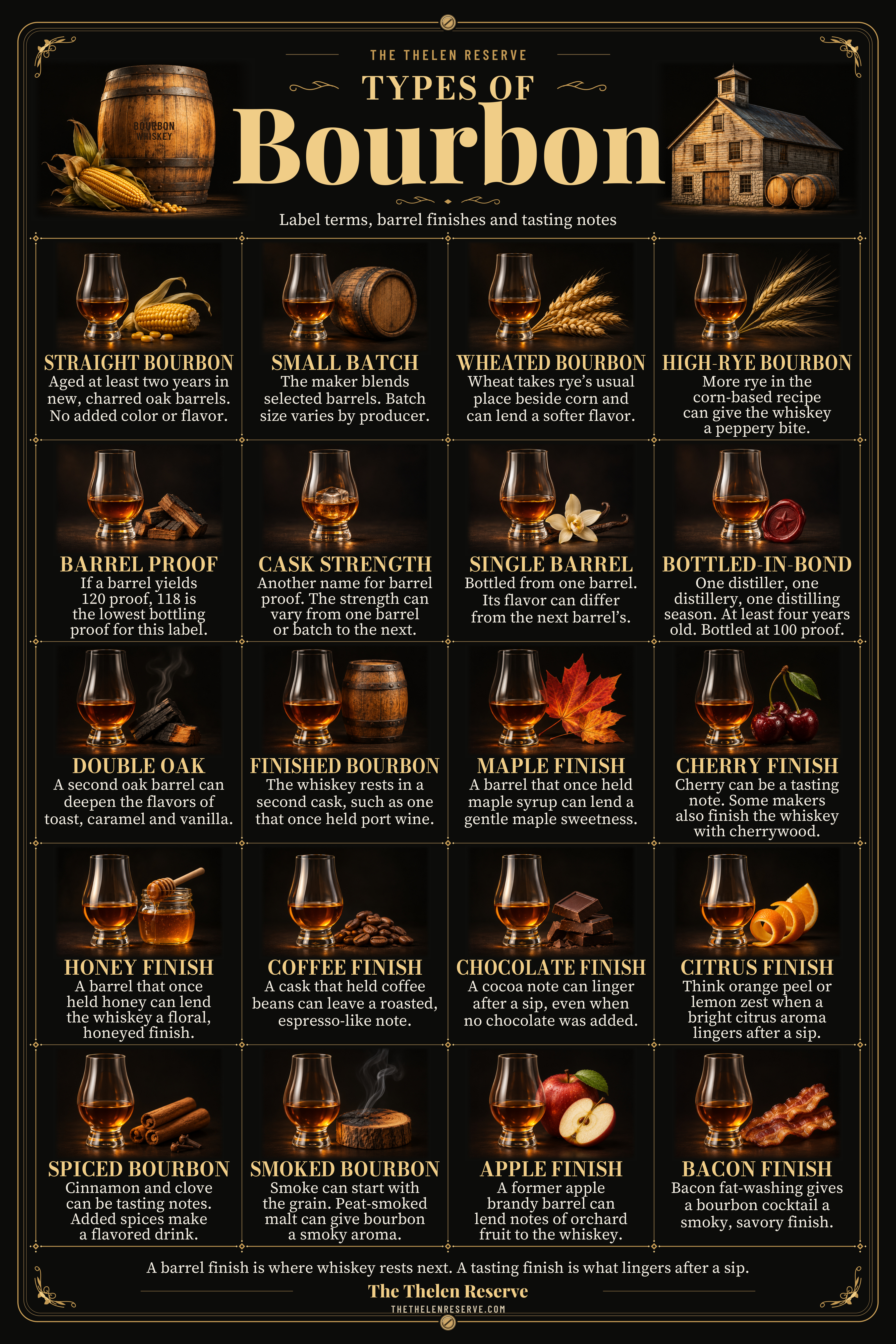
Types of Bourbon

Compare 20 terms for bourbon labels, barrel finishes and the flavors that linger after a sip.

Open guide
Formats and reading options

Viewing PNG, Home Print, 8 × 10 Print Shop and two poster sizes

Explore barrel selection in the Bourbon journey
Read as text

A barrel finish is where whiskey rests next. A tasting finish is what lingers after a sip. A single bottle can carry several of these descriptions.

Straight Bourbon

Aged at least two years in new, charred oak barrels. No added color or flavor.

Bourbon starts with at least 51% corn and must be made in the United States. The word straight adds a minimum age of two years. [1]

Small Batch

The maker blends selected barrels. Batch size varies by producer.

If the number of barrels matters to you, look for a published batch size. Small batch alone supplies no fixed U.S. barrel count. [7] [6]

Wheated Bourbon

Wheat takes rye’s usual place beside corn and can lend a softer flavor.

Wheat is a supporting grain. Maker’s Mark, for example, names soft red winter wheat in its bourbon grain recipe. [8] [1]

High-Rye Bourbon

More rye in the corn-based recipe can give the whiskey a peppery bite.

Corn still makes up at least 51% of the mash. The term high-rye has no single percentage threshold. Four Roses publishes the grain proportions for its two recipes. [9] [1]

Barrel Proof

If a barrel yields 120 proof, 118 is the lowest bottling proof for this label.

U.S. rules allow the bottling proof to be at most two proof points below the proof measured when the spirits leave the barrels. That difference is one percentage point of alcohol by volume. [2]

Cask Strength

Another name for barrel proof. The strength can vary from one barrel or batch to the next.

Both terms follow the same U.S. bottling-proof rule. The ice in the illustration is a serving choice. [2] [10]

Single Barrel

Bottled from one barrel. Its flavor can differ from the next barrel’s.

A barrel number can help you find another bottle from the same cask. A single-barrel release may be diluted to a chosen bottling proof. [6] [2]

Bottled-in-Bond

One distiller, one distillery, one distilling season. At least four years old. Bottled at 100 proof.

For bourbon, the whiskey must spend at least four years in wood and go into the bottle at exactly 50% alcohol by volume. The complete federal rule also specifies allowable treatments and label details. [3]

Double Oak

A second oak barrel can deepen the flavors of toast, caramel and vanilla.

A cooper can prepare the second barrel differently. Woodford Reserve, for example, gives its second barrel a deep toast and a light char. [11]

Finished Bourbon

The whiskey rests in a second cask, such as one that once held port wine.

Look for the full finishing statement on the bottle. For example, Angel’s Envy names port wine barrels on its Kentucky straight bourbon whiskey. [12] [5]

Maple Finish

A barrel that once held maple syrup can lend a gentle maple sweetness.

Read the label for the previous use of the cask. Ironclad describes transferring its bourbon into barrels used by a maple syrup producer. [13]

Cherry Finish

Cherry can be a tasting note. Some makers also finish the whiskey with cherrywood.

Cherry fruit and cherrywood tell different stories. Cleveland Whiskey explicitly identifies black cherry wood in its finishing process. [14] [11]

Honey Finish

A barrel that once held honey can lend the whiskey a floral, honeyed finish.

Starlight finishes one bourbon in barrels that previously held honey from its farm. Other labels may use honey to describe an aroma. [15] [11]

Coffee Finish

A cask that held coffee beans can leave a roasted, espresso-like note.

Ironclad describes a bourbon finished in oak casks used with espresso beans. A coffee tasting note on its own makes no claim about a cask. [13]

Chocolate Finish

A cocoa note can linger after a sip, even when no chocolate was added.

Chocolate is a tasting descriptor used for some bourbons. A product made with added cocoa or chocolate should identify its flavoring or composition on the label. [11] [4] [5]

Citrus Finish

Think orange peel or lemon zest when a bright citrus aroma lingers after a sip.

Use orange zest as a reference when smelling the pour. If citrus was added, check the bottle’s flavored-whiskey or composition statement. [11] [4] [5]

Spiced Bourbon

Cinnamon and clove can be tasting notes. Added spices make a flavored drink.

Read the full designation to tell a tasting description from a drink made with actual spices. A straight bourbon can evoke baking spice on its own. [11] [4] [1]

Smoked Bourbon

Smoke can start with the grain. Peat-smoked malt can give bourbon a smoky aroma.

Kings County makes a bourbon using malted barley exposed to peat smoke. Smoking a glass at the bar is a separate serving technique. [17]

Apple Finish

A former apple brandy barrel can lend notes of orchard fruit to the whiskey.

Watershed names its apple brandy barrels on the bottle. Apple can also appear in a tasting note for a bourbon aged entirely in new oak. [16] [11]

Bacon Finish

Bacon fat-washing gives a bourbon cocktail a smoky, savory finish.

In a Benton’s Old Fashioned, the bartender infuses bourbon with bacon fat and removes the fat before mixing the cocktail. This is a bar preparation. [18]

Sources

  1. U.S. whisky and bourbon standards, 27 CFR § 5.143
  2. Barrel proof and cask strength, 27 CFR § 5.87
  3. Bottled in bond, 27 CFR § 5.88
  4. Flavored spirits, 27 CFR § 5.151
  5. Distilled spirits specialty products, 27 CFR § 5.156
  6. Virginia ABC, Buying Guide for Bourbon
  7. VinePair, How ‘Small Batch’ Became the Most Confusing Term in American Whiskey
  8. Maker’s Mark, Its grain recipe
  9. Four Roses, Our Process
  10. Belle Meade, Cask Strength Reserve
  11. Woodford Reserve, Double Oaked and flavor wheel
  12. Angel’s Envy, Bourbon finished in port wine barrels
  13. Ironclad Distillery, Coffee, maple syrup and honey casks, producer’s SEC offering statement
  14. Cleveland Whiskey, Black Cherry Wood
  15. Starlight Distillery, Honey Reserve
  16. Watershed Distillery, Apple Brandy Barrel Finished Bourbon
  17. Kings County Distillery, Peated Bourbon
  18. Liquor.com, Benton’s Old Fashioned

Illustrated guideScotch

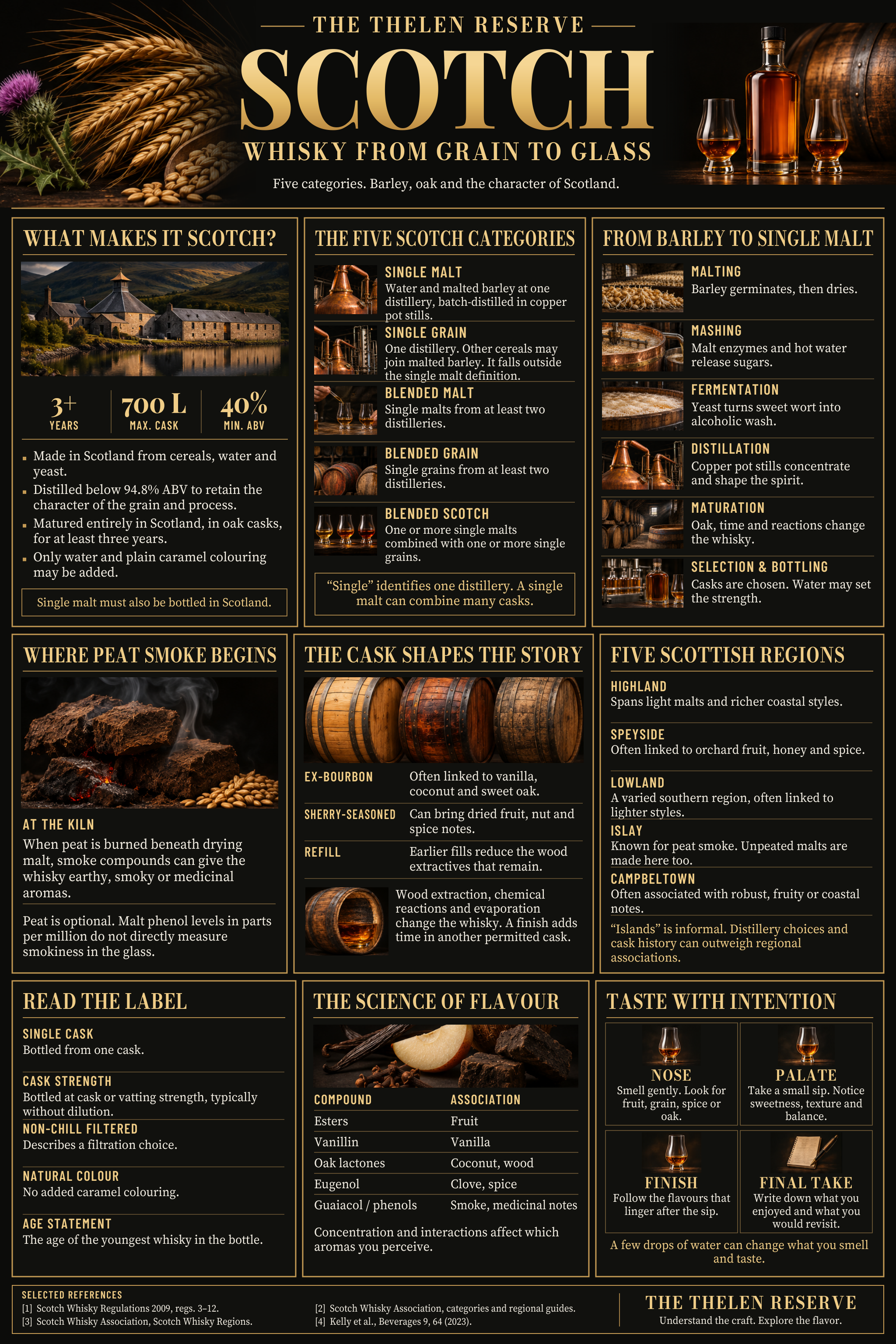
Scotch, explained

Identity, five categories and a more informed tasting.

Open guide
Formats and reading options

Viewing PNG, Home Print, 8 × 10 Print Shop and two poster sizes

Read the Scotch journey
Read as text

What makes it Scotch?

Made in Scotland from cereals, water and yeast. Distilled below 94.8% ABV. Matured entirely in Scotland in oak casks no larger than 700 litres, for at least three years. Bottled at 40% ABV or higher. Only water and plain caramel colouring may be added. Single malt must also be bottled in Scotland.

The five Scotch categories

Single malt
Water and malted barley at one distillery, batch-distilled in copper pot stills.
Single grain
One distillery. Other cereals may join malted barley. It falls outside the single malt definition.
Blended malt
Single malts from at least two distilleries.
Blended grain
Single grains from at least two distilleries.
Blended Scotch
One or more single malts combined with one or more single grains.

From barley to single malt

Malting
Barley germinates, then dries.
Mashing
Malt enzymes and hot water release sugars.
Fermentation
Yeast turns sweet wort into alcoholic wash.
Distillation
Copper pot stills concentrate and shape the spirit.
Maturation
Oak, time and reactions change the whisky.
Selection & bottling
Casks are chosen. Water may set the strength.

Where peat smoke begins

Peat can burn beneath drying malt. Smoke compounds can give whisky earthy, smoky or medicinal notes. Peat is optional. Malt phenol levels in parts per million do not directly measure smokiness in the glass.

The cask shapes the story

Ex-bourbon
Often linked to vanilla, coconut and sweet oak.
Sherry-seasoned
Can bring dried fruit, nut and spice notes.
Refill
Earlier fills reduce the wood extractives that remain.

Wood extraction, chemical reactions and evaporation change the whisky. A finish adds time in another permitted cask.

Five Scottish regions

Highland
Spans light malts and richer coastal styles.
Speyside
Often linked to orchard fruit, honey and spice.
Lowland
A varied southern region, often linked to lighter styles.
Islay
Known for peat smoke. Unpeated malts are made here too.
Campbeltown
Often associated with robust, fruity or coastal notes.

“Islands” is informal. Distillery choices and cask history can outweigh regional associations.

Read the label

Single cask
Bottled from one cask.
Cask strength
Bottled at cask or vatting strength, typically without dilution.
Non-chill filtered
Describes a filtration choice.
Natural colour
No added caramel colouring.
Age statement
The age of the youngest whisky in the bottle.

The science of flavour

Esters
Fruit
Vanillin
Vanilla
Oak lactones
Coconut, wood
Eugenol
Clove, spice
Guaiacol / phenols
Smoke, medicinal notes

Concentration and interactions affect which aromas you perceive.

Taste with intention

Nose
Smell gently. Look for fruit, grain, spice or oak.
Palate
Take a small sip. Notice sweetness, texture and balance.
Finish
Follow the flavours that linger after the sip.
Final take
Write down what you enjoyed and what you would revisit.

A few drops of water can change what you smell and taste.

Selected references

Illustrated guideAmerican whiskey

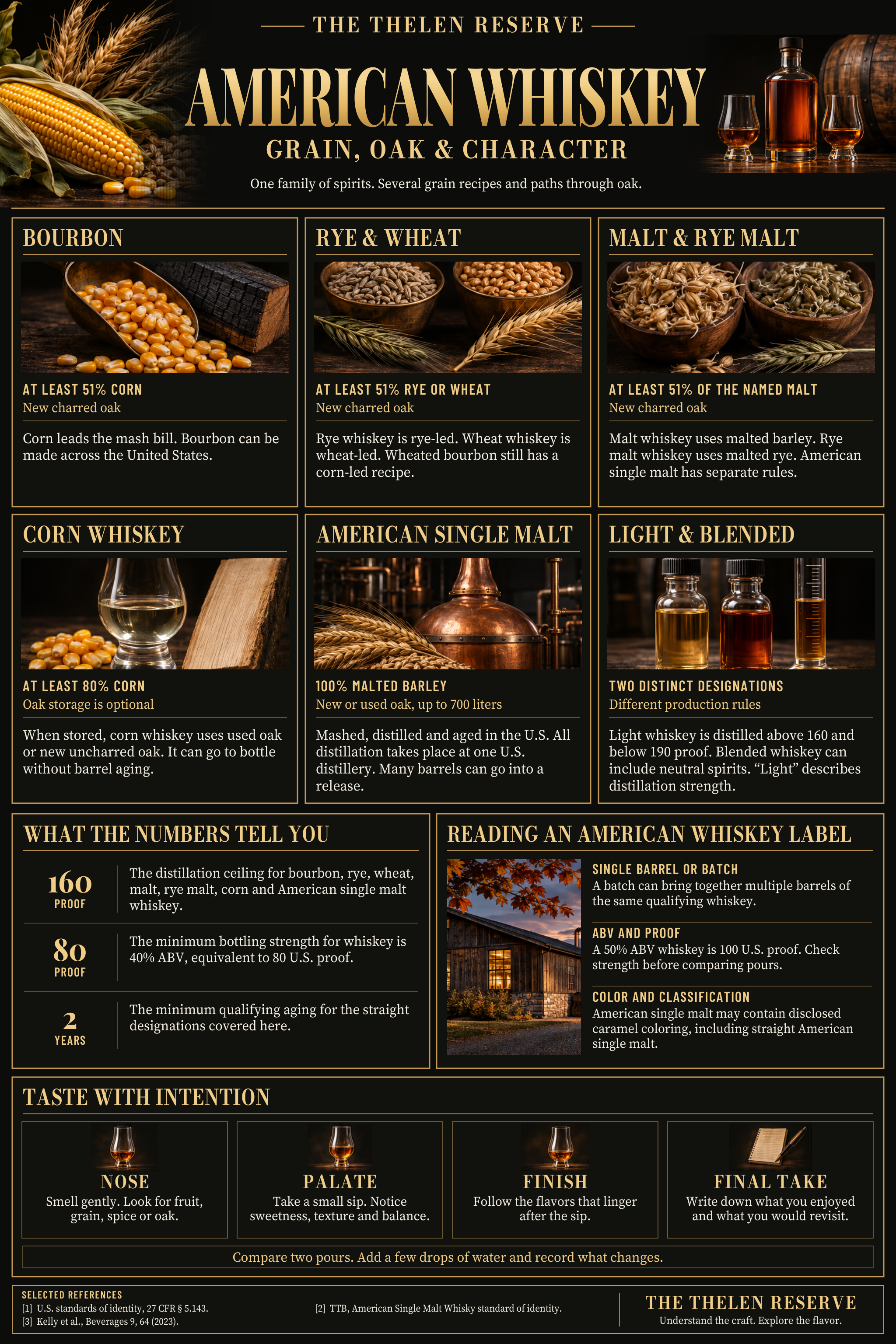
American whiskey, explained

The family, grain recipes and barrel distinctions.

Open guide
Formats and reading options

Viewing PNG, Home Print, 8 × 10 Print Shop and two poster sizes

Read the American Whiskey journey
Read as text

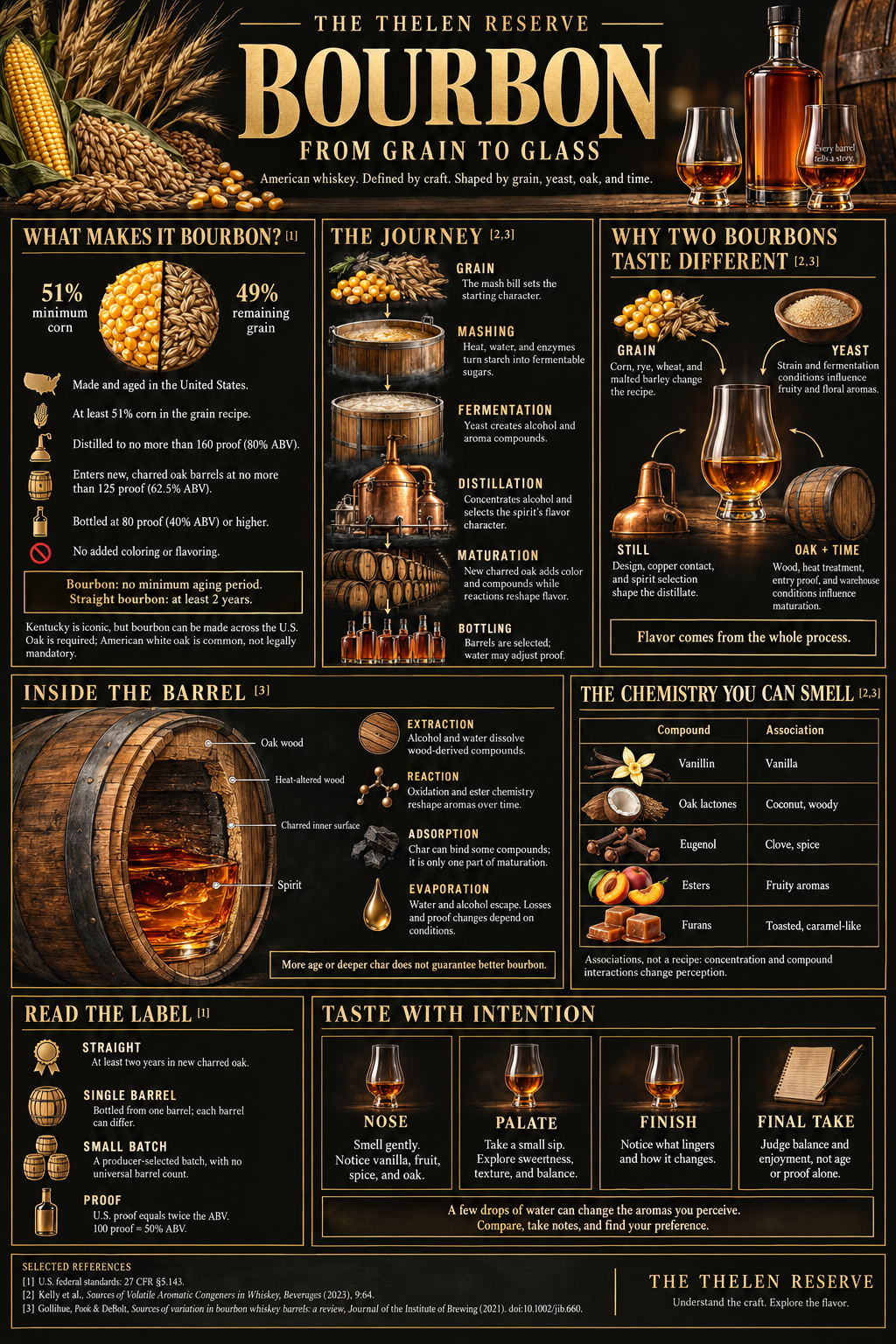
Bourbon

At least 51% corn. New charred oak. Corn leads the mash bill. Bourbon can be made across the United States.

Rye & wheat

At least 51% rye or wheat. New charred oak. Rye whiskey is rye-led. Wheat whiskey is wheat-led. Wheated bourbon still has a corn-led recipe.

Malt & rye malt

At least 51% of the named malt. New charred oak. Malt whiskey uses malted barley. Rye malt whiskey uses malted rye. American single malt has separate rules.

Corn whiskey

At least 80% corn. Oak storage is optional. When stored, corn whiskey uses used oak or new uncharred oak. It can go to bottle without barrel aging.

American single malt

100% malted barley. New or used oak, up to 700 liters. Mashed, distilled and aged in the U.S. All distillation takes place at one U.S. distillery. Many barrels can go into a release.

Light & blended

Two distinct designations. Different production rules. Light whiskey is distilled above 160 and below 190 proof. Blended whiskey can include neutral spirits. “Light” describes distillation strength.

What the numbers tell you

160 proof
The distillation ceiling for bourbon, rye, wheat, malt, rye malt, corn and American single malt whiskey.
80 proof
The minimum bottling strength is 40% ABV, or 80 U.S. proof.
2 years
The minimum qualifying aging for the straight designations covered here.

Reading an American whiskey label

Single barrel or batch
A batch can bring together multiple barrels of the same qualifying whiskey.
ABV and proof
A 50% ABV whiskey is 100 U.S. proof.
Color and classification
American single malt may contain disclosed caramel coloring, including straight American single malt.

Taste with intention

Nose
Smell gently. Look for fruit, grain, spice or oak.
Palate
Take a small sip. Notice sweetness, texture and balance.
Finish
Follow the flavors that linger after the sip.
Final take
Write down what you enjoyed and what you would revisit.

Compare two pours. Add a few drops of water and record what changes.

Selected references

Illustrated guideScotch

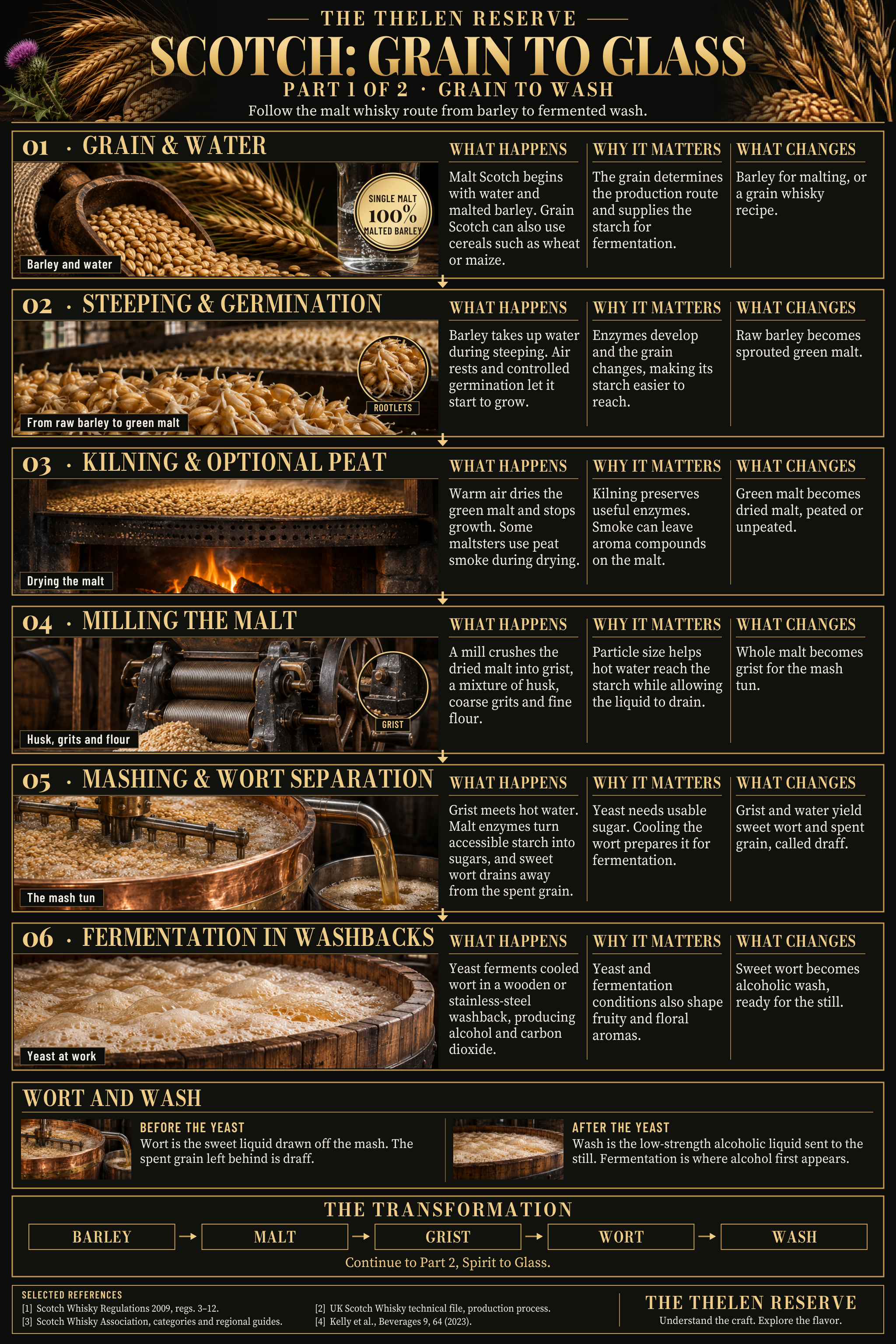
Grain to wash

Stages 1–6 · From raw barley to a fermented wash.

Open guide
Formats and reading options

Viewing PNG, Home Print, 8 × 10 Print Shop and two poster sizes

Explore the grain-to-wash lesson
Read as text

Follow the malt whisky route from barley to fermented wash.

01 · Grain & water

What happens
Malt Scotch begins with water and malted barley. Grain Scotch can also use cereals such as wheat or maize.
Why it matters
The grain determines the production route and supplies the starch for fermentation.
What changes
Barley for malting, or a grain whisky recipe.

02 · Steeping & germination

What happens
Barley takes up water during steeping. Air rests and controlled germination let it start to grow.
Why it matters
Enzymes develop and the grain changes, making its starch easier to reach.
What changes
Raw barley becomes sprouted green malt.

03 · Kilning & optional peat

What happens
Warm air dries the green malt and stops growth. Some maltsters use peat smoke during drying.
Why it matters
Kilning preserves useful enzymes. Smoke can leave aroma compounds on the malt.
What changes
Green malt becomes dried malt, peated or unpeated.

04 · Milling the malt

What happens
A mill crushes the dried malt into grist, a mixture of husk, coarse grits and fine flour.
Why it matters
Particle size helps hot water reach the starch while allowing the liquid to drain.
What changes
Whole malt becomes grist for the mash tun.

05 · Mashing & wort separation

What happens
Grist meets hot water. Malt enzymes turn accessible starch into sugars, and sweet wort drains away from the spent grain.
Why it matters
Yeast needs usable sugar. Cooling the wort prepares it for fermentation.
What changes
Grist and water yield sweet wort and spent grain, called draff.

06 · Fermentation in washbacks

What happens
Yeast ferments cooled wort in a wooden or stainless-steel washback, producing alcohol and carbon dioxide.
Why it matters
Yeast and fermentation conditions also shape fruity and floral aromas.
What changes
Sweet wort becomes alcoholic wash, ready for the still.

Wort and wash

Before the yeast
Wort is the sweet liquid drawn off the mash. The spent grain left behind is draff.
After the yeast
Wash is the low-strength alcoholic liquid sent to the still. Fermentation is where alcohol first appears.

The transformation

Barley → Malt → Grist → Wort → Wash

Selected references

Illustrated guideScotch

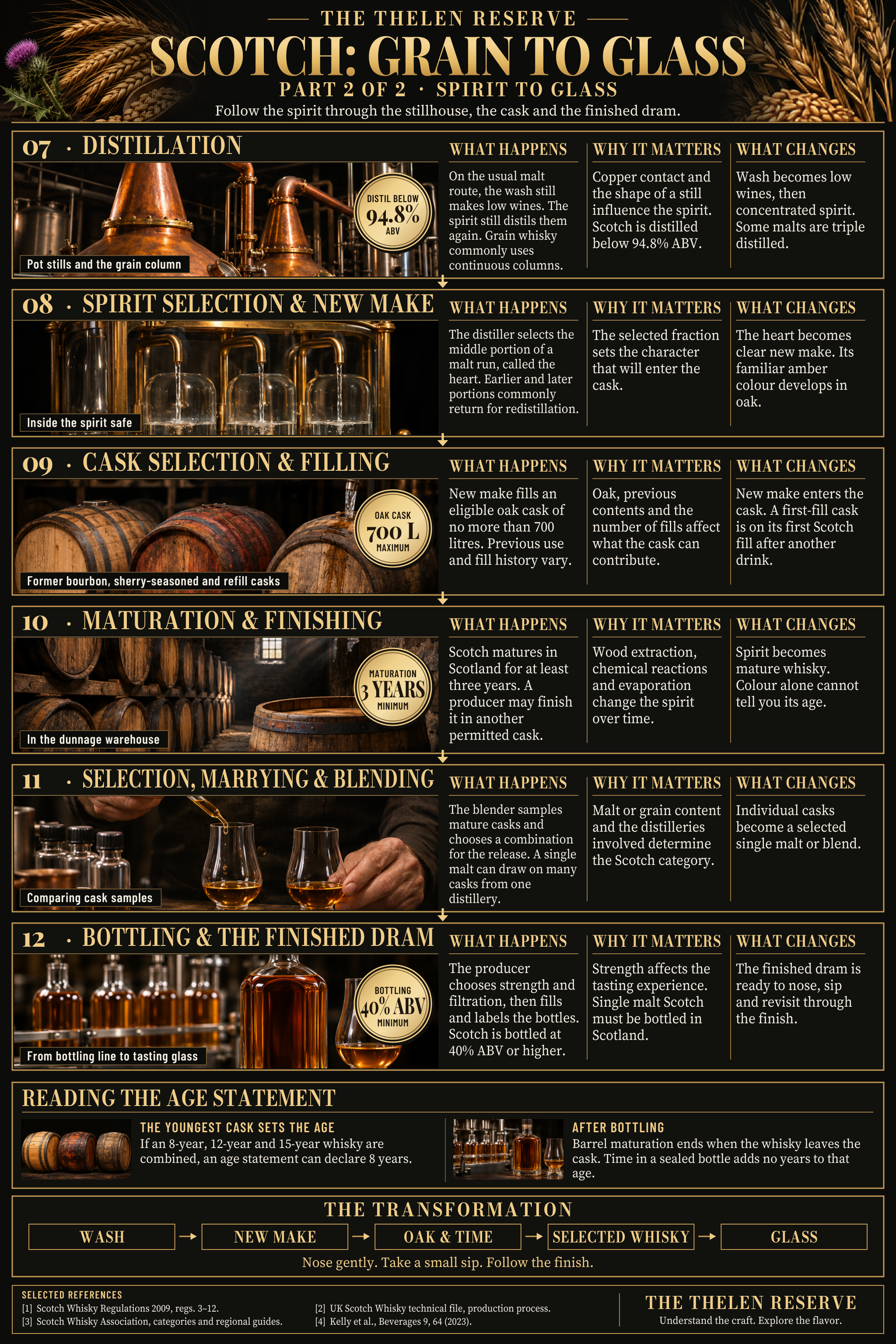
Spirit to glass

Stages 7–12 · From the stillhouse to the finished dram.

Open guide
Formats and reading options

Viewing PNG, Home Print, 8 × 10 Print Shop and two poster sizes

Explore the spirit-to-glass lesson
Read as text

Follow the spirit through the stillhouse, the cask and the finished dram.

07 · Distillation

What happens
On the usual malt route, the wash still makes low wines. The spirit still distils them again. Grain whisky commonly uses continuous columns.
Why it matters
Copper contact and the shape of a still influence the spirit. Scotch is distilled below 94.8% ABV.
What changes
Wash becomes low wines, then concentrated spirit. Some malts are triple distilled.

08 · Spirit selection & new make

What happens
The distiller selects the middle portion of a malt run, called the heart. Earlier and later portions commonly return for redistillation.
Why it matters
The selected fraction sets the character that will enter the cask.
What changes
The heart becomes clear new make. Its familiar amber colour develops in oak.

09 · Cask selection & filling

What happens
New make fills an eligible oak cask of no more than 700 litres. Previous use and fill history vary.
Why it matters
Oak, previous contents and the number of fills affect what the cask can contribute.
What changes
New make enters the cask. A first-fill cask is on its first Scotch fill after another drink.

10 · Maturation & finishing

What happens
Scotch matures in Scotland for at least three years. A producer may finish it in another permitted cask.
Why it matters
Wood extraction, chemical reactions and evaporation change the spirit over time.
What changes
Spirit becomes mature whisky. Colour alone cannot tell you its age.

11 · Selection, marrying & blending

What happens
The blender samples mature casks and chooses a combination for the release. A single malt can draw on many casks from one distillery.
Why it matters
Malt or grain content and the distilleries involved determine the Scotch category.
What changes
Individual casks become a selected single malt or blend.

12 · Bottling & the finished dram

What happens
The producer chooses strength and filtration, then fills and labels the bottles. Scotch is bottled at 40% ABV or higher.
Why it matters
Strength affects the tasting experience. Single malt Scotch must be bottled in Scotland.
What changes
The finished dram is ready to nose, sip and revisit through the finish.

Reading the age statement

The youngest cask sets the age
If an 8-year, 12-year and 15-year whisky are combined, an age statement can declare 8 years.
After bottling
Barrel maturation ends when the whisky leaves the cask. Time in a sealed bottle adds no years to that age.

The transformation

Wash → New make → Oak & time → Selected whisky → Glass

Selected references

Illustrated guideAmerican whiskey

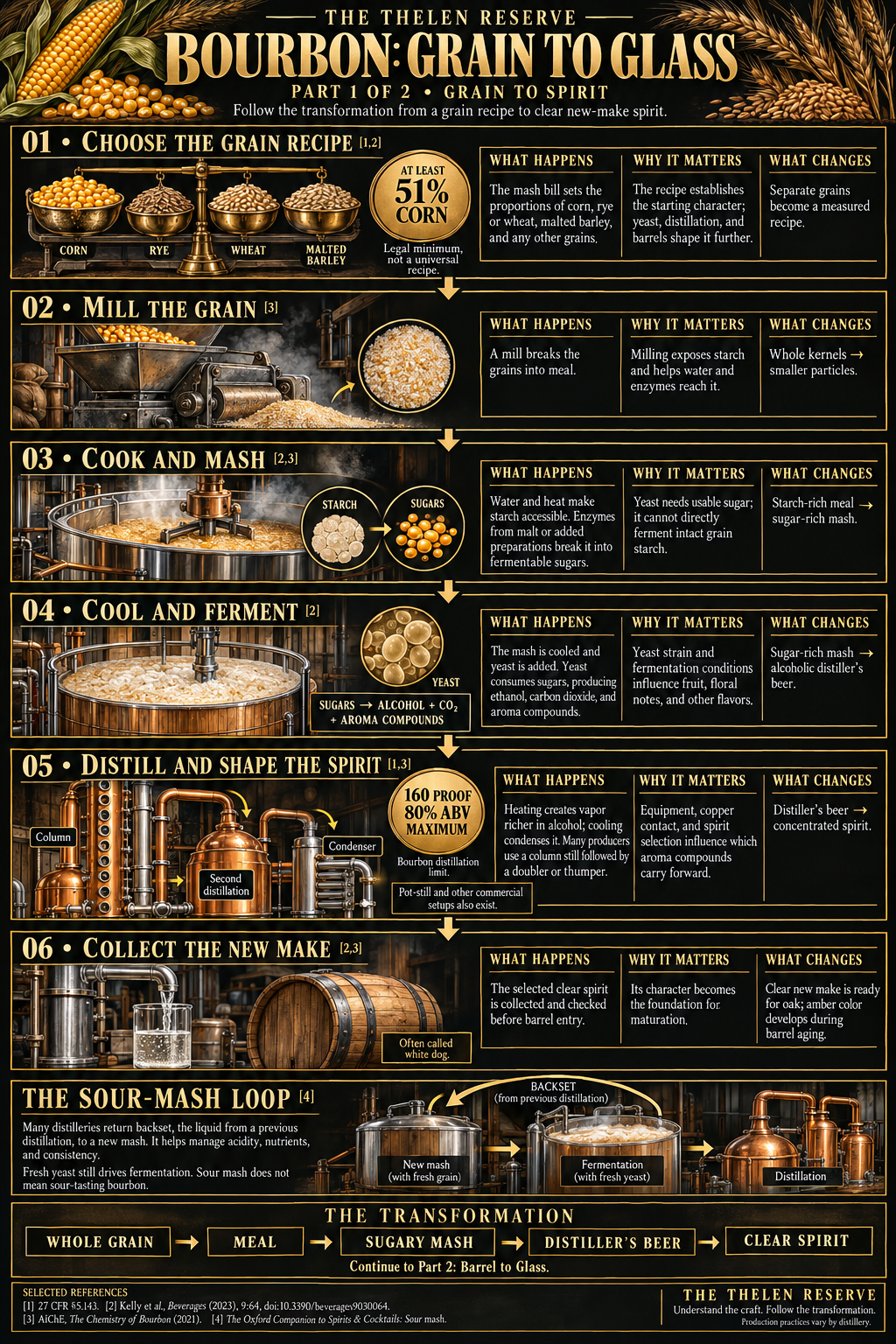
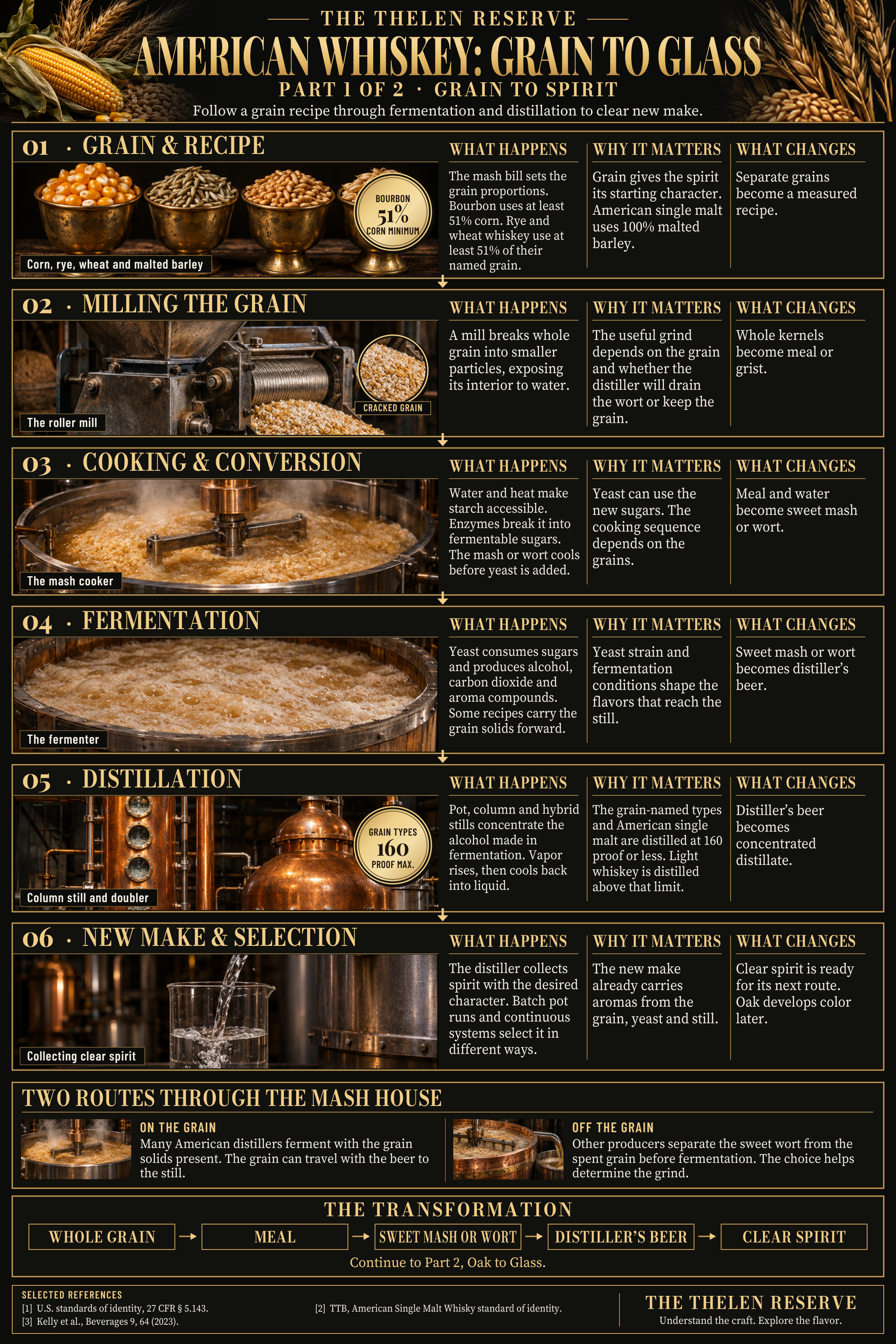
Grain to spirit

Stages 1–6 · From the recipe to clear new make.

Open guide
Formats and reading options

Viewing PNG, Home Print, 8 × 10 Print Shop and two poster sizes

Explore the grain-to-spirit lesson
Read as text

Follow a grain recipe through fermentation and distillation to clear new make.

01 · Grain & recipe

What happens
The mash bill sets the grain proportions. Bourbon uses at least 51% corn. Rye and wheat whiskey use at least 51% of their named grain.
Why it matters
Grain gives the spirit its starting character. American single malt uses 100% malted barley.
What changes
Separate grains become a measured recipe.

02 · Milling the grain

What happens
A mill breaks whole grain into smaller particles, exposing its interior to water.
Why it matters
The useful grind depends on the grain and whether the distiller will drain the wort or keep the grain.
What changes
Whole kernels become meal or grist.

03 · Cooking & conversion

What happens
Water and heat make starch accessible. Enzymes break it into fermentable sugars. The mash or wort cools before yeast is added.
Why it matters
Yeast can use the new sugars. The cooking sequence depends on the grains.
What changes
Meal and water become sweet mash or wort.

04 · Fermentation

What happens
Yeast consumes sugars and produces alcohol, carbon dioxide and aroma compounds. Some recipes carry the grain solids forward.
Why it matters
Yeast strain and fermentation conditions shape the flavors that reach the still.
What changes
Sweet mash or wort becomes distiller’s beer.

05 · Distillation

What happens
Pot, column and hybrid stills concentrate the alcohol made in fermentation. Vapor rises, then cools back into liquid.
Why it matters
The grain-named types and American single malt are distilled at 160 proof or less. Light whiskey is distilled above that limit.
What changes
Distiller’s beer becomes concentrated distillate.

06 · New make & selection

What happens
The distiller collects spirit with the desired character. Batch pot runs and continuous systems select it in different ways.
Why it matters
The new make already carries aromas from the grain, yeast and still.
What changes
Clear spirit is ready for its next route. Oak develops color later.

Two routes through the mash house

On the grain
Many American distillers ferment with the grain solids present. The grain can travel with the beer to the still.
Off the grain
Other producers separate the sweet wort from the spent grain before fermentation. The choice helps determine the grind.

The transformation

Whole grain → Meal → Sweet mash or wort → Distiller’s beer → Clear spirit

Selected references

Illustrated guideAmerican whiskey

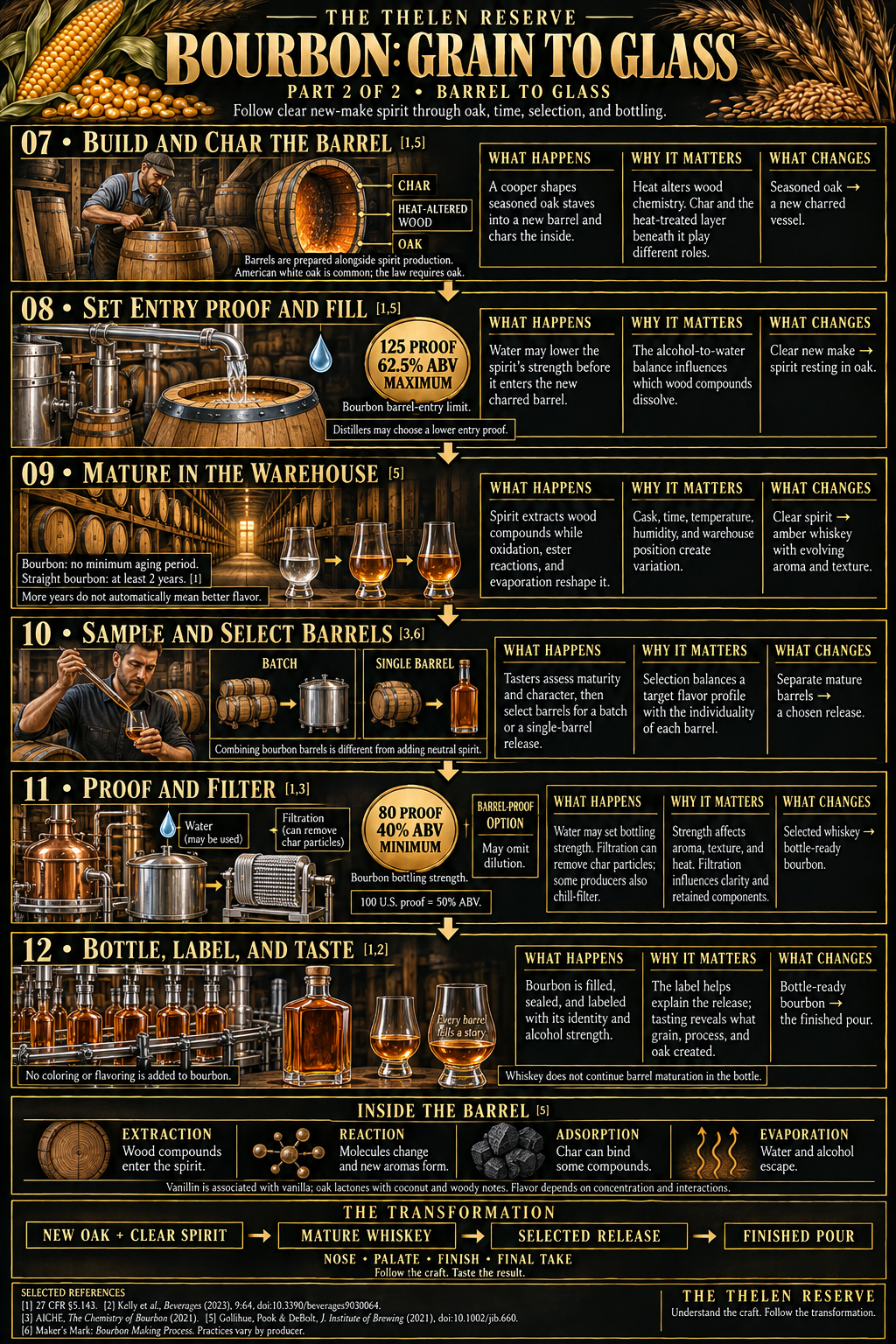
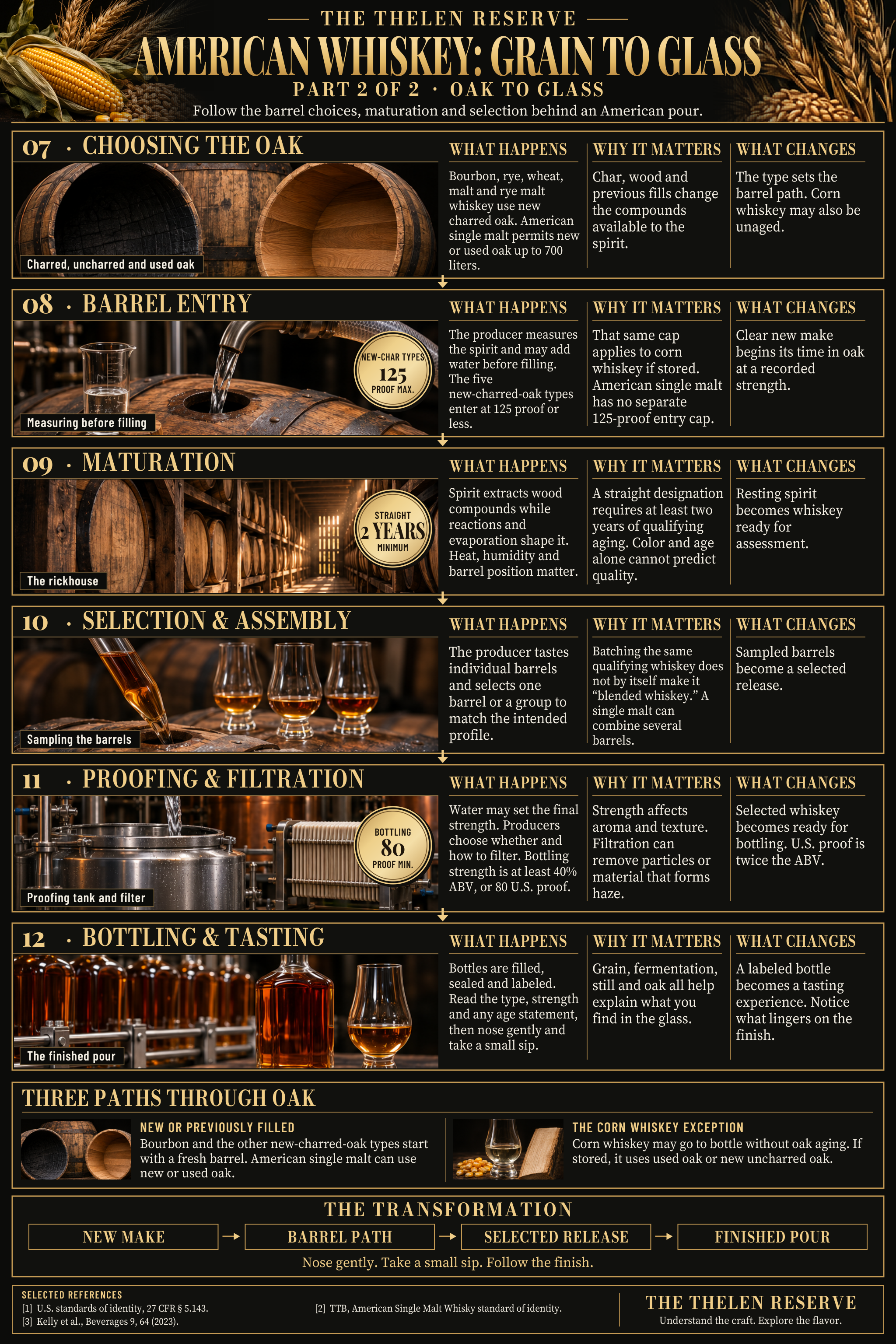
Oak to glass

Stages 7–12 · Barrel paths, maturation and the finished pour.

Open guide
Formats and reading options

Viewing PNG, Home Print, 8 × 10 Print Shop and two poster sizes

Explore the oak-to-glass lesson
Read as text

Follow the barrel choices, maturation and selection behind an American pour.

07 · Choosing the oak

What happens
Bourbon, rye, wheat, malt and rye malt whiskey use new charred oak. American single malt permits new or used oak up to 700 liters.
Why it matters
Char, wood and previous fills change the compounds available to the spirit.
What changes
The type sets the barrel path. Corn whiskey may also be unaged.

08 · Barrel entry

What happens
The producer measures the spirit and may add water before filling. The five new-charred-oak types enter at 125 proof or less.
Why it matters
That same cap applies to corn whiskey if stored. American single malt has no separate 125-proof entry cap.
What changes
Clear new make begins its time in oak at a recorded strength.

09 · Maturation

What happens
Spirit extracts wood compounds while reactions and evaporation shape it. Heat, humidity and barrel position matter.
Why it matters
A straight designation requires at least two years of qualifying aging. Color and age alone cannot predict quality.
What changes
Resting spirit becomes whiskey ready for assessment.

10 · Selection & assembly

What happens
The producer tastes individual barrels and selects one barrel or a group to match the intended profile.
Why it matters
Batching the same qualifying whiskey does not by itself make it “blended whiskey.” A single malt can combine several barrels.
What changes
Sampled barrels become a selected release.

11 · Proofing & filtration

What happens
Water may set the final strength. Producers choose whether and how to filter. Bottling strength is at least 40% ABV, or 80 U.S. proof.
Why it matters
Strength affects aroma and texture. Filtration can remove particles or material that forms haze.
What changes
Selected whiskey becomes ready for bottling. U.S. proof is twice the ABV.

12 · Bottling & tasting

What happens
Bottles are filled, sealed and labeled. Read the type, strength and any age statement, then nose gently and take a small sip.
Why it matters
Grain, fermentation, still and oak all help explain what you find in the glass.
What changes
A labeled bottle becomes a tasting experience. Notice what lingers on the finish.

Three paths through oak

New or previously filled
Bourbon and the other new-charred-oak types start with a fresh barrel. American single malt can use new or used oak.
The corn whiskey exception
Corn whiskey may go to bottle without oak aging. If stored, it uses used oak or new uncharred oak.

The transformation

New make → Barrel path → Selected release → Finished pour

Selected references