TJ THELEN'S COLLECTION
The Thelen Reserve

STAGE 09 OF 12 · WAREHOUSE MATURATION

Time becomes part of the recipe.

The filled barrel leaves the distillery floor. Follow it into the warehouse,
look beneath the char, and discover how the spirit changes before selection.

Enter the warehouse ↓Four views within Stage 9 · About 90 seconds · Scroll at your own pace
Where this fits · All 12 stages
  1. Grain selection & mash bill
  2. Milling
  3. Cooking & starch conversion
  4. Fermentation
  5. Distillation
  6. Collecting new-make spirit
  7. Barrel construction & charring
  8. Barrel-entry proof & filling
  9. Warehouse maturation · YOU ARE HERE
  10. Barrel selection & batching
  11. Proofing & filtration
  12. Bottling & the finished pour
Browse all 12 stages →
CHAPTER CONNECTION08 · Barrel filling → 09 · Warehouse maturation → 10 · Barrel selection
Explore at your own pace
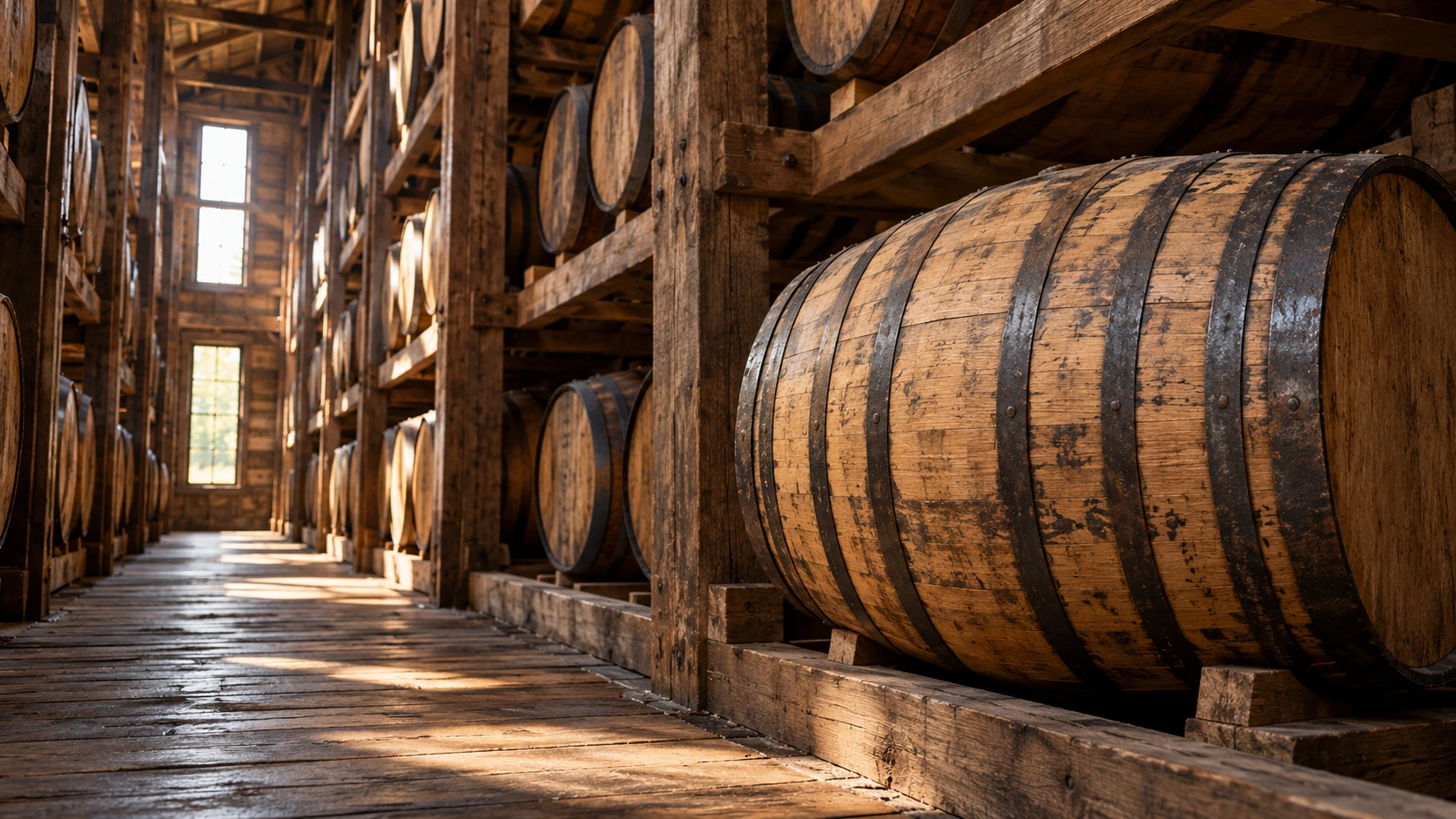
Oak barrels stored in timber racks along a traditional warehouse aisle.

ARRIVING FROM STAGE 08

A barrel gets an address.

The new charred oak barrel has been filled and closed. Now it rests in a warehouse, often called a rickhouse. Its surroundings help shape its development: temperature, humidity, airflow and location all matter.

ENTERSClear spirit in new charred oak
↓
WHAT CHANGESStorage conditions act over time
↓
LEAVESA barrel developing its own character
Location matters

Two barrels filled with the same spirit can develop differently. In some warehouses, higher floors experience more heat, but building design and barrel position complicate the pattern. Moving barrels is a producer’s choice, not a universal step.
Look inside the barrel →
FOLLOWING THE BARRELA barrel developing its own characterNEXT VIEW ↓
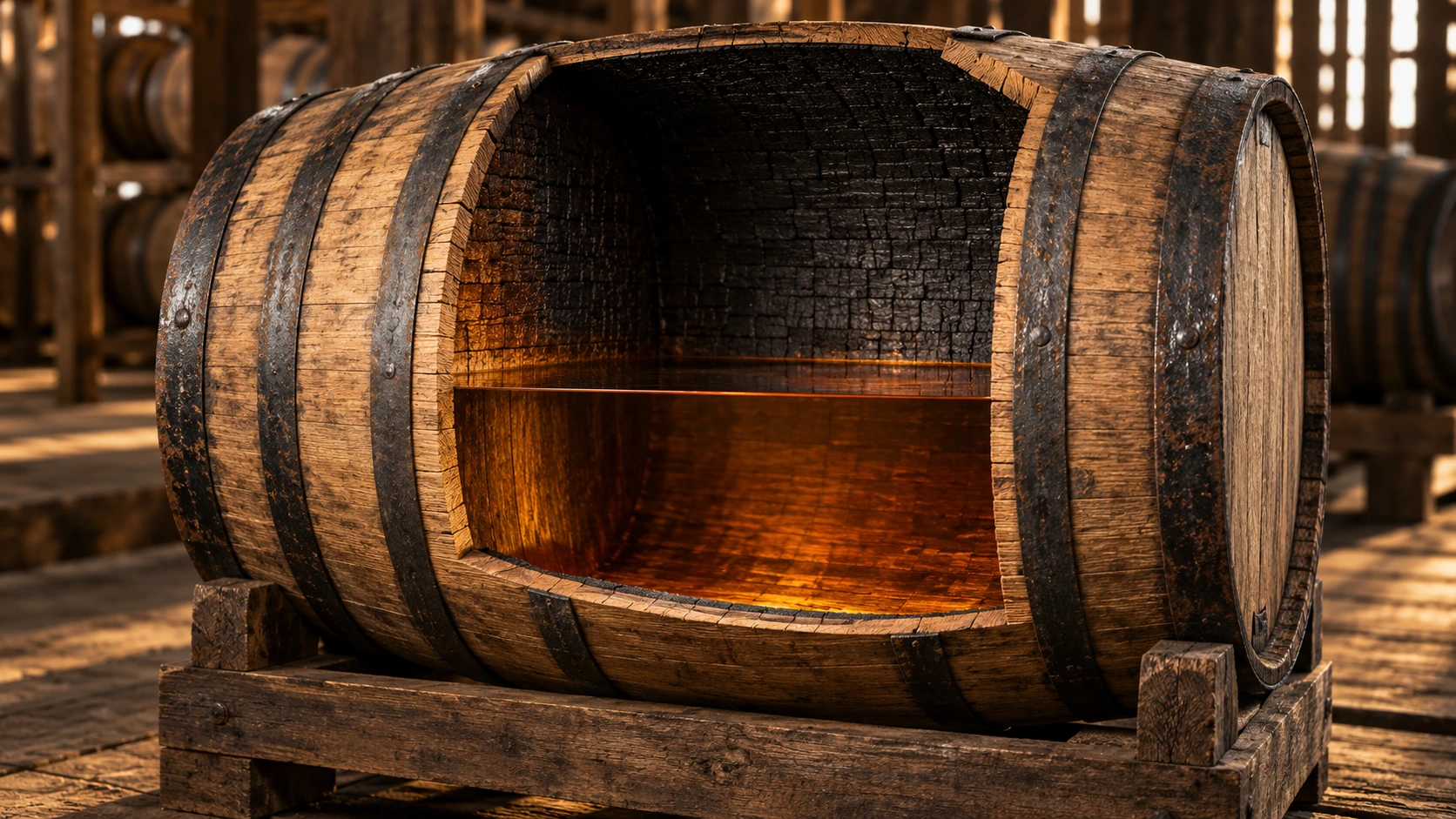
Conceptual section of an oak barrel revealing charred inner wood and amber spirit.CONCEPTUAL CUTAWAY · NOT AN AGE SCALE

LOOKING BENEATH THE SURFACE

The barrel is an ingredient and a reaction vessel.

Spirit extracts compounds from oak while chemical reactions alter its aroma and flavor. The black char is one part of a layered wood surface. Select a marker to explore the material beneath it.

1 · CHARRED SURFACE

Charring transforms the inner surface. The char layer can adsorb some compounds; the heat-altered oak beneath it also supplies extractable material.

ENTERSSpirit + charred oak
↓
WHAT CHANGESExtraction and chemical reactions
↓
LEAVESEvolving color, aroma and flavor
A conceptual window into oak

The opening and liquid level are explanatory, not a working barrel or a measurement of evaporation. Amber illustrates wood contact; it does not represent a specific age or degree of readiness.

Explore the seasons →
FOLLOWING THE BARRELEvolving color, aroma and flavorNEXT VIEW ↓
The same warehouse scene used to compare warmer and cooler seasonal conditions.
SPRING · WARMING CONDITIONS

TIME, TEMPERATURE & AIR

The warehouse never holds perfectly still.

Explore one illustrative seasonal cycle. Conditions influence extraction, reaction rates and losses, while the spirit keeps changing over repeated cycles. This is a comparison of conditions, not an aging calculator.

Warming conditions

As conditions warm, the spirit and barrel respond. Temperature influences transport of compounds and reaction rates.

Illustrative cycle only. Lighting indicates the selected season; it does not simulate measured temperature, proof, color or age.

EXTRACTIONWood contributes compounds.
REACTIONSOxidation and ester reactions alter composition.
EVAPORATIONWater and alcohol gradually leave.
ENTERSA barrel exposed to its environment
↓
WHAT CHANGESChanging conditions + ongoing chemistry
↓
LEAVESA changing spirit and gradual volume loss
What the angel’s share means

Both water and alcohol can evaporate during storage. Their relative losses depend on conditions, so proof can rise or fall. There is no single annual loss rate that describes every barrel.

Go to sampling →
FOLLOWING THE BARRELA changing spirit and gradual volume lossNEXT VIEW ↓
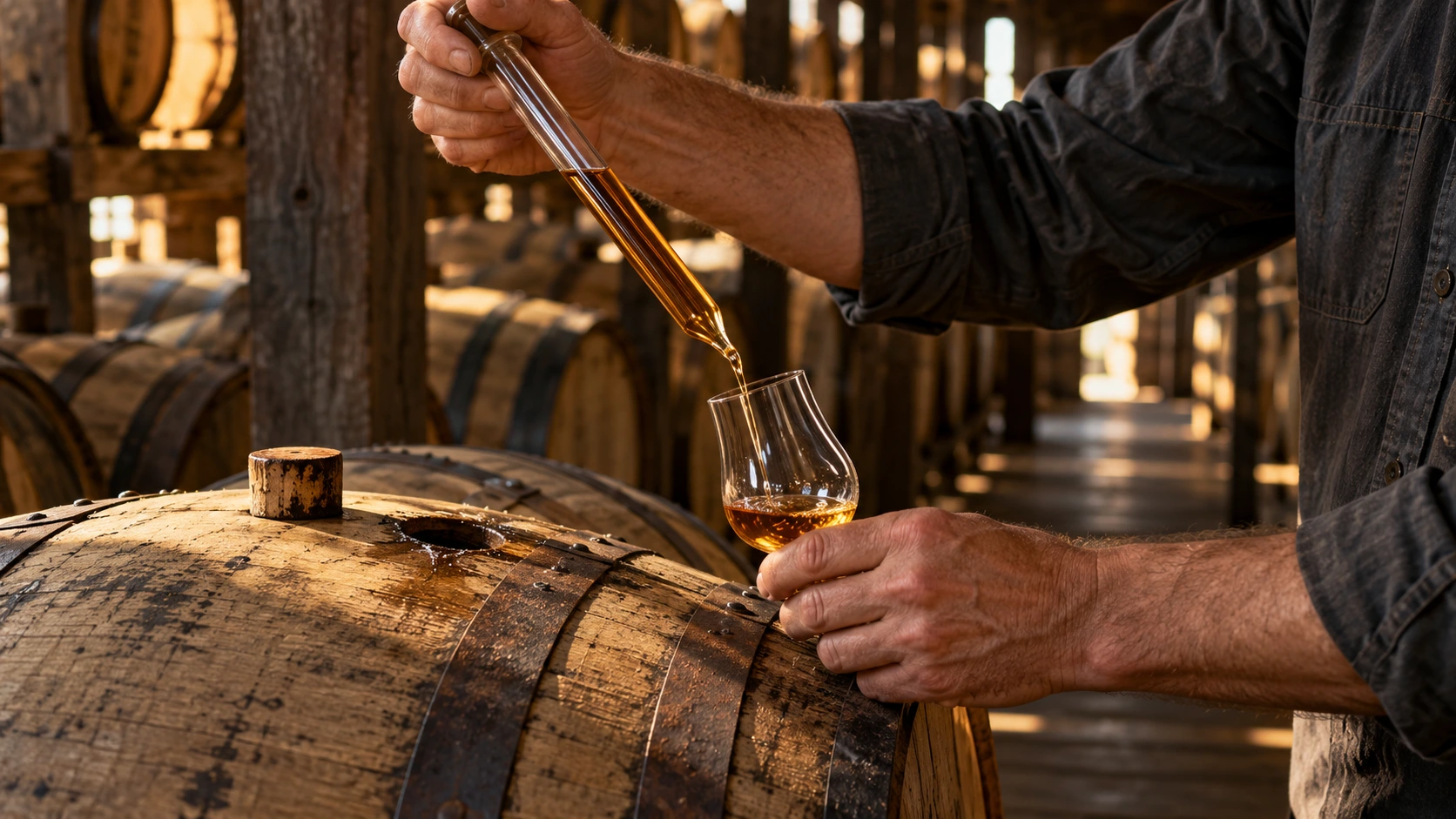
A distiller draws an amber sample with a glass whiskey thief into a tasting glass.

THE HANDOFF TO STAGE 10

Readiness is assessed in the glass.

A sample connects the barrel’s history to its present character. The team evaluates aroma, palate and finish alongside measurements and records, deciding whether to keep aging it or consider it for a release.

NOSE
Aroma & balance
PALATE
Flavor & texture
FINISH
Length & character
ENTERSA sample from the maturing barrel
↓
WHAT CHANGESSensory assessment + measurements
↓
LEAVESA decision: keep aging or consider selection
Color is not a maturity score

Darker whiskey is not automatically older or better. Evaluation asks whether the spirit suits the intended style. Barrel selection and batching remain their own chapter: Stage 10.

Continue to the chapter handoff →

STAGE 09 COMPLETE

Maturation creates possibilities.
Selection makes the release.

The next chapters follow the mature whiskey through barrel selection, proofing, filtration and bottling, before arriving at the finished glass.

Continue to Stage 10 · Barrel selection →Explore all 12 stages