TJ THELEN'S COLLECTION
The Thelen Reserve
Behind the Bottles / Lawrenceburg, Kentucky

Wild Turkey

Last updated Last researched

A Kentucky river bluff, three Russell generations, and a flavor worth protecting

Wild Turkey’s story is most revealing when read through its contrasts: historic warehouses beside modern production equipment, a familiar everyday bourbon alongside scarce experimental releases, and successive generations who share a foundation without sharing exactly the same palate. Lawrenceburg provides the setting. The Ripy family, Austin Nichols and the Russells supply different chapters of the history. Together they explain a producer whose identity rests on continuity, but whose best-known milestones also show a willingness to make something new.

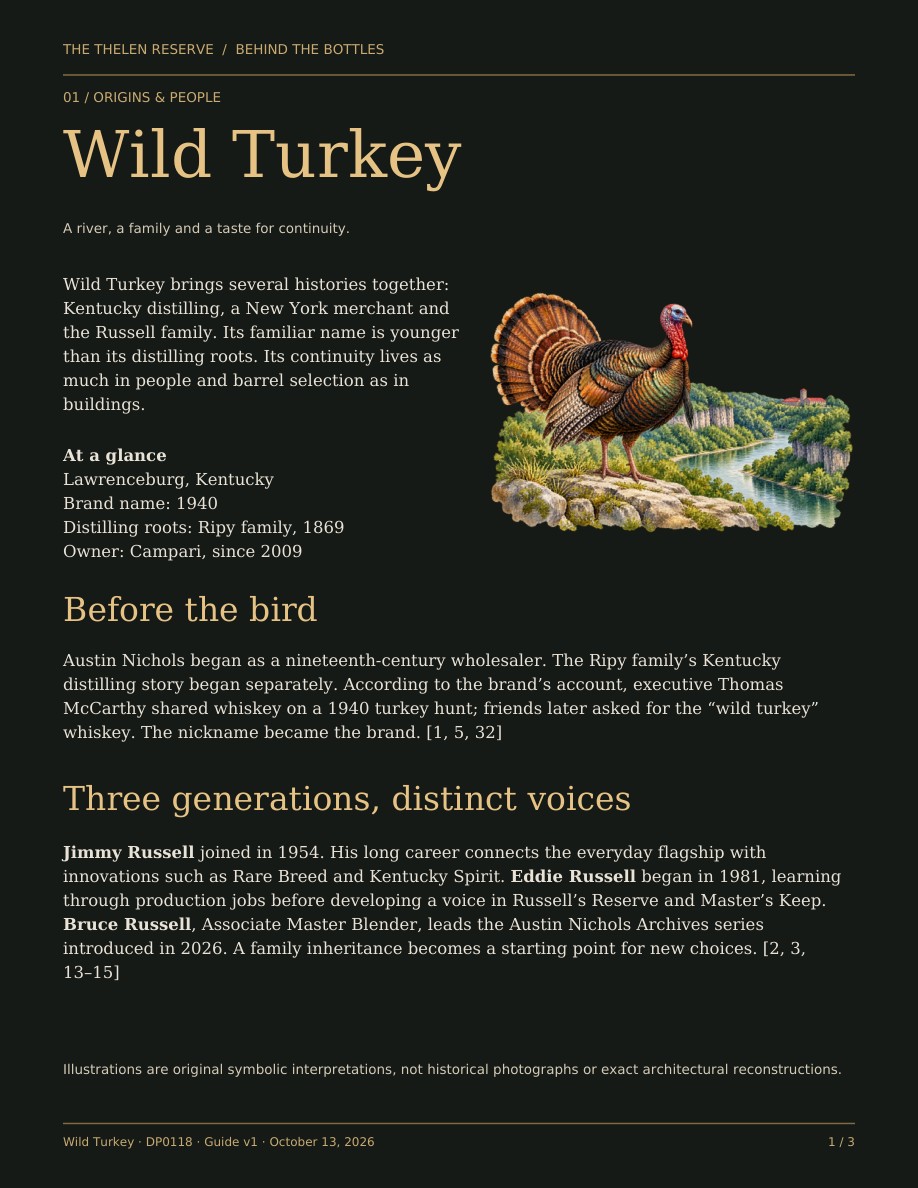
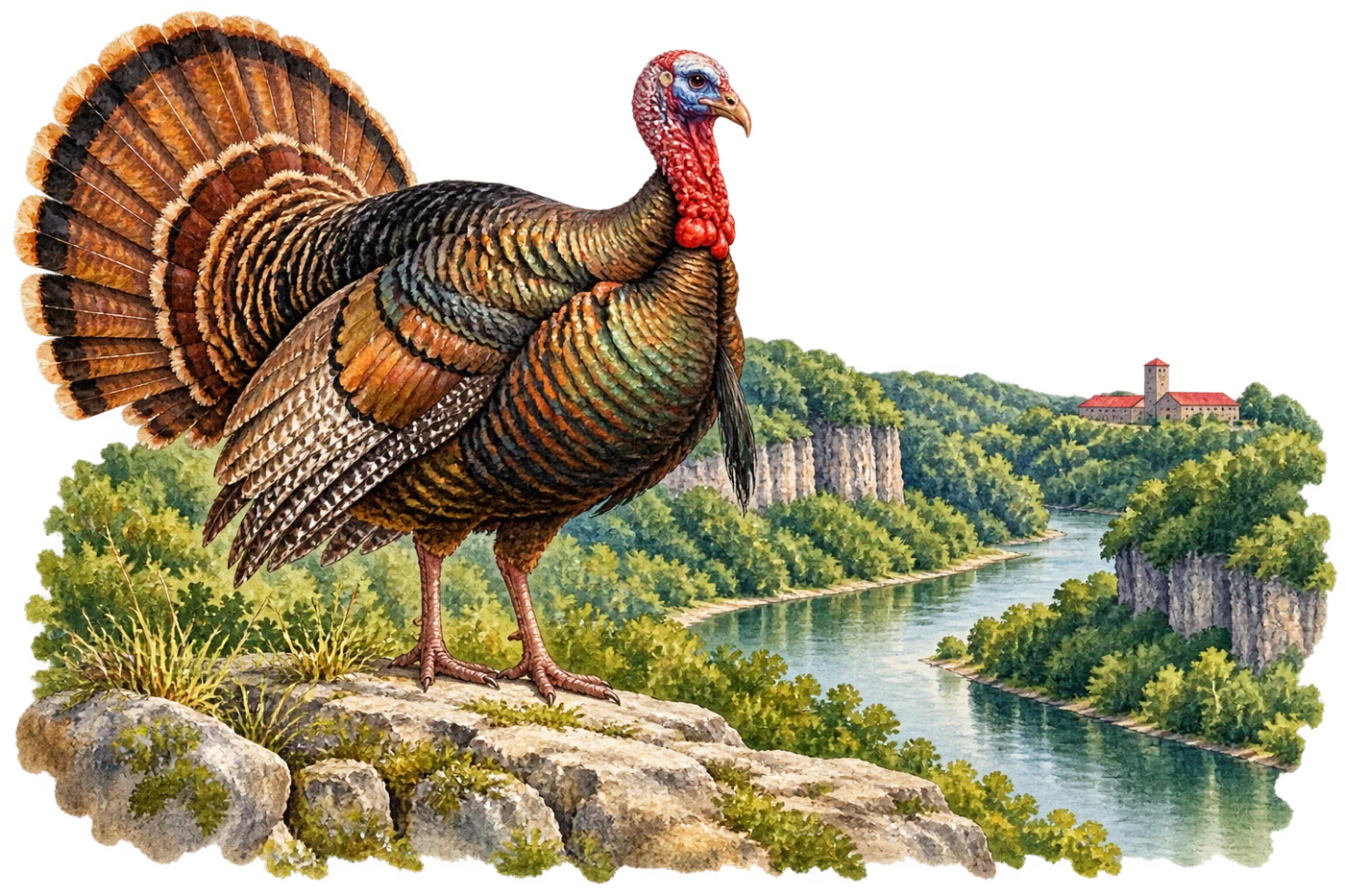
Symbolic watercolor of a wild turkey above the Kentucky River
Home
Lawrenceburg, Kentucky[9]
Distilling heritage
Ripy family roots traced to 1869[1]
Brand origin story
A hunting trip in 1940[32]
Owner
Campari Group, since 2009[5]
01 / Origins & people

Before the bird, there were two stories.

Two beginnings, one identity

The earliest date in the official chronology belongs to a merchant: Austin Nichols began selling wine and spirits in 1855. The distilling lineage is separate, rooted in the Ripy family’s Kentucky operation. Keeping those beginnings distinct helps explain why a bottle can carry a long commercial heritage without having been sold under its modern name throughout that entire period.[1]

A working landscape survives

The most tangible historical evidence is on the ground. Kentucky’s architectural survey identifies nineteenth- and early twentieth-century warehouse fabric alongside later additions. Its significance is cumulative: buildings, roads and the arrangement of the site record how whiskey production developed. The campus is therefore more informative than a single founding date, showing successive generations adapting a working place rather than preserving a frozen exhibit.[6]

Revival after interruption

Prohibition interrupted the regional distilling economy, and the Ripy operation returned in the post-repeal period. Accounts disagree on the precise reopening year, so that revival should not be reduced to a falsely certain date. The important continuity is one of local knowledge and enterprise surviving disruption, not an assertion that the modern distillery operated without interruption from its nineteenth-century beginnings.[33]

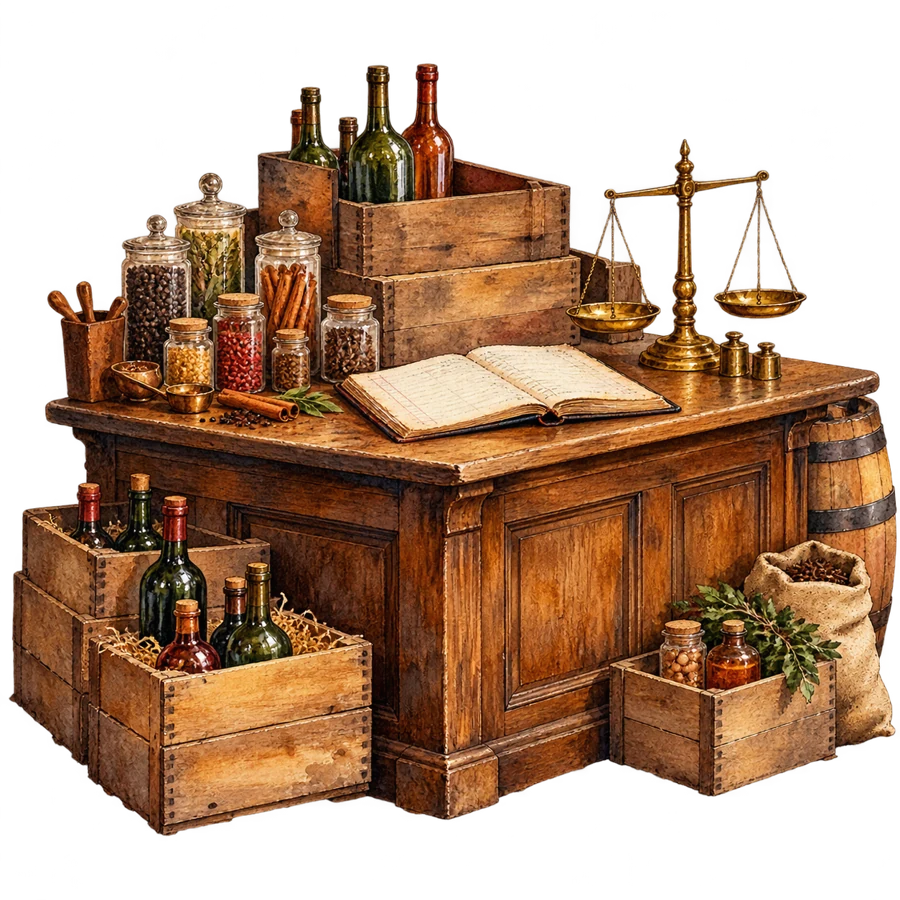
Symbolic Austin Nichols wholesale merchant counter

Jimmy Russell: the standard keeper

Jimmy’s influence extends beyond a job title. His biography describes an apprenticeship shaped by Bill Hughes and Ernest W. Ripy Jr., followed by responsibility for both the flagship and distinctive new expressions. That combination matters: the figure associated with protecting Wild Turkey’s identity also helped bring Rare Breed, Kentucky Spirit and honeyed whiskey to drinkers. Preservation and invention were already intertwined in his career.[2]

Eddie Russell: experience with a different palate

Eddie began on June 5, 1981, doing production work before gradually taking on broader responsibility. His career makes the family story less a matter of simply inheriting a name than learning a distillery from its ordinary jobs upward. Russell’s Reserve and later experimental releases offered room for his preferences to emerge within the same house tradition.[3]

Bruce Russell: an archive becomes a new chapter

By 2026, Associate Master Blender Bruce Russell was leading Austin Nichols Archives. The series looks to admired older bottlings as creative reference points, beginning with Gold Foil Edition. It does not promise to reproduce the past exactly. Instead, Bruce uses a shared production inheritance to interpret the character that collectors associate with an earlier era.[13]

02 / The illustrated history

A long view of Wild Turkey.

From Kentucky distilling roots to a new generation of barrel selection. Dates distinguish the merchant, the whiskey brand and the facilities.
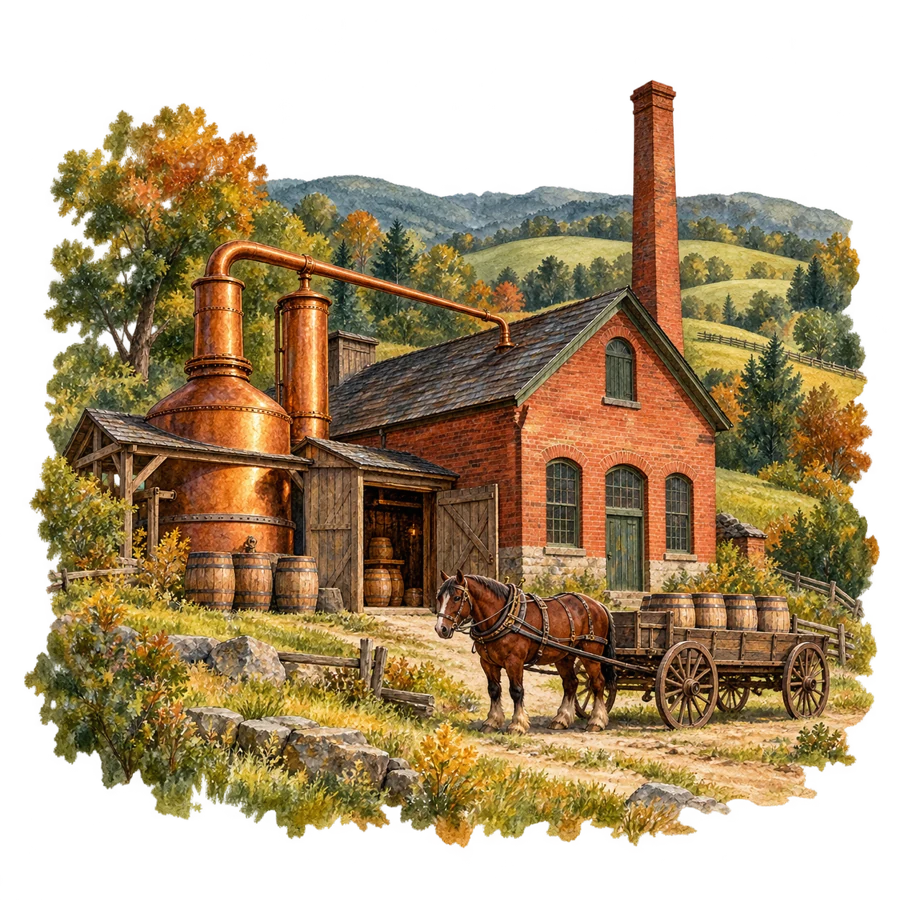
Symbolic illustration: The distilling roots
1869

The distilling roots

Wild Turkey’s official history traces its distilling ancestry to the Ripy brothers’ family operation in Lawrenceburg. This is the Kentucky production chapter, distinct from Austin Nichols’ earlier beginnings as a merchant.[1]
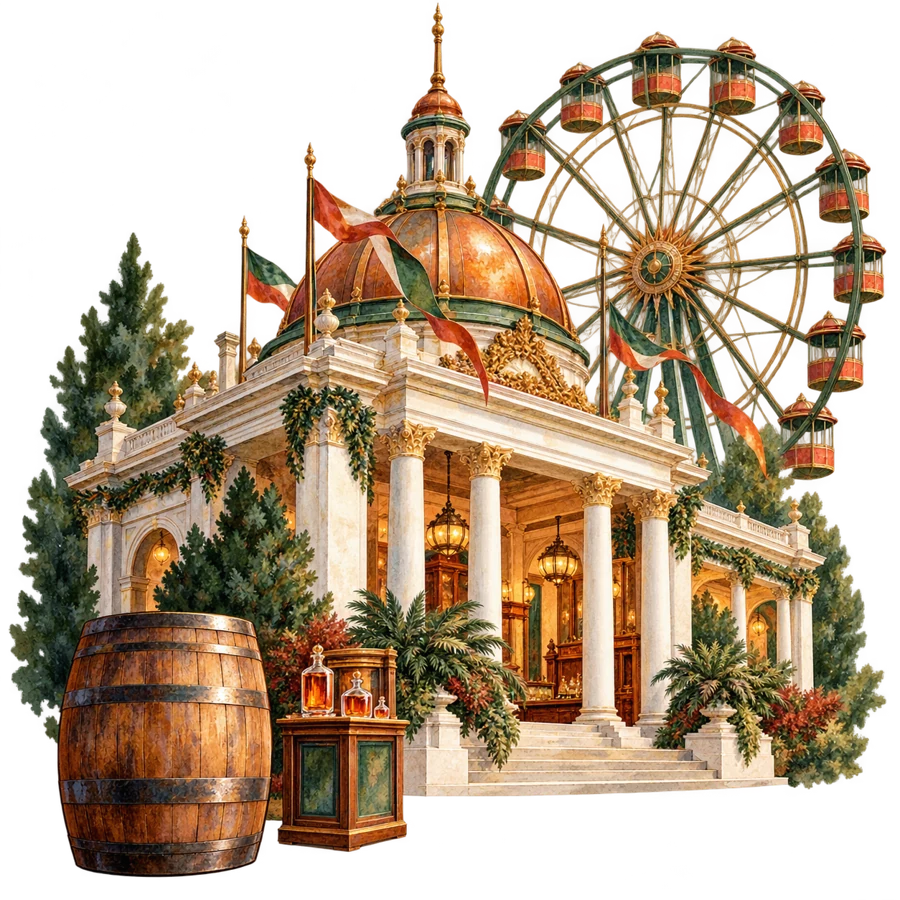
Symbolic illustration: Kentucky on a wider stage
1893

Kentucky on a wider stage

Ripy bourbon represents Kentucky at Chicago’s World’s Fair, according to the brand chronology. The milestone belongs to the predecessor distilling story, decades before the Wild Turkey name becomes part of the narrative.[1]
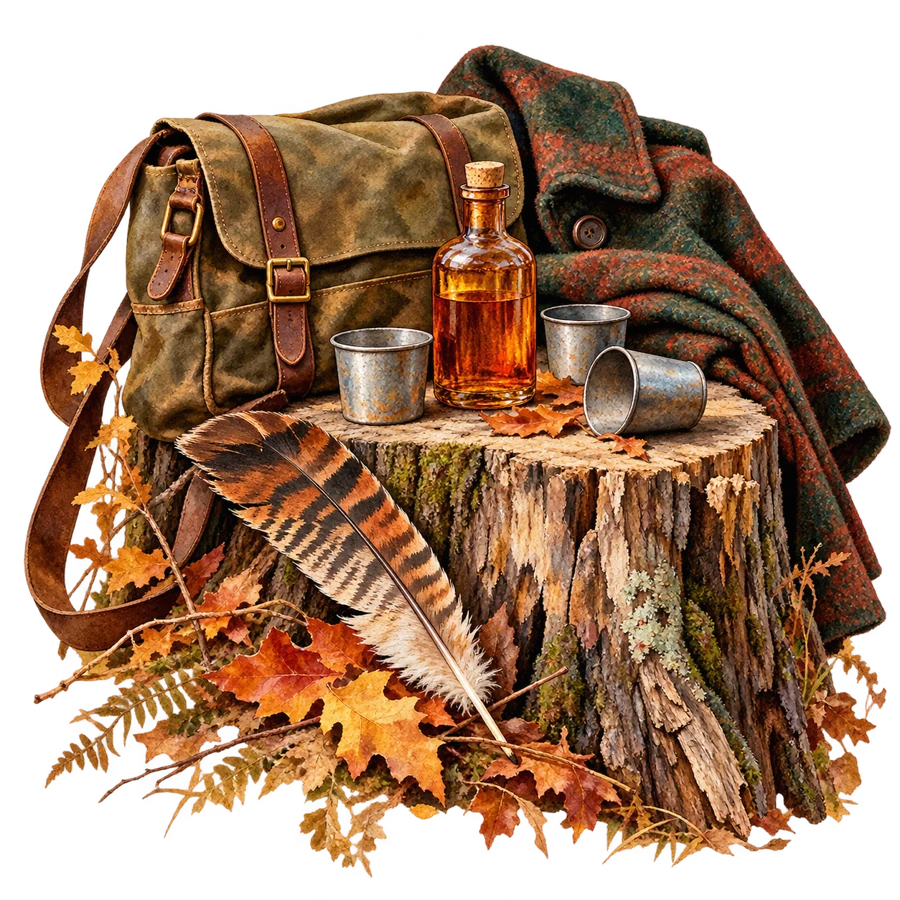
Symbolic illustration: A name from the hunt
1940

A name from the hunt

In the producer’s account, Thomas McCarthy shares whiskey on a wild turkey hunting trip. Friends later ask for the whiskey by that association, giving a memorable social occasion a lasting place in the brand’s identity.[32]
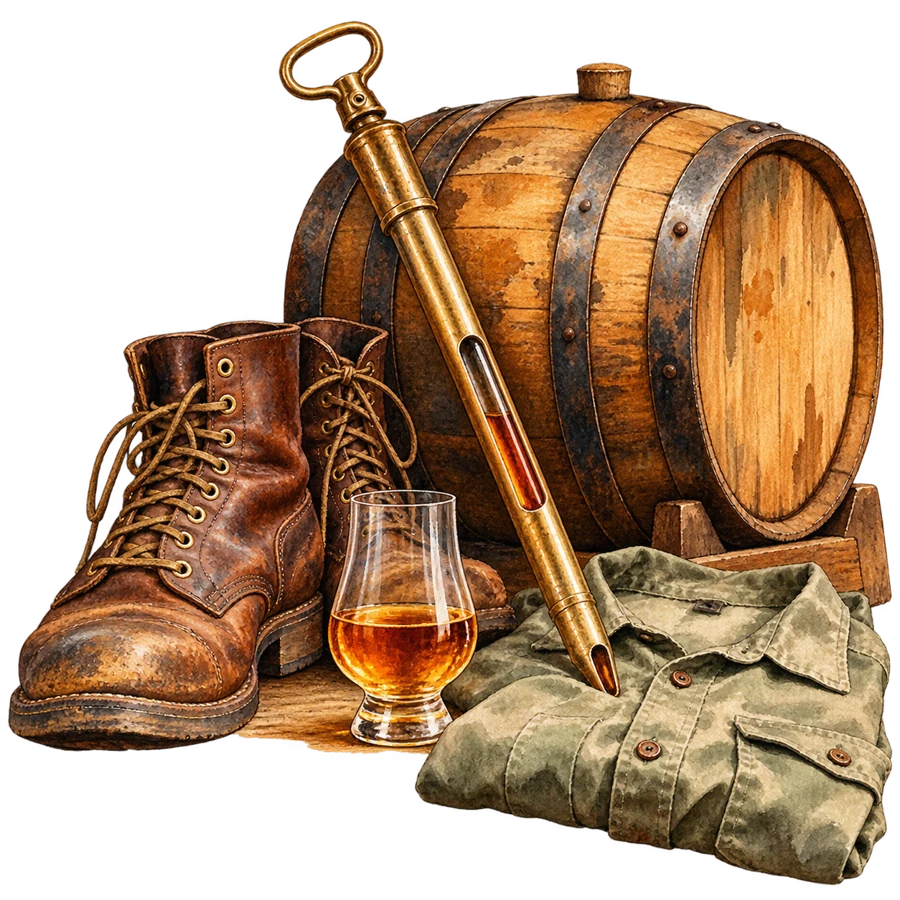
Symbolic illustration: Jimmy walks through the door
1954

Jimmy walks through the door

Jimmy Russell begins work on September 10 at eighteen years old. What starts with practical distillery work becomes a career spanning generations, anchored in learning the craft and maintaining a recognizable bourbon character.[10]
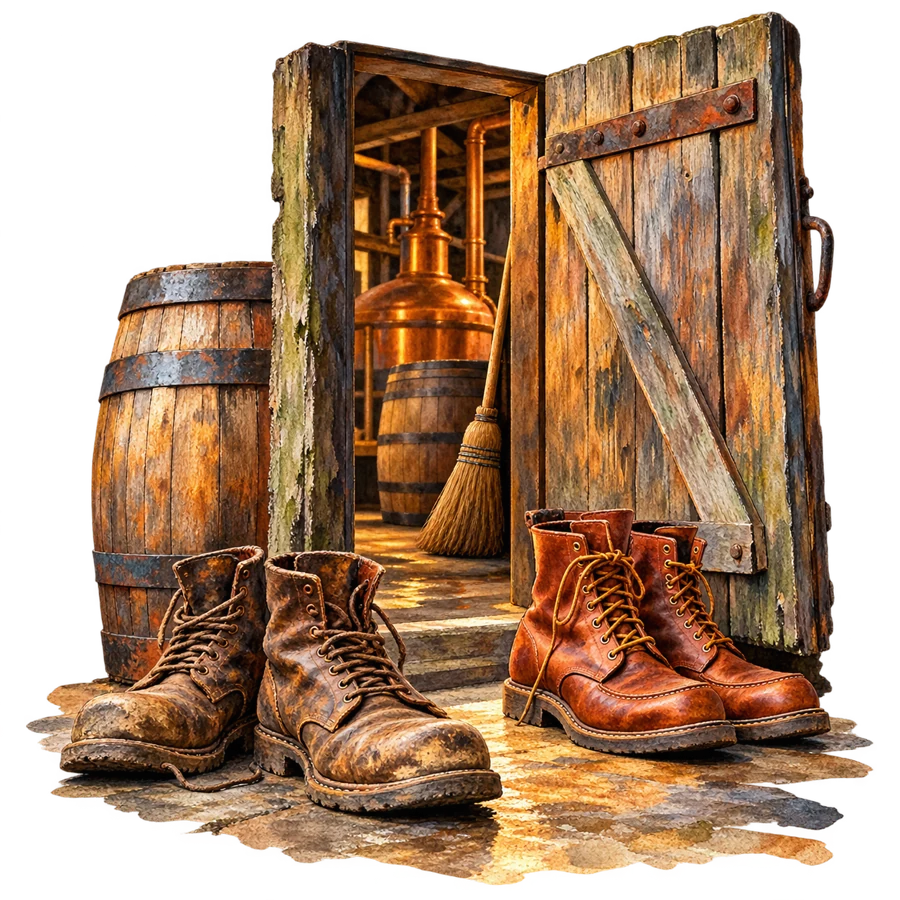
Symbolic illustration: Innovation and another generation
1976–1981

Innovation and another generation

Jimmy introduces a honeyed bourbon liqueur in 1976, an ancestor of American Honey. In 1981, Eddie joins the distillery, beginning the long apprenticeship that will eventually give the family’s next generation its own creative voice.[2][3]
Symbolic illustration: Two ways to reveal character
1991–1995

Two ways to reveal character

The current official chronology dates Rare Breed to 1991 and Kentucky Spirit to 1995. Barrel-proof blending and single-barrel selection give drinkers different perspectives on the whiskey, expanding the range beyond the familiar flagship.[1]
Symbolic illustration: Russell’s Reserve takes shape
Late 1990s–2007

Russell’s Reserve takes shape

Conceived in the late 1990s, Russell’s Reserve debuts in 2001 as a ten-year-old, 101-proof bourbon. The bourbon shifts to 90 proof in 2005, and a six-year-old rye joins the family in 2007.[4]
Symbolic illustration: The Campari era begins
2009

The Campari era begins

Campari’s acquisition of Wild Turkey and American Honey closes on May 29. New ownership connects the Kentucky producer with a global spirits group, setting the context for substantial investment in its production and packaging facilities.[5][16]
Symbolic illustration: A modern production platform
2011–2013

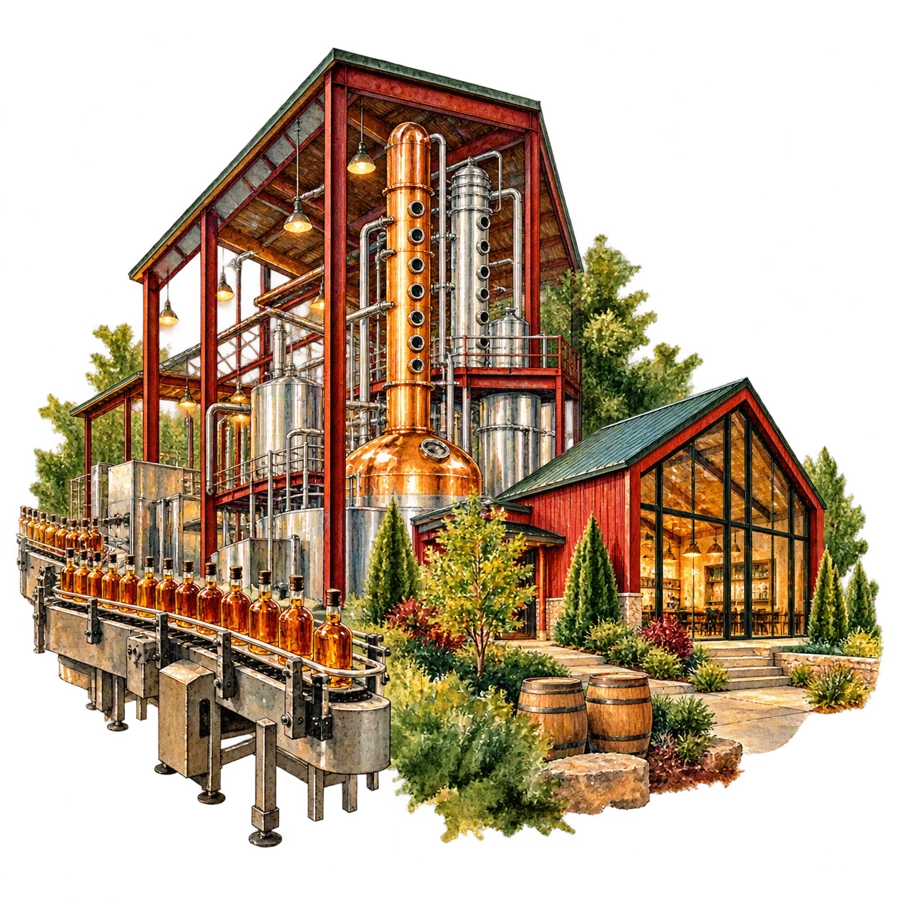
A modern production platform

A major distillery expansion is unveiled in 2011. Bottling returns to Lawrenceburg in September 2013 with a new packaging facility, bringing another part of the whiskey’s journey back to its Kentucky home.[16][17]
Symbolic illustration: Eddie’s vision gets a series
2015

Eddie’s vision gets a series

Eddie becomes Master Distiller, and Master’s Keep begins with a seventeen-year-old release. The series creates a recurring space to explore age, maturation and finishing while keeping the producer’s established whiskey at the center.[4][34]
Symbolic illustration: New charcoal, renewed rye
2018–2020

New charcoal, renewed rye

Longbranch arrives in 2018 with oak and Texas mesquite charcoal refinement. Cornerstone Rye follows in 2019, then Rare Breed Rye in 2020. Together they show experimentation across process, maturity and the bourbon–rye divide.[26][25][24]
Symbolic illustration: Age and place become the focus
2021–2022

Age and place become the focus

Russell’s Reserve introduces its thirteen-year-old bourbon in 2021. The next year, Single Rickhouse begins with Camp Nelson C, turning the location of aging barrels into the central subject of a limited-release collection.[4][35]
Symbolic illustration: Collaboration across generations and oceans
2023

Collaboration across generations and oceans

Generations brings Jimmy, Eddie and Bruce together on one whiskey. Voyage connects Eddie with Appleton Estate’s Joy Spence, using Jamaican rum casks for a second maturation that broadens what a Wild Turkey release can express.[21][23]
Symbolic illustration: Seventy years, and a place to tell the story
2024

Seventy years, and a place to tell the story

Jimmy’s seventy-year anniversary is marked with a special bourbon. The renovated visitor center reopens as the Jimmy Russell Wild Turkey Experience, connecting the family’s working history with a renewed welcome for visitors.[10][30]
Symbolic illustration: Beacon closes a chapter
2025

Beacon closes a chapter

Master’s Keep concludes with Beacon, blending ten- and sixteen-year-old bourbons. Eddie and Bruce’s names appear together on the release, making the series finale both a retrospective and a visible signal of the next generation’s role.[18][19]
Symbolic illustration: An archive and an anniversary
May–June 2026

An archive and an anniversary

May brings Gold Foil Edition, the first Austin Nichols Archives release led by Bruce. June’s celebrations recognize Eddie’s forty-five years with a documentary and a commemorative spring edition of Russell’s Reserve 13 Year Old.[14][15]
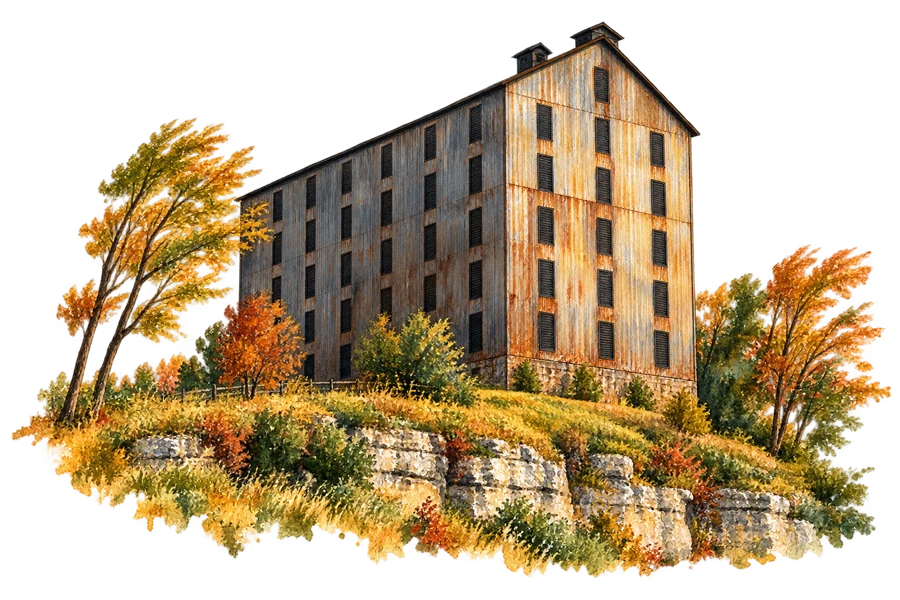
Symbolic illustration: Camp Nelson D takes the spotlight
October 2026

Camp Nelson D takes the spotlight

The fifth Single Rickhouse release arrives from Camp Nelson D at 120.8 proof. Built in 1946, the warehouse’s elevated, exposed setting gives the series another opportunity to explore how place shapes whiskey during maturation.[11]

Original watercolor interpretations accompany the history. Buildings, objects and scenes are symbolic, not documentary reconstructions.
03 / Geography & roles

One name. Several places that matter.

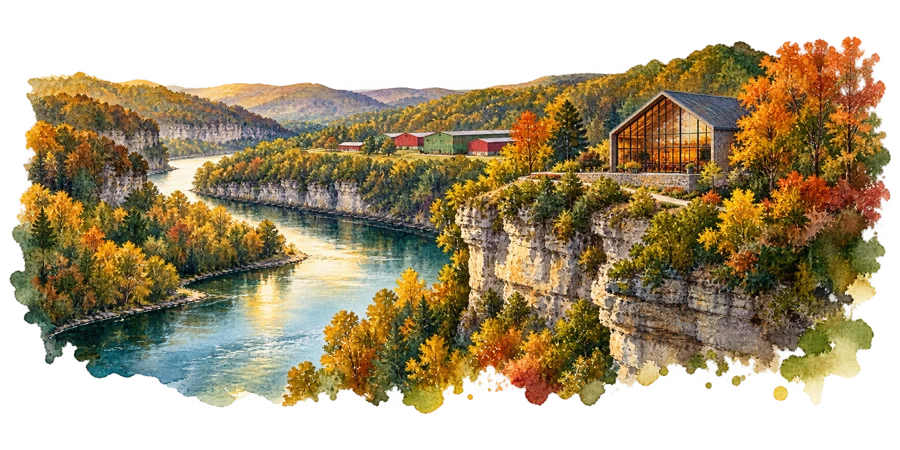
Symbolic Kentucky River, visitor pavilion and warehouse landscape

Wild Turkey Hill, Lawrenceburg

The main distillery sits above the Kentucky River in Lawrenceburg. This is the production home and the geographic anchor of the story, not simply a label address. River views, steep surrounding landscape and clustered working buildings connect the visitor’s experience to the place in which the whiskey is made.[9]

The historic warehouse campus

Warehouses A and B date to 1894 and 1902 in the state survey. Their stone foundations, wooden frames and metal exteriors connect today’s aging operation to earlier construction traditions. These buildings carry their own histories; they should not be confused with similarly lettered warehouses at another maturation site.[6]

The bottling and packaging operation

The 2013 facility brought bottling home after a seven-year absence, according to Campari’s announcement. It also served other company spirits, including SKYY. That distinction is useful: a packaging location may handle several brands without making their spirits part of the same distilling family or recipe.[17]

The Jimmy Russell Wild Turkey Experience

The public-facing destination occupies the Lawrenceburg campus at 1417 Versailles Road. Its 2024 renovation combines history, tastings and hospitality. It is the appropriate starting point for planning a visit; tour access, reservations and current offerings belong to the official booking service rather than assumptions drawn from old travel articles.[30][9]

Camp Nelson maturation campus

Camp Nelson is another aging setting within the producer’s story. The Single Rickhouse series differentiates individual buildings rather than treating the property as one uniform environment. Camp Nelson D’s western exposure and elevation, and the now-dismantled Camp Nelson C, illustrate why warehouse identity adds information beyond the distillery name.[11][35]

04 / The whiskey family

Understand the name on the label.

Selected ownership, brand and creative relationships. A shared family name does not make every release the same whiskey.

Symbolic white oak shoots and three whiskey glasses

Wild Turkey Distilling Co.

Kentucky producer

The Lawrenceburg operation supplies the central production identity behind Wild Turkey’s bourbon and rye. Understanding the distillery separately from its individual product names makes the broader range easier to navigate: a shared home can support several bottling strengths, age selections and release formats.[7]

Campari Group

Corporate owner

Campari has owned Wild Turkey and American Honey since the 2009 acquisition. Ownership describes the commercial organization and its investments. It does not replace the importance of the Kentucky production site or the Russell family’s work in explaining the whiskey’s identity.[5]

Austin Nichols

Historic merchant and brand lineage

The merchant’s name connects the whiskey to its commercial past and reappears in Austin Nichols Archives. In the new series, that name provides historical context for a collection inspired by admired vintage bottlings rather than identifying a separate modern distillery.[14]

The Ripy family

Predecessor distilling heritage

The Ripys belong to the foundational Kentucky chapter. State heritage research documents their ownership into the twentieth century and the older buildings that remain. Their role should be preserved without suggesting that every later owner or every modern brand existed in the original operation.[6]

Russell’s Reserve

Related whiskey brand

Russell’s Reserve carries the family name across small-batch bourbon, rye, single barrels and limited releases. It is a related brand from the Wild Turkey production family, with an editorial identity focused on selection and the Russells’ accumulated experience.[4]

American Honey

Honeyed liqueur lineage

American Honey evolved from Jimmy’s 1976 honeyed bourbon liqueur. It belongs in the family tree as a flavored branch, helping readers distinguish it from the straight bourbon and straight rye expressions rather than treating every bottle under the wider umbrella as the same category.[2]

Longbranch

Distinct charcoal-refined bourbon

The 2018 collaboration between Eddie Russell and Matthew McConaughey used oak and Texas mesquite charcoals. That process gives Longbranch a specific conceptual identity within the broader story. A different presentation does not, by itself, mean a separate distilling origin.[26]

Master’s Keep

Concluded limited-release series

Master’s Keep gave Eddie’s explorations a recurring home from 2015 through Beacon in 2025. Its expressions examined advanced age, rye and secondary maturation. The series is best understood as a sequence of distinct experiments, not a single liquid repeated in different packages.[19]

Appleton Estate

Collaborating Jamaican rum producer

Appleton enters this story through Voyage. Joy Spence selected rum casks that were brought to Kentucky for bourbon finishing. This is a collaboration between distinct spirits traditions, not evidence that Appleton produces the bourbon or that Wild Turkey makes Jamaican rum.[22]

05 / Making & choosing

The recipe is only the beginning.

Grain, fermentation, distillation, oak and selection each leave a mark. Age and proof claims below belong to the expressions named.

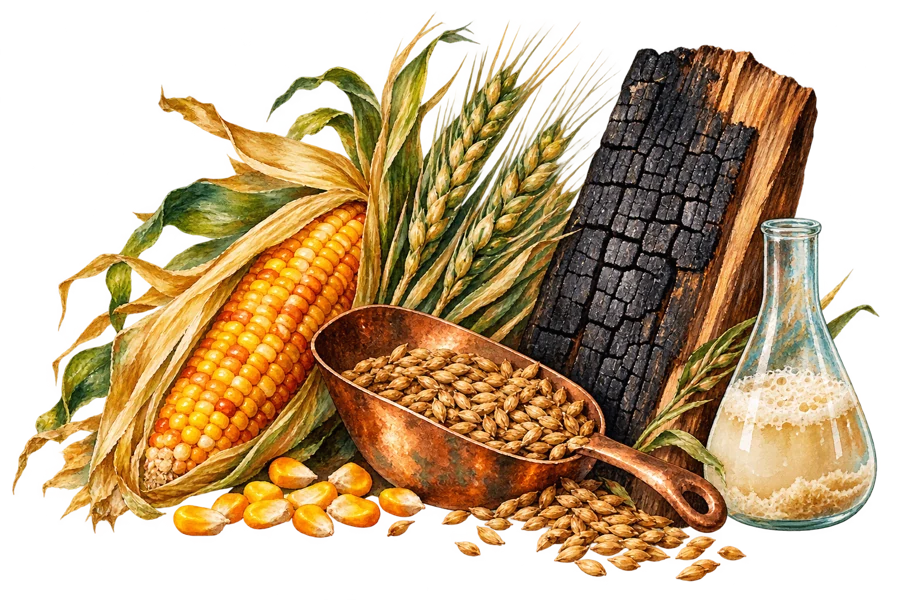
Corn, rye, malted barley and charred oak watercolor

Grain and yeast establish the foundation

Wild Turkey describes a grain program built around corn, rye and malted barley, together with a proprietary yeast strain. The ingredients establish an initial flavor framework, but they do not explain the finished whiskey alone. Subsequent distillation, years in wood and barrel selection all contribute to the eventual expression.[7]

Fermentation and two-stage distillation

Grain starches are converted into fermentable sugars; yeast then produces alcohol and flavor compounds. Wild Turkey’s process description identifies a column still followed by a doubler. This distinction matters because the finished whiskey is not simply cooked grain flavor: fermentation and distillation create and select the spirit that will enter wood.[8]

Entry proof and the barrel

The producer emphasizes a relatively low barrel-entry proof and new American white oak with No. 4 char. These are choices at the start of maturation, distinct from the proof printed on a finished bottle. A bottling number therefore should not be used as a shortcut for reconstructing every earlier stage of production.[7]

The warehouse is an ingredient in practice

Single Rickhouse treats the aging environment as an active influence. Floor, airflow and warehouse position can separate the character of barrels made with common foundations. The collection’s logic is comparative: it invites attention to differences within one producer instead of assuming a shared recipe guarantees an identical result.[12]

A blend can reveal individual preferences

Generations makes barrel selection unusually visible. Jimmy selected nine-year-old whiskey, Bruce chose twelve-year-old bourbon, and Eddie contributed an older preference, with a fourteen-year selection shared by Eddie and Bruce. The final combination shows how a house style can accommodate contrasting judgments rather than requiring every blender to choose the same barrels.[20]

Finishing adds another conversation with wood

Voyage begins with ten-year-old bourbon, then introduces a second maturation in casks that previously held fourteen-year-old Jamaican pot-still rum. The finishing stage belongs to that expression’s design. It should not be generalized across all Wild Turkey bourbon, whose identities often rely on selection without an additional finishing cask.[22]

06 / The details worth knowing

The stories behind the familiar name.

The familiar bottle is part of the achievement

Wild Turkey 101 is useful as the center of the story because it connects the producer’s history with an accessible, recurring expression. Its 101 proof and oak-and-spice profile provide a reference point when considering the wider range. The editorial lesson is simple: limited editions become more informative when the reader first understands the continuing whiskey they branch away from.[27]

The person behind the anniversary

The seventy-year celebration highlights Jimmy’s resistance to abandoning the whiskey he believed in during bourbon’s difficult decades. It also gives the story a human scale: an eighteen-year-old employee becomes a source of institutional memory. The anniversary is not merely an impressive number; it explains why continuity of judgment is such a strong part of the brand’s public identity.[10]

Rye has its own family champions

The Cornerstone announcement credits Bruce’s enthusiasm for rye and his experience with bartenders as an influence on Eddie’s renewed exploration. This broadens the generational narrative beyond bourbon. Knowledge also moves upward: a younger family member can draw attention to an overlooked part of the house’s capabilities and encourage a more ambitious expression of it.[25]

A disappeared building can leave a flavor record

The inaugural Single Rickhouse bottling drew on seventy-two barrels from Camp Nelson C after the warehouse had been dismantled. That makes the release more than a study of location. It is a reminder that whiskey spends years in places that may change or disappear before the bottle reaches a drinker, preserving a connection to a vanished working environment.[35]

07 / Selected expressions

Different ways to meet the same distillery.

A curated reading of the whiskey family, selected for its role in the story. This is not an exhaustive current catalog.

Wild Turkey 101: the reference point

The flagship pairs 101 proof with the producer’s familiar balance of caramel, vanilla, oak and spice. The official product page describes a six- to eight-year maturation range. Those descriptors are a producer’s guide, not a substitute for a personal tasting, and the bottle should not be conflated with separately labeled eight-year releases.[27]

Rare Breed: a barrel-proof perspective

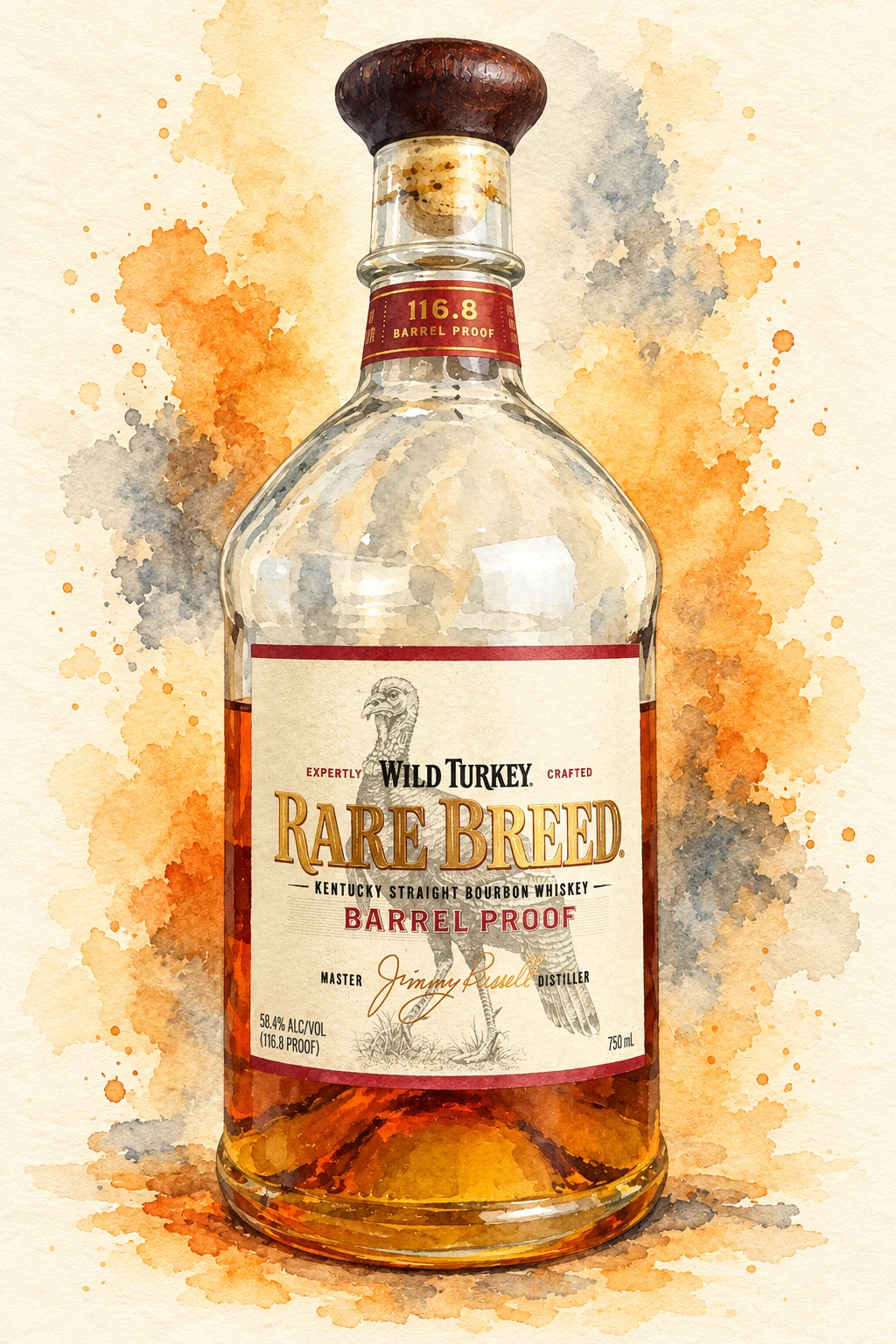
The current listed bourbon combines six-, eight- and twelve-year-old whiskey at 116.8 proof. Its significance is the barrel-proof presentation and combination of maturities, rather than simply being a stronger version of another bottle. Historical Rare Breed releases can carry different proofs, making the exact label an essential part of identification.[28]

Rare Breed Rye: a parallel, distinct expression

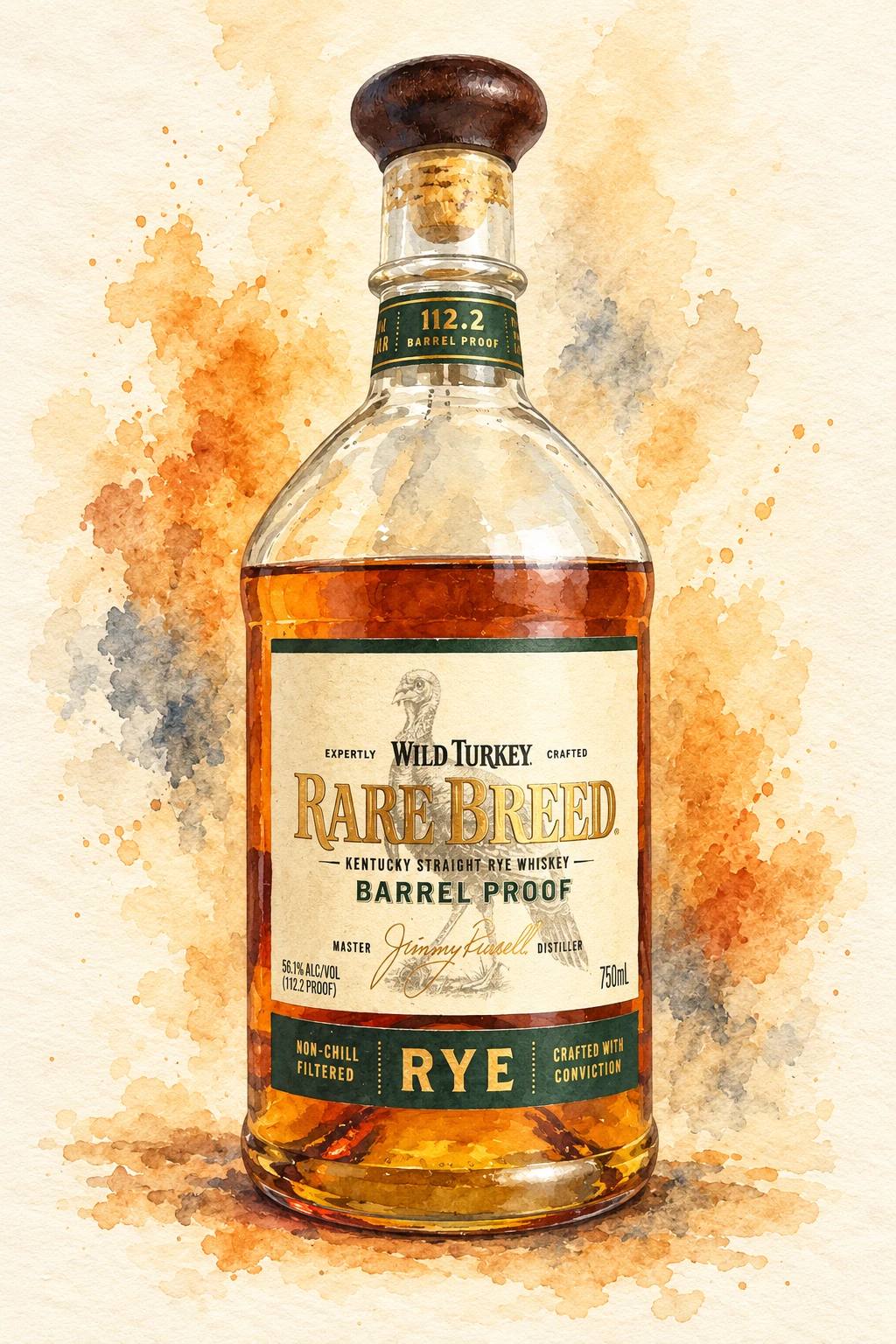
The 2020 launch brought a four-, six- and eight-year-old rye blend to the barrel-proof range at 112.2 proof, without chill filtration. Bourbon and rye here share a product-family name but remain different whiskeys. Comparing them is an opportunity to explore grain identity as well as strength and maturity.[24]

Russell’s Reserve 13 Year: maturity with release identity

The thirteen-year expression places an explicit age statement within Russell’s Reserve’s limited offerings. Its recurring releases require attention to the specific bottling, not just the large number on the front. The spring 2026 edition also became part of the celebration of Eddie’s forty-five-year career, linking an established whiskey with a personal milestone.[29][15]

Beacon: a finale with another generation present

Beacon blends ten- and sixteen-year-old bourbons and closes Master’s Keep at the series’ highest proof. The joint recognition of Eddie and Bruce gives that final release a forward-looking dimension. It ends a named collection while making clear that the family’s selection work and creative development continue.[18]

Gold Foil and Camp Nelson D: the 2026 horizon

Gold Foil opens Bruce’s Archives series with sixteen-year-old, 120-proof bourbon inspired by a vintage favorite. Camp Nelson D takes a different approach: its 120.8-proof release studies an elevated warehouse environment. One looks toward remembered bottlings, the other toward a precise aging place, demonstrating two distinct ways to deepen the same producer’s story.[14][11]

08 / The Reserve connection

Continue from the story to the bottles.

Wild Turkey in The Thelen Reserve

12 physical bottle records connect this story to the collection. Each keeps its own proof, barrel, batch, pick and release details.

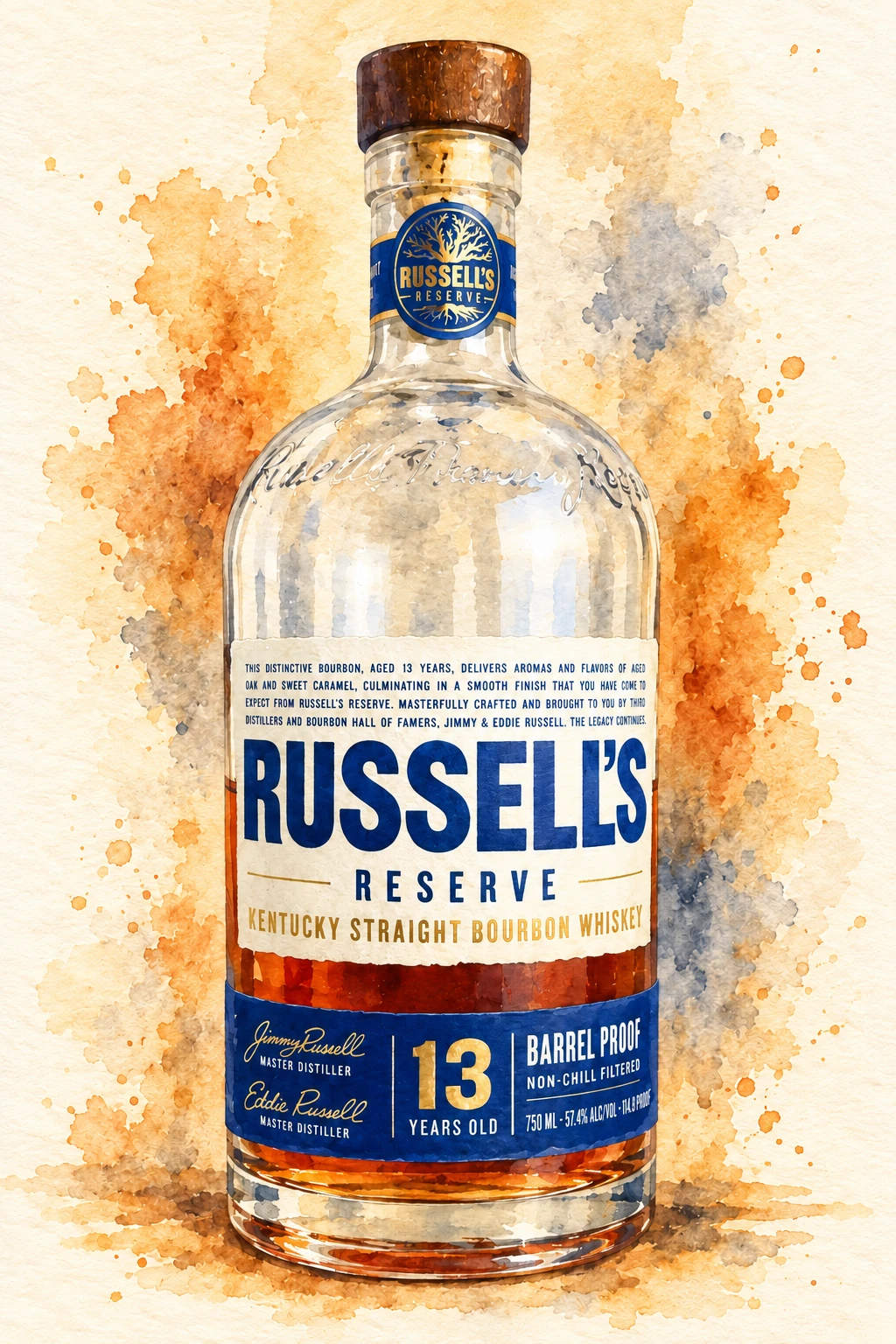
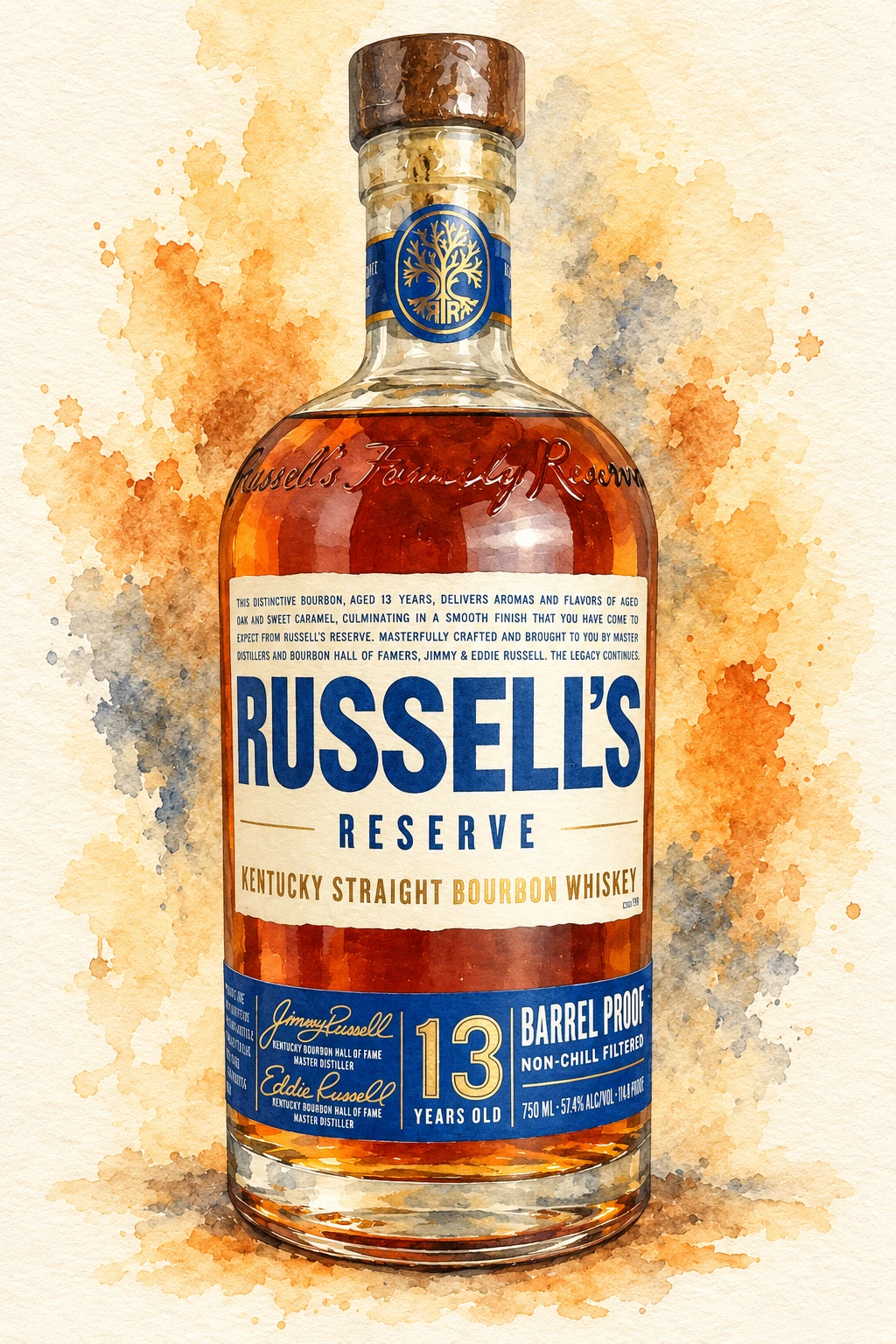
Approved watercolor of Russells Reserve Barrel Proof 13 Year

Russells Reserve Barrel Proof 13 Year

W0406 · 114.8 proof

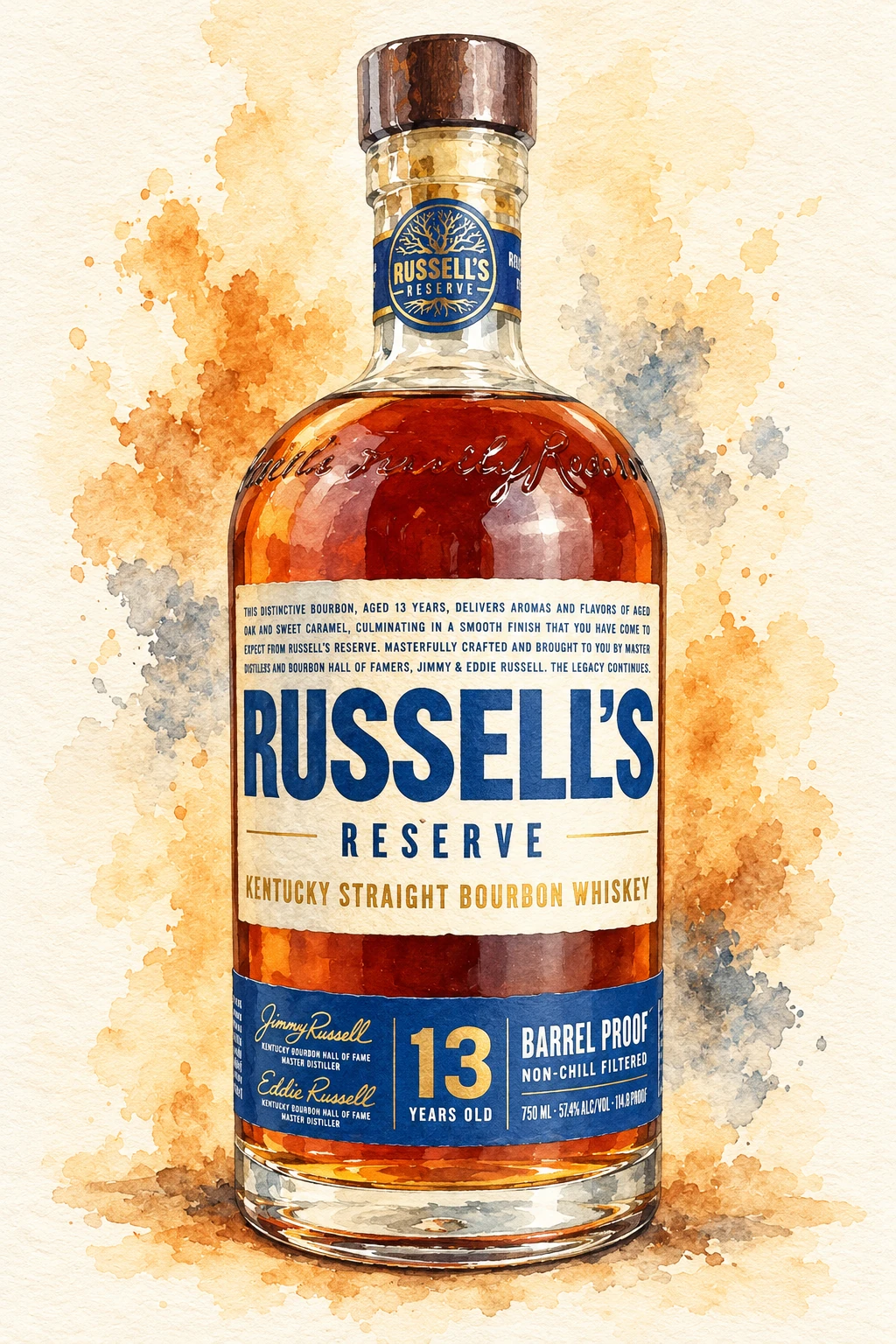
Approved watercolor of Russells Reserve Barrel Proof 13 Year

Russells Reserve Barrel Proof 13 Year

W0407 · 114.8 proof

Approved watercolor of Russells Reserve Barrel Proof 13 Year

Russells Reserve Barrel Proof 13 Year

W0408 · 114.8 proof

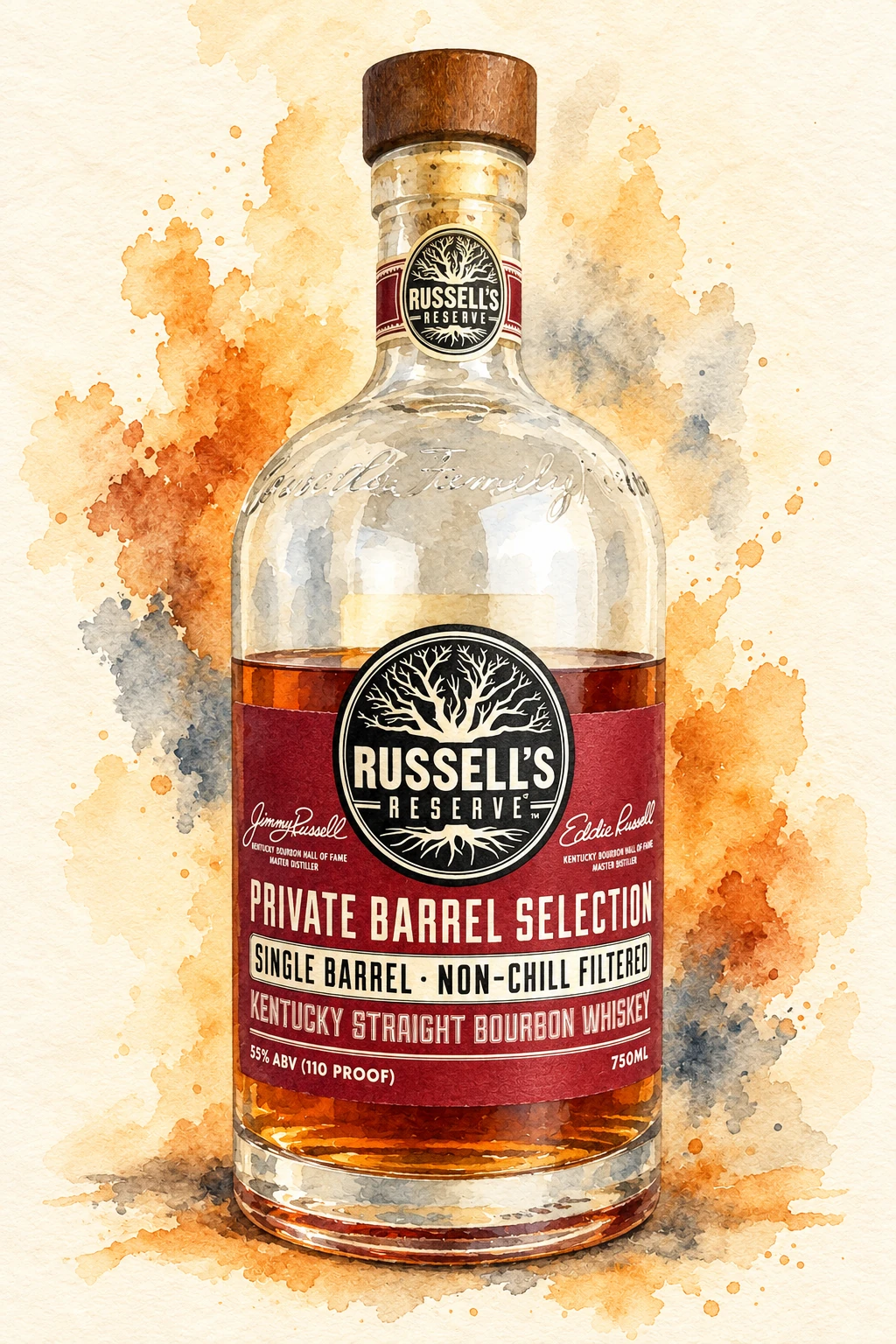
Approved watercolor of Russells Reserve Single Barrel Private Barrel Select

Russells Reserve Single Barrel Private Barrel Select

W0409 · 110 proof · Barrel 19-1718 · Pick Total Wine AZ · Bottled / release detail Bottled 02/05/2020 from physical label; corrected previous 02/15/2020. Dumped 12/18/2019; warehouse F, floor 6. Barrel 19-1718, selected Total Wine & More. Distillation-to-dump interval is not a separately printed age statement. · Barreled detail Label says DISTILLED 11/18/2009, not barreled. Existing H=11/18/2009 retained as legacy distillation date; do not treat as independently verified barrel-entry date. · Bottled / release 2/5/2020 · Barreled 11/18/2009

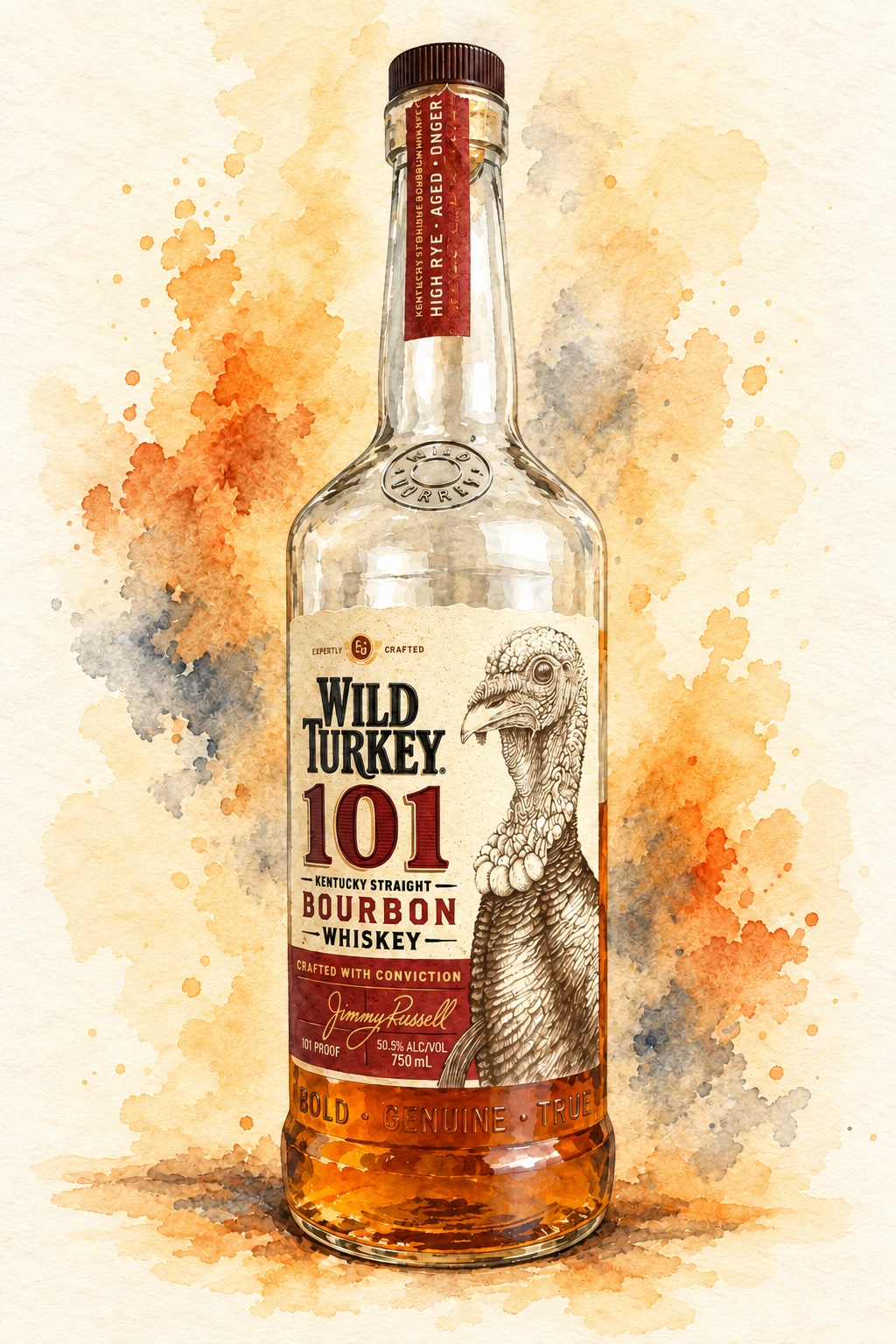
Approved watercolor of Wild Turkey 101

Wild Turkey 101

W0481 · 101 proof

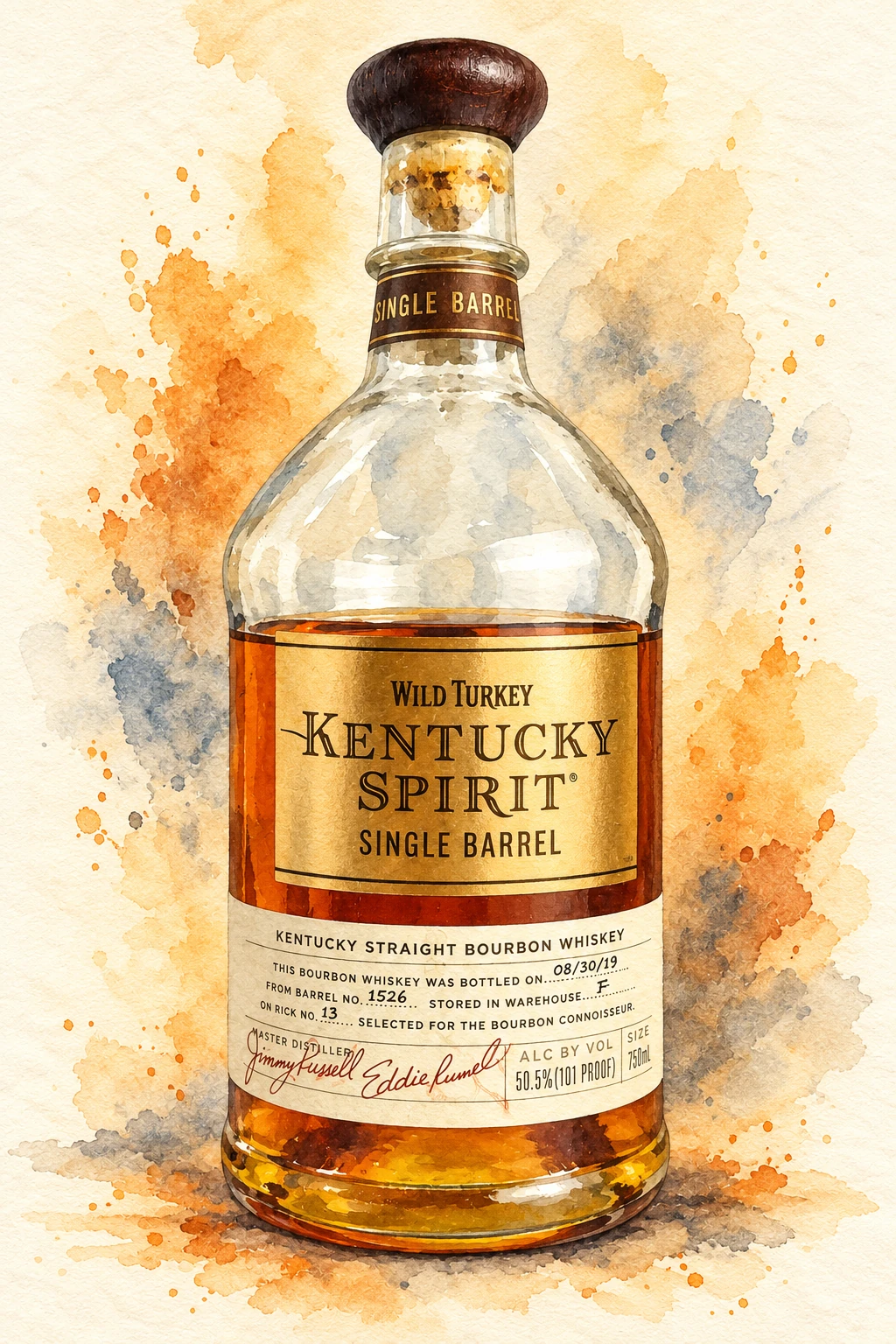
Approved watercolor of Wild Turkey Kentucky Spirit Single Barrel

Wild Turkey Kentucky Spirit Single Barrel

W0482 · 101 proof · Barrel 1526 · Bottled / release detail Bottled August 30, 2019; barrel1526; warehouse F; rick13. Label-confirmed. No numerical age or barrelled date stated. · Bottled / release 8/30/2019

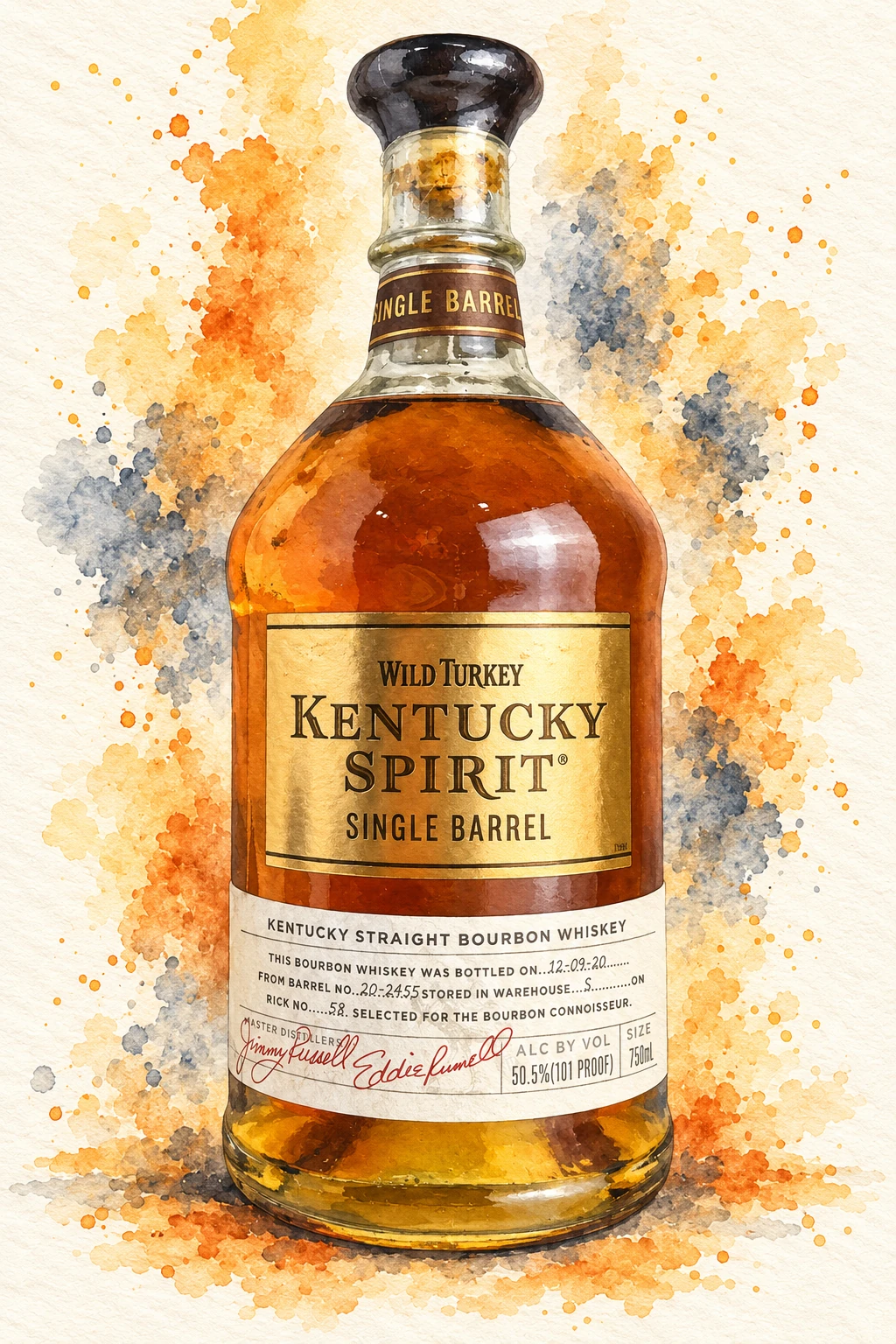
Approved watercolor of Wild Turkey Kentucky Spirit Single Barrel

Wild Turkey Kentucky Spirit Single Barrel

W0483 · 101 proof · Barrel 20-2455 · Bottled / release 12/9/2020

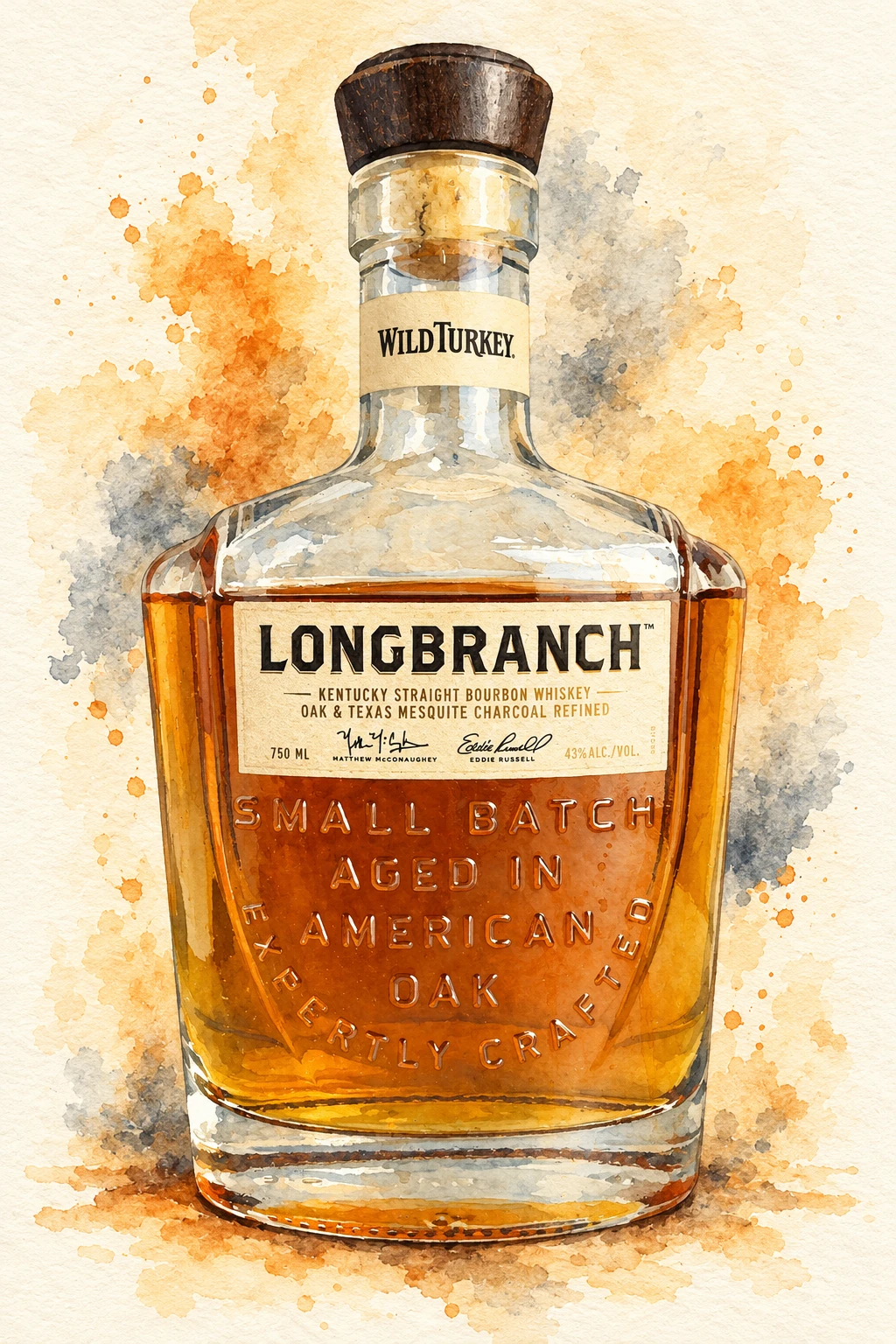
Approved watercolor of Wild Turkey Longbranch

Wild Turkey Longbranch

W0484 · 86 proof

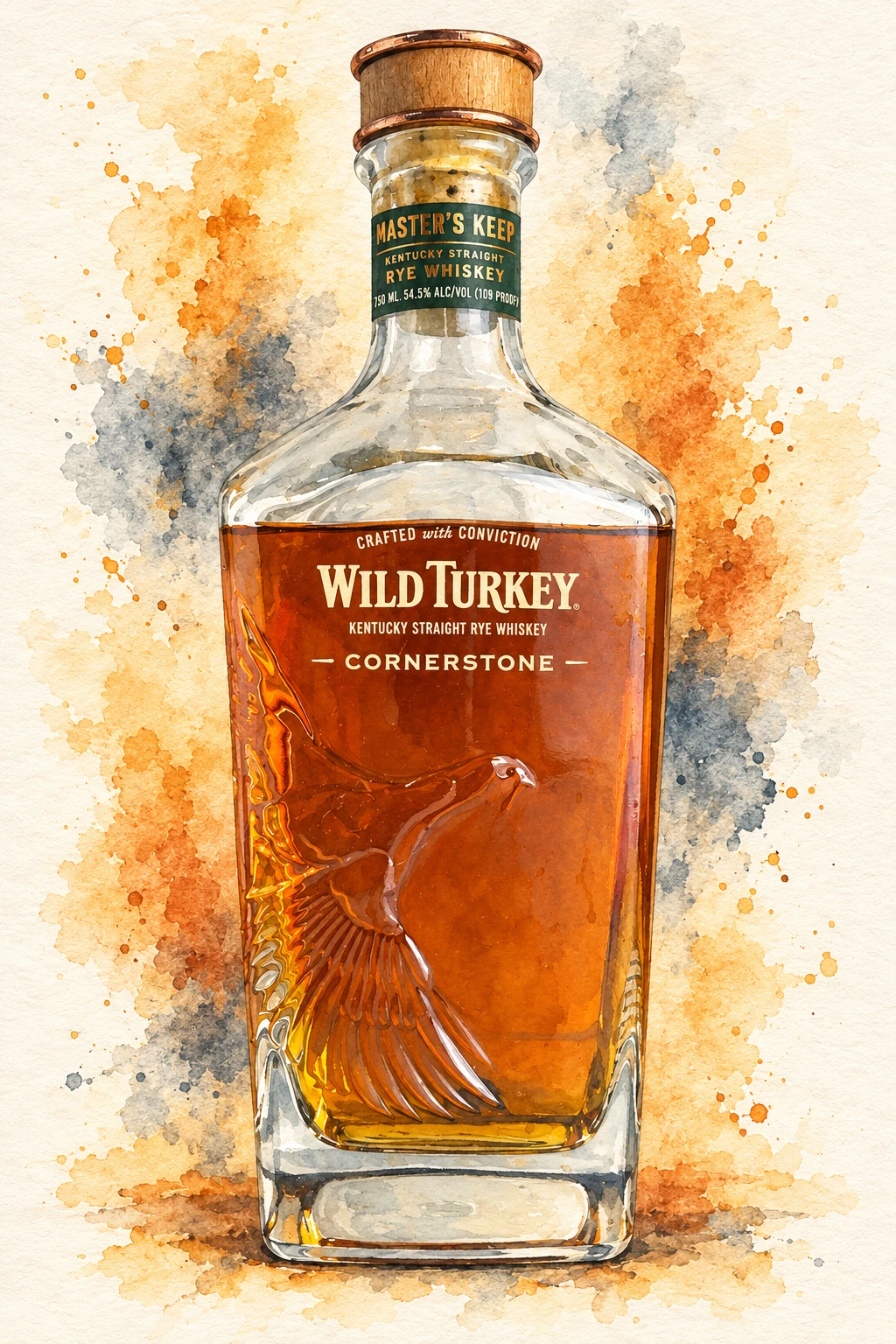
Approved watercolor of Wild Turkey Master's Keep Cornerstone Rye

Wild Turkey Master's Keep Cornerstone Rye

W0485 · 109 proof · Batch 17119

Approved watercolor of Wild Turkey Rare Breed

Wild Turkey Rare Breed

W0486 · 116.8 proof

Approved watercolor of Wild Turkey Rare Breed Rye

Wild Turkey Rare Breed Rye

W0487 · 112.2 proof

Approved watercolor of Wild Turkey Rare Breed Rye

Wild Turkey Rare Breed Rye

W0488 · 112.2 proof

Collection checked November 10, 2026. Approved watercolor artwork appears where an exact record or verified release match is available. Separate physical bottles and release distinctions are preserved.

Wild Turkey three-page guide cover
The illustrated companion

Wild Turkey, in three pages.

Origins and people, history and places, whiskey and stories. The approved illustrated companion includes linked research sources.

Sources & research notes

Researched October 13, 2026. Primary producer announcements and institutional records are used wherever available. Product specifications are release- and market-specific.

Research qualifications

  • Research current through October 13, 2026. Dates refer to announcements or releases as specified; regional availability may differ.
  • Official heritage lists Rare Breed in 1991 and Kentucky Spirit in 1995. Alternate dates appear elsewhere; this profile follows the current brand chronology.
  • Russell’s Reserve dates creation to 1998 and debut to 2001, but its reference to Jimmy’s forty-fifth anniversary does not reconcile with his 1954 start. The narrative therefore uses late 1990s for conception.
  • Pernod Ricard’s 2025 history dates its Austin Nichols acquisition to 1979, while many secondary histories use 1980. No definitive acquisition-year claim is made here.
  • The frequently cited 1971 distillery purchase was not given a standalone timeline milestone because primary confirmation was insufficient in this research pass.
  • Post-Prohibition reopening dates vary. The profile describes revival without selecting an unsupported exact year.
  • Historical production continuity is cultural and technical, not a claim that all equipment, barrel-entry proofs, ownership or individual releases have remained unchanged.

Full sources

  1. Wild Turkey history and heritage1855, 1869, 1893; official release chronology Note: Current brand chronology uses 1991 and 1995; alternate dates circulate.
  2. Jimmy Russell biographyMentors, innovations and flagship stewardship Note: Some tenure wording is stale; no precise master-distiller appointment year adopted.
  3. Eddie Russell biographyJune 5, 1981 start and career Note: Published biography, not a current staffing directory.
  4. Russell’s Reserve historyCreation versus debut, bourbon and rye development Note: 1998 creation and 45th anniversary wording conflict arithmetically.
  5. Campari acquisitions and disposalsMay 29, 2009 closing Note: Closing date differs from announcement date.
  6. Kentucky Heritage Council architectural surveyHistoric warehouses and campus evolution Note: Survey conducted 2022; not an inventory of all current structures.
  7. Wild Turkey craftIngredients, yeast, barrels and maturation Note: Fermentation wording simplified incorrectly in original; corrected scientifically here.
  8. Wild Turkey Kentucky bourbon guideColumn still and doubler; fermentation Note: Used for production description, not a legal reference.
  9. Wild Turkey visitor informationLocation, river setting and visitor experience Note: Bookings and hours may change; consult official booking page.
  10. Jimmy Russell’s seventy yearsSeptember 10, 1954 start; 2024 anniversary Note: Historical anniversary article, not current age/tenure count.
  11. 2026 Camp Nelson D announcementOctober 6, 2026 release; warehouse and selection Note: Brand-issued press release.
  12. Russell’s Reserve Single Rickhouse2022–2026 editions and warehouse distinction Note: Live product page was read directly; search snippets may be stale.
  13. Austin Nichols Archives Gold FoilBruce-led series and vintage inspiration Note: Retrospective inspiration does not establish identical historical recipes or flavor.
  14. Gold Foil launch announcementMay 2026 series launch Note: Brand-issued announcement.
  15. Eddie Russell’s forty-five-year anniversaryJune 2026 anniversary and documentary Note: Specific spring release; proofs vary by release.
  16. 2011 distillery expansionJune 21, 2011 facility announcement Note: Historical capacity, not a current production estimate.
  17. 2013 bottling facilitySeptember 10, 2013 bottling return Note: Facility serves multiple Campari spirits.
  18. Master’s Keep BeaconFinal release, age blend and family credit Note: Series conclusion does not mean production of other whiskey stopped.
  19. Beacon 2025 announcement2025 conclusion and 2015 series start Note: Release chronology may vary by market.
  20. Wild Turkey GenerationsThree family palates, component ages and 120.8 proof Note: Individual tasting descriptions are producer descriptions.
  21. Generations announcementOctober 2023 collaboration Note: Brand-issued release.
  22. Master’s Keep VoyageAppleton collaboration and rum-cask finishing Note: Product-specific finishing, not a house-wide practice.
  23. Voyage announcement2023 release and collaboration Note: June announcement refers to July availability.
  24. Rare Breed Rye introduction2020 rye expansion and four/six/eight-year blend Note: Historical launch specification.
  25. Master’s Keep Cornerstone Rye2019 rye release and Bruce’s influence Note: Oldest-rye language was true of that release date, not today.
  26. Campari June 2018 investor presentation2018 Longbranch launch and charcoal process Note: Month differs from April introduction in annual report; use year only.
  27. Wild Turkey 101Flagship proof, maturation and character Note: Producer tasting descriptions; not a personal tasting.
  28. Rare Breed specifications116.8 proof and six/eight/twelve-year blend Note: Applies to current listed bourbon, not every historical release.
  29. Russell’s Reserve 13 YearAge-stated limited release Note: Batch proof and availability vary.
  30. 2024 visitor experience openingRenovation, hospitality and planned expansion Note: Planned expansion is not treated as confirmed operational capacity.
  31. Pernod Ricard 2025 anniversary historyPernod ownership history Note: Says 1979, while secondary histories often say 1980.
  32. Campari 2019 brand backgroundThomas McCarthy hunting story Note: Origin narrative attributed to producer.
  33. Lawrenceburg distilling historyLocal Ripy history and post-Prohibition revival Note: Reopening dates differ among accounts; avoid a definitive date.
  34. Master’s Keep Unforgotten announcement2015 series origin and experimentation Note: Brand-issued release.
  35. Single Rickhouse inaugural announcement2022 Camp Nelson C, 72 barrels Note: Historic warehouse dismantled before release.
↑