Mare Island, California / Selection, distillation & wine-cask finishing
A winemaker’s eye, a working island, and whiskey shaped by the barrel.
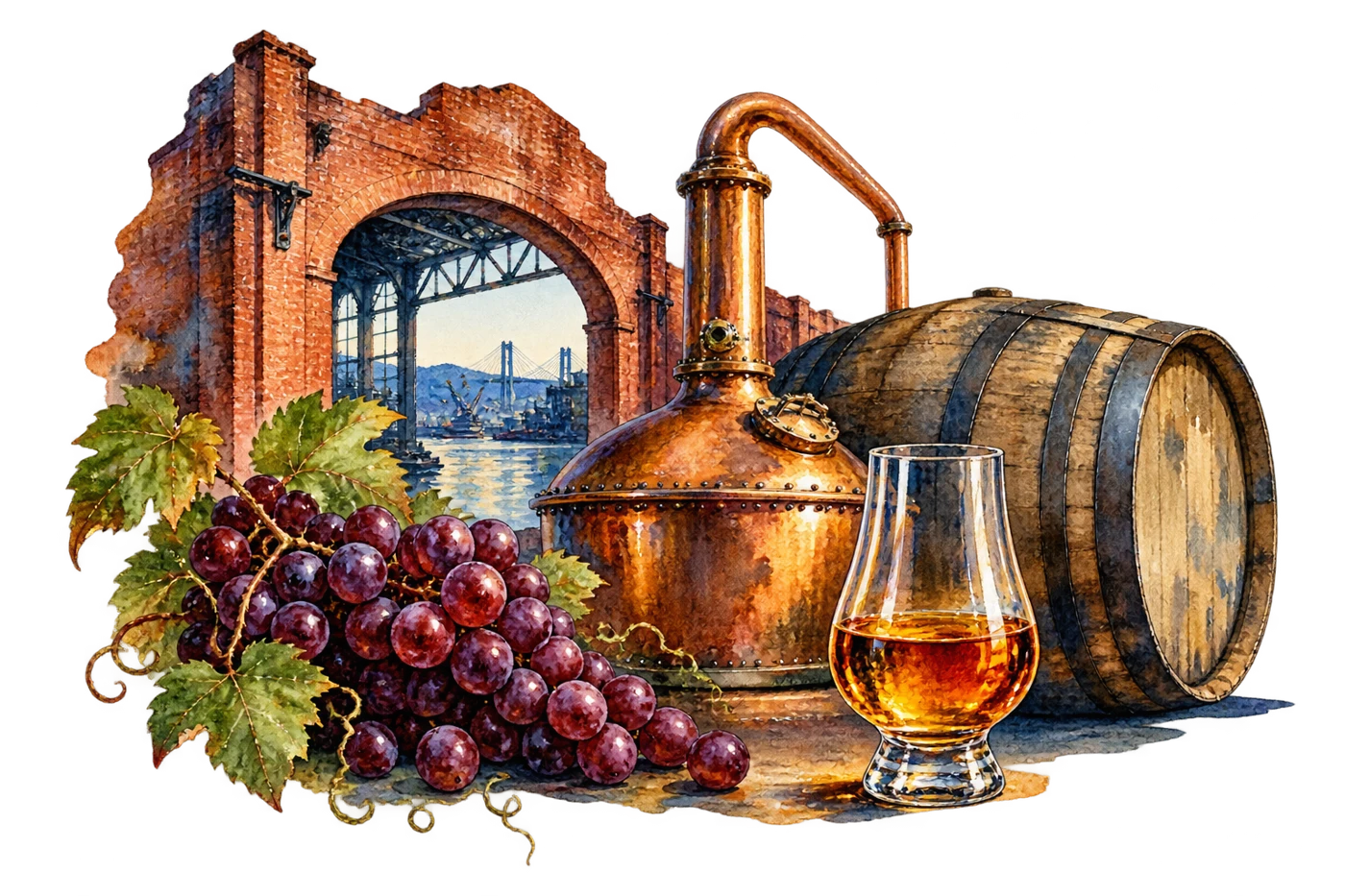
On Mare Island, old industrial brickwork gave Dave Phinney’s whiskey project a setting as distinctive as its wine-cask finishes. Savage & Cooke began with selection and maturation, then added whiskeys distilled from local grain. Its next chapter belongs to Redwood Empire and Purple Brands, whose acquisition changed the site’s ownership and visitor identity. Following the people, liquid and buildings separately reveals a richer California story.[2][10][16]
Phinney’s wine background supplied an instinct for selecting lots and building texture through oak. Savage & Cooke’s early technical sheets describe mature whiskey bought from other states and finished in barrels from his wine projects. The creative act was the choice and combination of those elements, even before local distillate was ready.[3][19]
An island with room for another industry
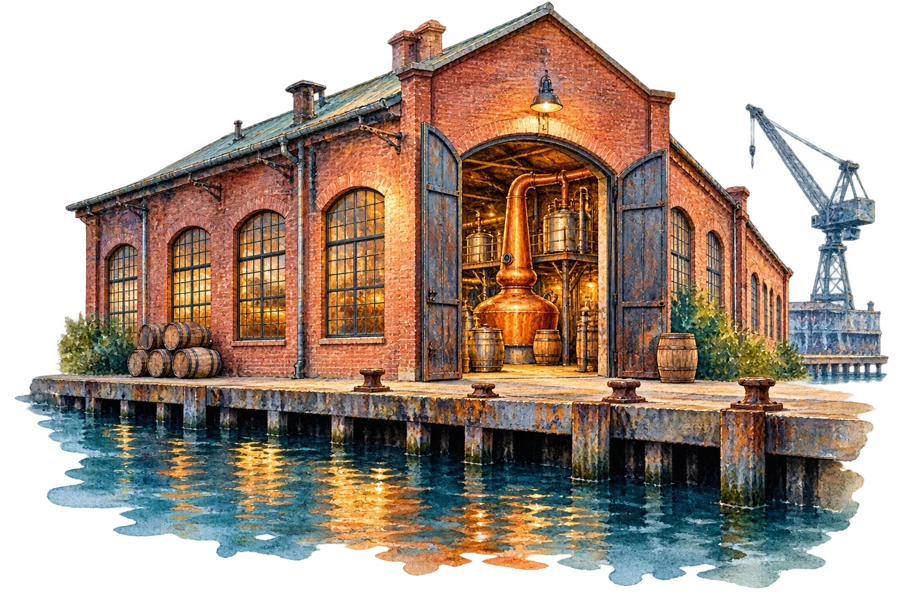
The former naval setting offered character, space and proximity to Napa and San Francisco. The company dates the distillery’s opening to 2018, separate from its 2016 venture start. Brick buildings and a waterfront location became part of the experience, while maturation and production gave them a new working purpose.[1][2]
Dave Phinney
Founder and the original creative bridge between wine and spirits. The company biography traces his beverage interests to time in Florence and later winemaking. His wine barrels helped define the whiskey’s finishing vocabulary. That founding role remains part of the story after the distillery sale.[1]
Jordan Via
The master distiller associated with the house-distilled releases and earlier blending work. The 2021 DIGITS announcement specifically credits his blending, while the 2023 core-trio report distinguishes local bourbon and rye from sourced American whiskey. These are historical project credits rather than a promise about every current staff role.[14][16]
Lauren Blanchard
A general-management and commercial figure in the original operation. The 2020 company release identifies her during the sanitizer pivot, and the historical team page describes her work across the wine and spirits business. Those records show the operational team behind a founder-led brand.[1][13]
02 / The illustrated history
From a new venture to a new steward.
Follow the people, partnerships and documented releases. Dates of reporting and partner offerings remain distinct from founding and release dates.
2016
The venture takes shape
The company biography dates Phinney’s Savage & Cooke venture to 2016. It is the beginning of the project, distinct from the later public opening and the maturity of its own whiskey.[1]
2018
Mare Island opens its doors
The official distillery history gives 2018 as the opening year. The former shipyard’s brick architecture and waterfront become the setting for a new spirits operation and visitor experience.[2]
March / May 2020
The plant changes course
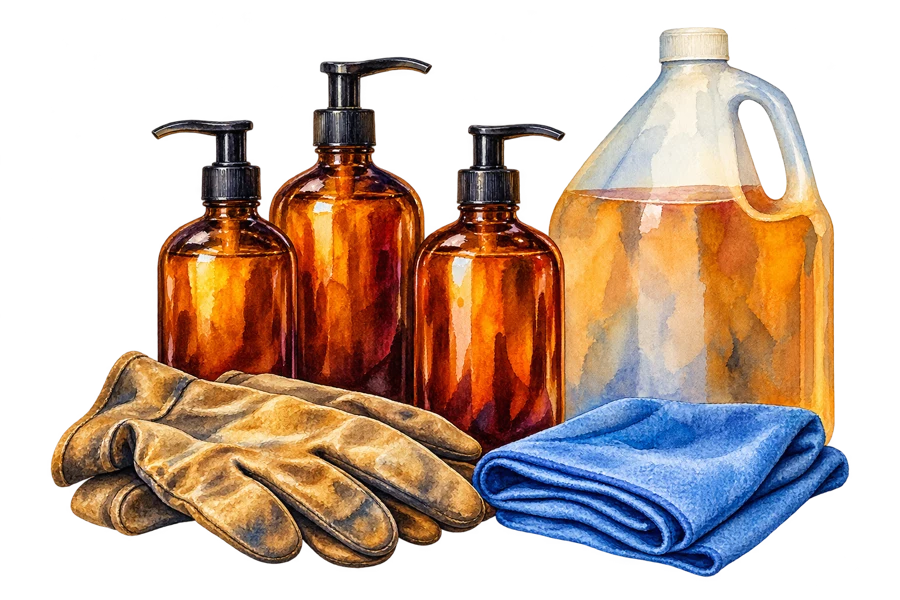
A May company release says the distillery redirected operations in early March to RX 20/20 hand sanitizer. It also describes hiring furloughed hospitality workers. This was a temporary community-response chapter during the pandemic.[13]
June 2021
A basketball collaboration reaches Chicago
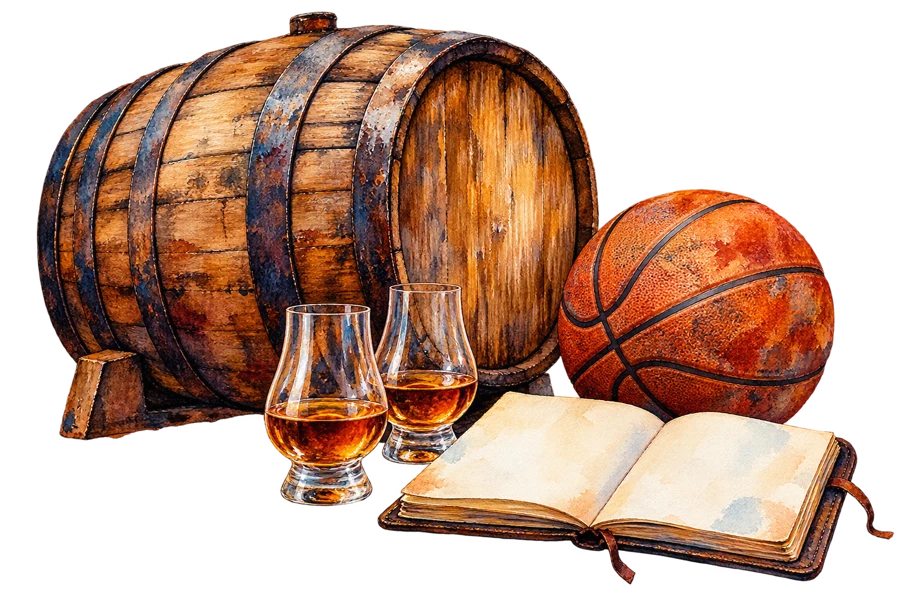
The June 15 announcement introduces DIGITS with Scottie Pippen and Dave Phinney, crediting Jordan Via’s blending. It names June 24 as the Chicago launch. Collaboration, branding and whiskey selection come together without proving every component’s distillation site.[14]
2023
House distillate steps forward
A contemporary December report describes a new core trio: Mare Island-distilled bourbon and rye, plus sourced American whiskey matured there. This is a meaningful change in the liquid behind the label, rather than simply a new bottle design.[16]
Spring 2024
Heirloom corn gets two distinct voices
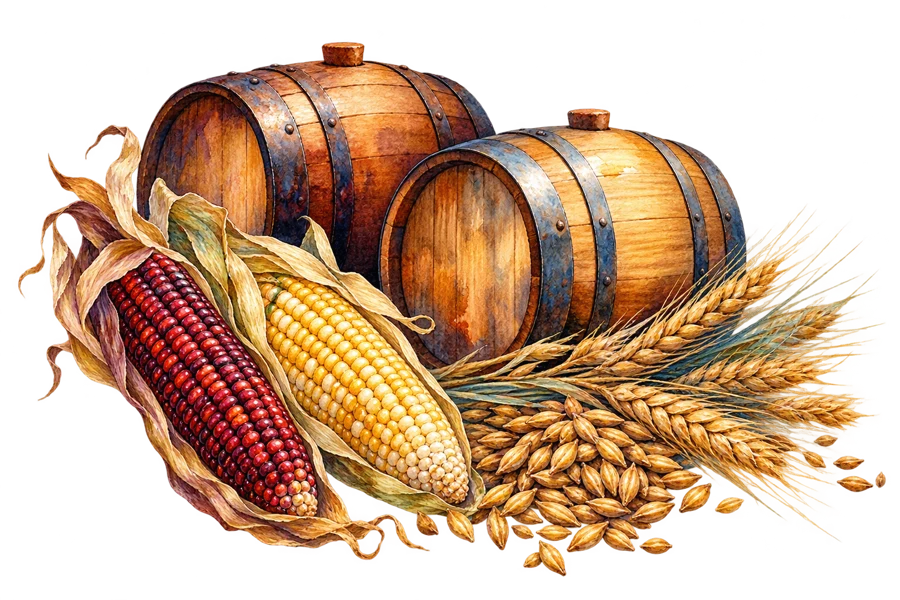
The spring bottled-in-bond releases pair Bloody Butcher with Howling Mob. Official descriptions specify different recipes, four years of age and 100 proof. The grain varieties make the agricultural side of the distillery visible.[7][8][17]
December 20, 2024
Purple Brands announces the acquisition
The buyer’s dated announcement includes the distillery, all spirits brand assets and hospitality spaces. It also discloses prior supplementary production for Redwood Empire. The transaction joins businesses with an existing working relationship.[10]
2025
Redwood Empire makes Mare Island home
Redwood Empire’s own history confirms the move of operations in 2025. Its current visitor pages present Mare Island as the Redwood Empire destination. The Savage & Cooke chapter remains part of the buildings’ whiskey history.[11][12]
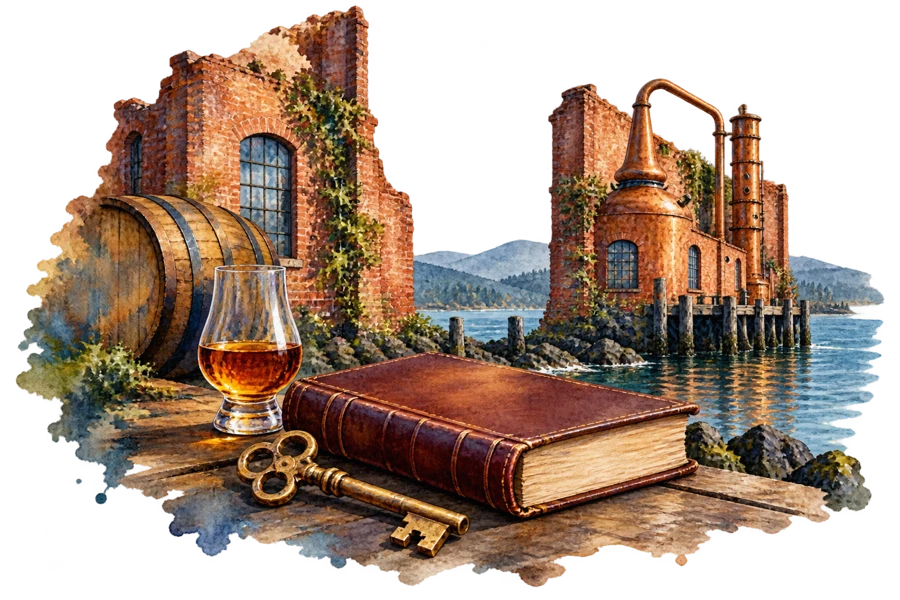
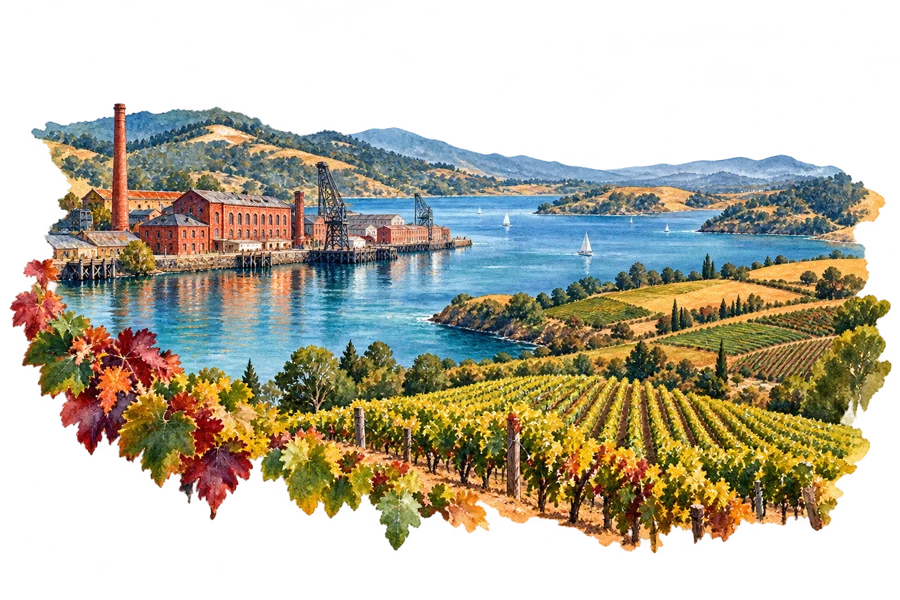
Original watercolor interpretations accompany the history. Buildings, objects and scenes are symbolic, not documentary reconstructions.
03 / Geography & roles
One name. Several places that matter.
Mare Island / production and maturation
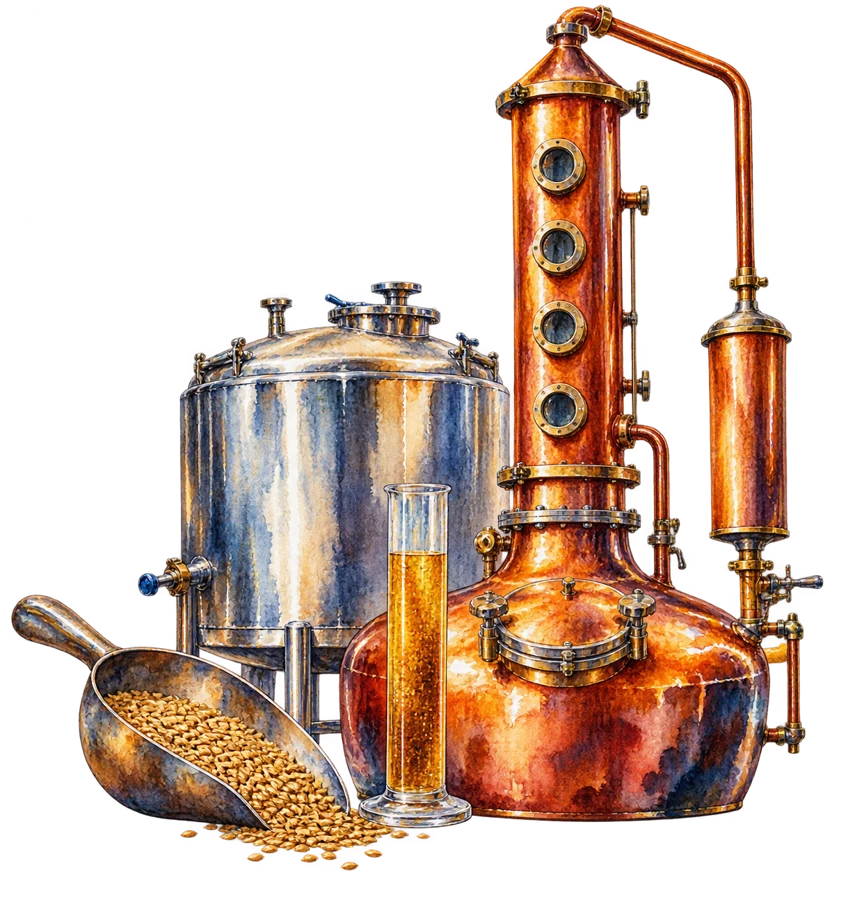
The Vallejo waterfront site held distillation, barrel storage and hospitality. The acquisition release describes two historic brick buildings and a Vendome pot-column hybrid. A physical facility can continue working even when its public brand changes.[10]
Winters / the heirloom grain fields
The limited bourbon descriptions identify a selected field in Winters, roughly 35 miles from the distillery. Growing conditions, yields and grain character are part of these particular releases’ story. The claim should not be generalized to every sourced whiskey.[7][8]
Alexander Valley / proofing water
The Burning Chair and Second Glance sheets describe spring water from Phinney’s high-elevation property. This is a proofing-water role. It does not mean the whiskey was originally distilled there or that every grain came from that property.[3][19]
Napa and Sta. Rita Hills / the wine-cask connection
Napa Cabernet and Zinfandel barrels appear in the early range. Guero 15 Year uses OLG Pinot Noir barrels from the Sta. Rita Hills. The vineyard and the distillery contribute different stages to the finished whiskey.[3][9][19]
04 / The whiskey family
Understand the name on the label.
Trace the producer, its expression families and the distinct roles of collaborators and historical personnel.
Savage & Cooke
Producer / historical distillery identity
The producer identity founded by Phinney, with a Mare Island facility and a changing mixture of sourced and house-distilled spirits. The brand name alone cannot determine where a particular whiskey began.[1][16]
Purple Brands / Redwood Empire
Acquirer / continuing site operator
The December 2024 buyer announcement says the acquisition covers the distillery and all spirits brand assets. Redwood Empire’s 2025 move and present visitor identity are the continuing facility chapter.[10][11]
The Burning Chair and Second Glance
Earlier expression family
Early named whiskeys whose official sheets describe different sourced liquids, ages and finishing casks. Their identities should not be silently replaced with the later house bourbon or American Whiskey recipes.[3][19]
House Bourbon and Rye
House-distilled core releases
The later core products have distinct local-grain recipes and wine-finishing choices. Their shared 100 proof presentation does not make them one recipe or an exact continuation of every earlier named bottle.[4][5]
Bloody Butcher and Howling Mob
Heirloom / bottled-in-bond releases
Limited bourbons built around different heirloom corn varieties. They belong to the agricultural and distillation story, with separate mash bills and published barrel totals.[7][8]
DIGITS / Scottie Pippen
Collaborative whiskey project
A collaboration announced in 2021 with Phinney and Via. It extends the distillery’s blending work into another brand identity; the collaboration is not evidence that every older barrel was distilled on Mare Island.[14]
Guero
Mature whiskey / finishing series
A limited-release family that includes mature sourced whiskey. The 15 Year description explicitly identifies Tennessee distillation and a California wine-cask finish, making the distinction between source and finishing unusually clear.[9]
Home School
Historical ready-to-drink line
The 2021 company announcement introduces bottled craft cocktails as a separate format. This belongs to the broader historical portfolio rather than the whiskey production recipe or an exhaustive current product list.[20]
05 / Making & choosing
The choices behind the label.
Recipes, fermentation, oak and mingling shape the whiskey. Keep every specification tied to the expression and edition named.
Selection was an early production skill
The Burning Chair sheet describes small lots sourced from Kentucky, Indiana and Tennessee, with a minimum age of four years before Cabernet-barrel finishing. Selection and finishing explain that expression. They should not be replaced retrospectively by a local-grain distillation story.[3]
A local-grain bourbon route
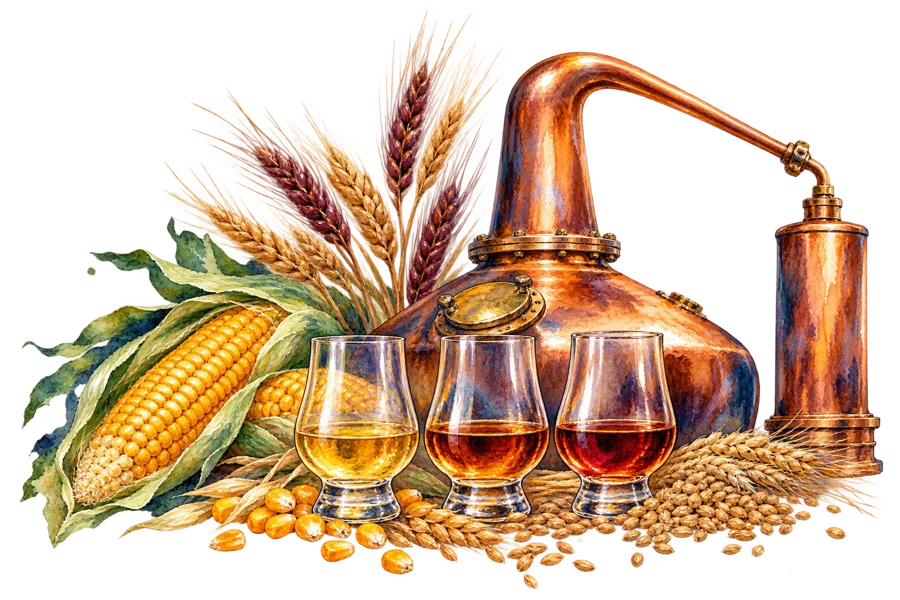
The house Bourbon page describes milling and mashing on site, fermentation and a 20-plate,24-inch Vendome column. Its listed recipe is 75%corn,21%rye and 4%maltedbarley. The page describes at least three years in char#3 new oak, with a portion later finished in Cabernet casks.[4]
Rye takes another wine direction
The house Rye lists 51%rye,45%corn and 4%maltedbarley. A portion receives about two months in Grenache barrels after its initial maturation. Both the grain balance and finishing cask differ from the house bourbon.[5]
The sourced route continues alongside it
The American Whiskey page describes barrels bought young, matured on site and partly finished in Zinfandel casks. Its 66/30/4 recipe differs from the earlier Second Glance sheet’s 95%corn and 5%maltedbarley. Shared finishing language is not proof of an unchanged release.[6][19]
Corn variety can lead the recipe
Bloody Butcher lists 70%of its namesake corn,16%RedWinterWheat and 14%maltedbarley. Howling Mob lists 86%corn and 14%maltedbarley. The producer describes low yield as a particular challenge for Howling Mob, connecting farming choices to what could be bottled.[7][8]
A finished whiskey carries more than one place
Guero 15 Year is described as Tennessee-distilled whiskey, aged in California and finished in OLG Pinot Noir barrels. The stated 117 proof and 99%corn recipe belong to that release. A place of finishing should never erase the place where the spirit was first distilled.[9]
06 / The details worth knowing
The stories inside the barrels.
Wine oak is a set of choices
Cabernet, Grenache, Zinfandel and Pinot Noir appear across the range. Each barrel brings a different prior use, and the product pages often say only a portion of a blend is finished. The interesting question is which whiskey met which cask, rather than whether every bottle is simply wine-finished.[4][5][9]
A pandemic pivot involved people as well as equipment
The 2020 company account describes a shift from normal distillery work and hiring furloughed bartenders and restaurant workers for orders and delivery. It is a concrete example of an industrial site finding another role during an emergency, preserved here as dated history.[13]
A new label need not mean a new origin for every barrel
The 2023 trio combined house-distilled bourbon and rye with sourced American whiskey. Reading those as three separate production stories avoids turning a brand refresh into an unsupported claim that all its liquid was made locally.[16]
The future owner already knew the stillhouse
Purple Brands’ acquisition release notes that Redwood Empire had used the facility for supplementary production. The sale therefore formalized a connection already present in the working plant, while opening a larger chapter in Redwood Empire’s own development.[10]
A corn name can record a difficult harvest
Howling Mob’s official page calls the corn low yielding and weather-sensitive and presents its 31-barrel bottling as a singular release. Bloody Butcher’s separate 44-barrel description shows why two agricultural experiments should remain individual stories.[7][8]
The date on a website needs context
Savage & Cooke’s transition notice says as of 2025, while the buyer’s announcement is dated December 20,2024. These records describe announcement and transition rather than competing founding dates. Current tours now sit within Redwood Empire’s Mare Island presentation.[2][10][12]
07 / Selected expressions
Different ways into the whiskey family.
A curated reading of the whiskey family, selected for its role in the story. This is not an exhaustive current catalog.
The Burning Chair / the early bourbon voice
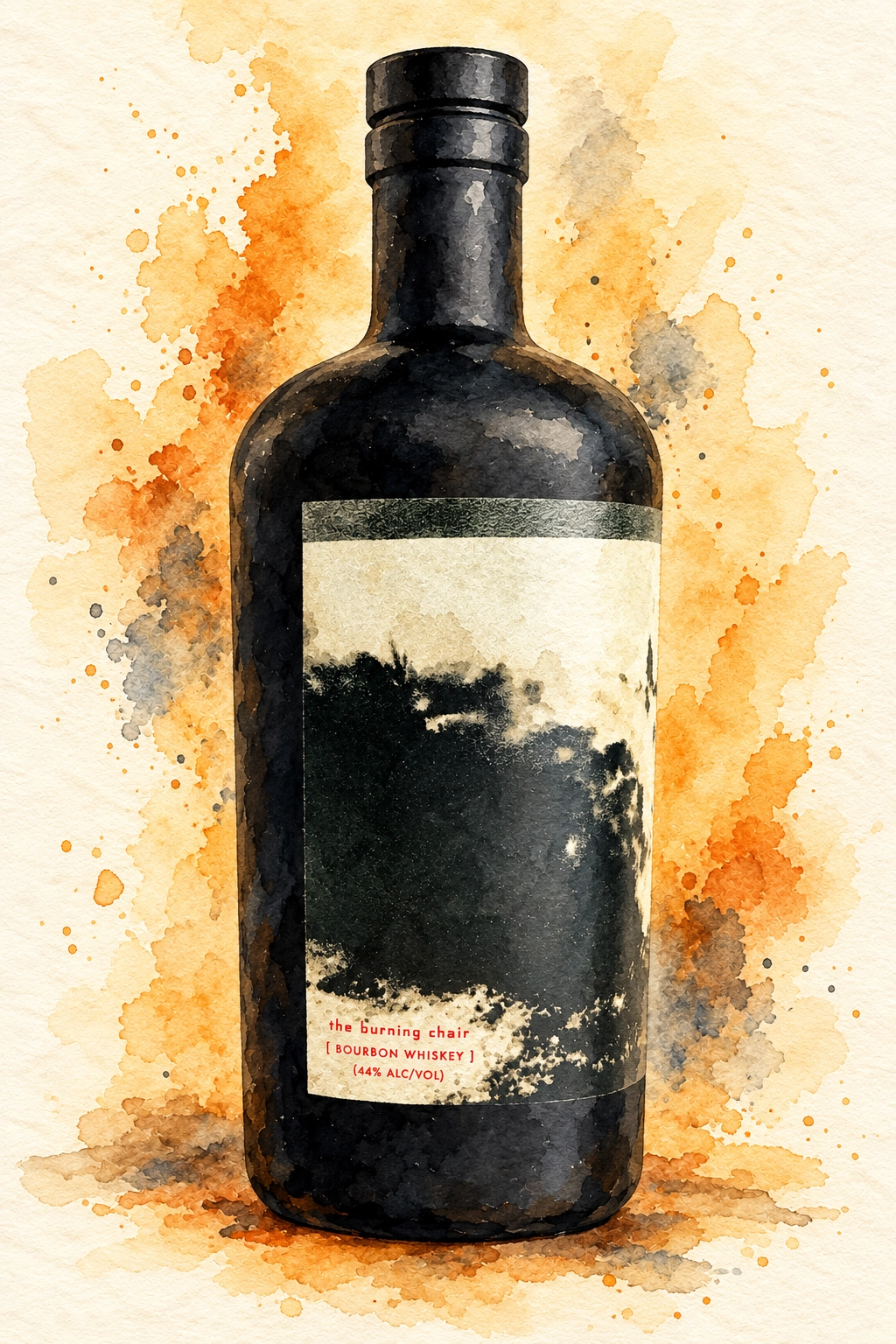
The official 2023 sheet presents an 88 proof sourced bourbon, at least four years old, finished in Cabernet wine casks. It is a useful entry into the original selection-and-finishing approach, with specifications tied to that document.[3]
House Bourbon and Rye / the local-grain chapter
Two 100 proof releases make local distillation visible through distinct corn-led and rye-led recipes. Cabernet and Grenache finishing provide different accents. They should be read alongside, rather than substituted for, earlier sourced expressions.[4][5]
Bloody Butcher and Howling Mob / grain as the subject
The 2024 limited pair places corn variety at the center. Both are described at four years and 100 proof, with separate recipes and barrel totals. Their role is to show how grain development broadened the story beyond cask selection.[7][8][17]
Guero 15 Year / mature whiskey meets Pinot Noir
A Tennessee-distilled American whiskey given a California finishing chapter. Its age and 117 proof presentation demonstrate another side of the range, distinct from both the house-distilled core and the earlier 88 proof bottlings.[9]
08 / The Reserve connection
Continue from the story to the bottles.
Savage & Cooke in The Thelen Reserve
Approved watercolor artwork is shown wherever an exact physical record or confirmed release match is available. Each physical bottle keeps its own verified details.
One physical bottle and separate release record. Exact age, blend, distillation source, batch and bottle number remain unverified without original label evidence. The standard blend fact sheet is not assigned to barrel 49.
Collection snapshot: October 26, 2026. One physical record, with its proof, barrel and pick preserved. No price or storage details are published.
The illustrated companion
Savage & Cooke, in three pages.
Origins and people, history and places, whiskey and stories. A concise companion to this complete profile, with linked research sources.
Researched October 20, 2026. Official brand and company pages, dated announcements and clearly identified supporting sources are distinguished in the research. Product specifications are release- and market-specific.
Research qualifications
Research checked October 20,2026. Primary producer descriptions, buyer announcements and dated releases have different evidence roles. The profile is an independent historical and production account, not an exhaustive current catalog.[1][10]
The 2016 venture start and 2018 distillery opening are separate events. No exact start of distillation is inferred from either date, nor is a name origin invented.[1][2]
Purple Brands announced the acquisition on December 20,2024; Redwood Empire confirms its 2025 move. The older website’s spring-opening forecast and historical team biographies are not treated as current operating promises.[2][10][11][12]
Recipes, ages and strengths stay attached to named editions. The Burning Chair technical sheet describes the standard blend and does not establish an individual Barrel Select barrel’s composition.[3]
The American Whiskey page labels the product cask strength while showing 100 proof; a 2023 report gives 113 proof. No one fixed strength is asserted for every edition. The 2021 DIGITSrelease says 92 proof; later documents are not silently substituted.[6][14][15][16]
Named source states do not reveal specific underlying distilleries. Mature Guero whiskey is not portrayed as 15 years of Mare Island distillation. Production partnerships do not make Savage & Cooke and Redwood Empire identical releases.[9][10]
Illustrations are fresh symbolic watercolors. Buildings and equipment are interpretive, not photographs, exact plans or documentary reconstructions. No unavailable bottle art is fabricated.
Full sources
Our team: founder and historical production team2016 venture start; Dave Phinney, Jordan Via and Lauren Blanchard historical roles. Note: Page retains earlier present-tense biographies despite later acquisition; roles are qualified by chapter.
Distillery and transition notice2018 opening, Mare Island setting and the site's as-of-2025 Redwood transition notice. Note: Dated December 2024 buyer announcement takes precedence for transaction chronology; spring opening wording is historical.
The Burning Chair official 2023 technical sheet88 proof,minimum 4 years,sourced KY/IN/TN,Cabernet finish,75/21/4. Note: Standard blend description, not evidence for a specific Barrel Select bottle or barrel 49.
House Bourbon official product descriptionLocal grain,milling/mashing,Vendome column,75/21/4,100 proof,minimum 3 years,partial Cabernet finish. Note: Release-specific historical brand description; not a universal specification for Burning Chair.
House Rye official product description51/45/4,100 proof,local production and partial Grenache finish. Note: Do not transfer these specifications to Lip Service or unrelated editions.
American Whiskey official product descriptionSourced barrels,matured onsite,minimum 4 years,partial Zinfandel finish,66/30/4. Note: Page labels cask strength alongside 100 proof;2023 report gives 113 proof. No universal strength inferred.
Bloody Butcher official product descriptionWinters field,70%corn/16%RedWinterWheat/14%maltedbarley,4 years,100 proof,44 barrels. Note: Specifications belong to described limited bottling; no future availability assumed.
Howling Mob official product description86%corn/14%maltedbarley,4 years,100 proof,31 barrels and low-yield one-time release. Note: Published release claim, not a permanent production quota.
Guero 15 Year official product descriptionTennessee distillation,California aging,99/1,OLG PinotNoir finish,117 proof. Note: Does not disclose a named Tennessee distiller;age belongs to sourced whiskey.
Purple Brands acquisition announcement,December 20,2024Distillery and all spirits brand assets acquired; prior supplementary production;two brick buildings and hospitality assets. Note: January 2025 full transition was a forward-looking target, not a verified day of completion.
Redwood Empire official historyConfirms operations moved to Mare Island in 2025. Note: Current buyer account; exact handover/opening day not supplied.
Redwood Empire tours and experiencesCurrent Mare Island visitor identity and production/barrel-room experience. Note: Operational descriptions checked 2026-10-20; no schedules or availability promised.
Savage & Cooke May 15,2020 RX 20/20 releaseMarch 2020 temporary production pivot,local distribution and hiring furloughed hospitality workers. Note: Historical company account; no medical efficacy or formulation guidance reproduced.
DIGITS June 15,2021 launch releaseScottiePippen/DavePhinney collaboration,June 24 Chicago rollout,JordanVia blending,fiveyears. Note: Release says 92 proof;laterfactsheet differs. Not all ages prove Mare Island distillation.
DIGITS official fact sheetOfficial product document retained for edition-specific comparison. Note: PDF has no extractable text in web viewer;not used alone to set exact strength.
2023 core trio contemporary reportDecember 10,2023 report distinguishes two Mare Island distilled products from sourced American whiskey. Note: Secondary contemporary report;page dates do not establish exact first-sale day.
April 2,2024 bottled-in-bond release accountDated company-style announcement reproduced with two spring 2024 limitedbourbons and prior-fall rebrand. Note: Publisher-hosted company release/account;product details crosschecked against official pages.
Official news archiveEarly named range and 2018 recognition/historicalpresslinks. Note: Archive dates/awards do not prove all liquid was distilled onsite.
Home School March 24,2021 company releaseBottled craft cocktail line adds a separate format to the historic portfolio. Note: Product/launch context only;no current catalog oravailability claim.