TJ THELEN'S COLLECTION
The Thelen Reserve
Behind the Bottles / California whiskey

Redwood Empire Whiskey

Last updated Last researched

Northern California / Grain, oak & redwoods

Coastal patience. Grain character. A wider view of whiskey.

Redwood Empire joins Northern California distilling to the patient work of selecting and blending mature whiskey. Its forest-inspired identity travels from the original Graton stills to a larger Mare Island home, while estate releases and sourced components keep their own places in the story.[24][22]

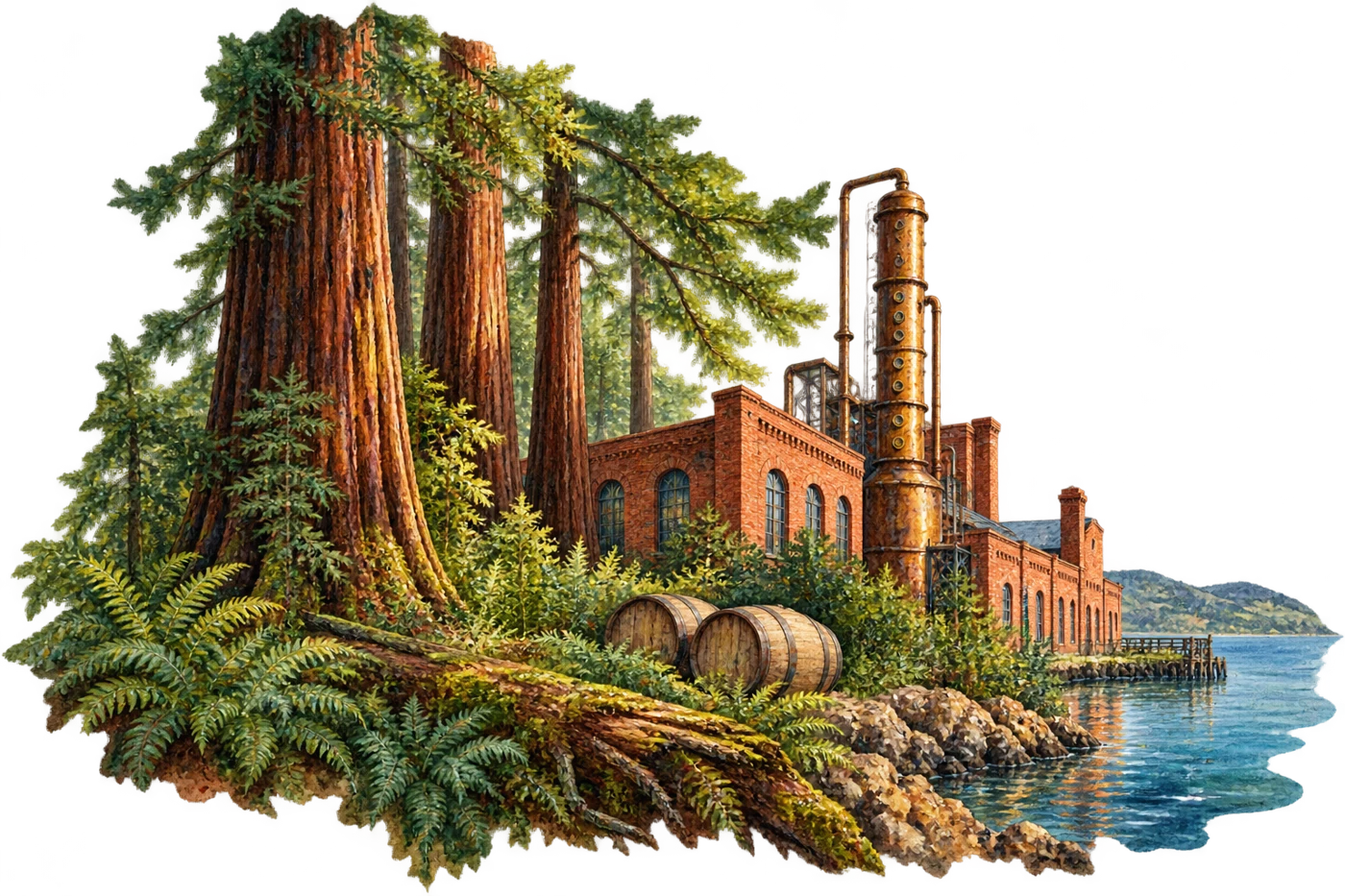
Symbolic redwood forest, Mare Island brick distillery, copper still and oak
Distilling began
2015 · Graton[4]
First label release
September 2017[2]
Current whiskey home
Mare Island, California[16]
Founder
Derek Benham[1]
01 / Origins & people

A wine-country idea finds its own spirit.

An idea grows into a working distillery

The current history places Derek Benham’s California whiskey idea in 2013. Production in Graton followed in 2015. Older announcements use other project and founding dates, so the creative beginning and the first working still should remain separate landmarks.[1][4]

The first label came before the familiar trio

Redwood Empire American Whiskey reached the market in September 2017 as a rye-forward blend. Pipe Dream, Emerald Giant and Lost Monarch followed in 2019. The brand’s recognizable modern family therefore has an earlier chapter behind it.[2][3]

A regional name, not a claim of ancient production

The name draws on Northern California’s coast-redwood landscape. Trees lend the whiskies their imagery and many of their names, but the forest’s age is not the company’s age. This is a modern distilling and blending venture with a regional point of view.[37]

Symbolic distillery team, tasting glasses and grain

Derek Benham

Founder and owner

Benham brought a wine-business background to the whiskey project. Purple Wine + Spirits, founded in 2001, added Graton Distilling Company in 2015. The business grew a whiskey identity through production, barrel selection and blending.[3]

Jeff Duckhorn

Master distiller and general manager

An accountant with a long-standing interest in fermentation, Duckhorn became the production team’s technical leader. His approach links practical process control to the grain character the distillery wants to carry into the barrel.[5]

Lauren Patz

Master blender

Patz arrived as Head Distiller in 2021 after leading production at Spirit Works. Now Master Blender, she brings the selection and assembly of whiskey into focus as skilled work in its own right, alongside the operation of the still.[4][5]

A wider circle of specialists

Production support and creative collaborators

Facility manager Mark Clark appears alongside the distilling leadership on the current team. The work also extends beyond the plant: the estate single-barrel program’s bark-textured packaging was developed with design studio Stranger & Stranger.[5][13]

02 / The illustrated history

From an apple-processing shed to Mare Island.

Follow the California production, blending and conservation story. The first release, the core range and the new distillery opening are separate milestones.
Symbolic illustration: The California idea takes shape
2013

The California idea takes shape

The current history places Derek Benham’s regional whiskey idea in 2013. Earlier producer accounts use different project and founding dates, making this an origin narrative rather than one universally agreed company anniversary.[1]
Symbolic illustration: Graton becomes a working distillery
2015

Graton becomes a working distillery

Purple’s Graton distillery began production in 2015. The operational start is better supported than a single founding year, which differs among the producer’s own accounts.[4]
Symbolic illustration: The first Redwood Empire whiskey reaches market
September 21, 2017

The first Redwood Empire whiskey reaches market

The inaugural American Whiskey was a 90-proof, rye-forward blend drawing on house-distilled rye, port-barrel-rested rye and mature bourbon. It precedes today's familiar named trio.[2]
Symbolic illustration: Three trees become a recognizable range
2019

Three trees become a recognizable range

Pipe Dream bourbon, Emerald Giant rye and Lost Monarch bourbon-and-rye blend launched as the brand's core family. They organize the drinker's choices around different styles rather than one supposedly universal California recipe.[3]
Symbolic illustration: A bottle-linked planting commitment starts
2019

A bottle-linked planting commitment starts

The brand dates its tree-funding campaign to 2019. The program supports Trees for the Future's work and should not be described as planting one California redwood for each bottle.[11]
Symbolic illustration: Two complementary makers lead production
March 22, 2021

Two complementary makers lead production

Purple announced Jeff Duckhorn’s promotion to Master Distiller and Lauren Patz’s arrival as Head Distiller. Her later role as Master Blender adds another chapter to their shared production and selection work.[4][5]
Symbolic illustration: The first estate bonded releases arrive
October 2021

The first estate bonded releases arrive

Grizzly Beast bourbon and Rocket Top rye reached the public as five-year, 100-proof whiskeys from spring 2016. These releases make the producer's own distillation visible alongside its blending work.[8][6][7]
Symbolic illustration: A second bonded season follows
September 14, 2022

A second bonded season follows

The second batches came from spring 2017. Repeating a product name did not mean repeating the exact seasonal whiskey or mash bill.[9]
Symbolic illustration: The core range goes to cask strength
October 2022

The core range goes to cask strength

Uncut, unfiltered versions of Pipe Dream, Emerald Giant and Lost Monarch first appeared. Later bottlings have different proofs, so the expression name alone cannot identify a bottle.[10]
Symbolic illustration: The million-tree milestone is announced
July 10, 2023

The million-tree milestone is announced

Redwood Empire reported reaching one million trees through the bottle-linked initiative. Today's partner record uses the more precise word funded for its accumulated count.[11][36]
Symbolic illustration: Small Lot opens new grain paths
January 31, 2024

Small Lot opens new grain paths

Foggy Burl single malt and Devils Tower high-rye bourbon inaugurated the Small Lot Series, with Screaming Titan wheated bourbon announced for March. The first two are explicitly grain-to-glass; the launch describes Screaming Titan as a blend.[12]
Symbolic illustration: Haystack Needle gets an estate single-barrel program
November 21, 2024

Haystack Needle gets an estate single-barrel program

A new 53-barrel bourbon-and-rye selection program showcased the producer's older grain-to-glass stock. It is a new chapter for an existing name, not the first historical appearance of Haystack Needle.[13][29]
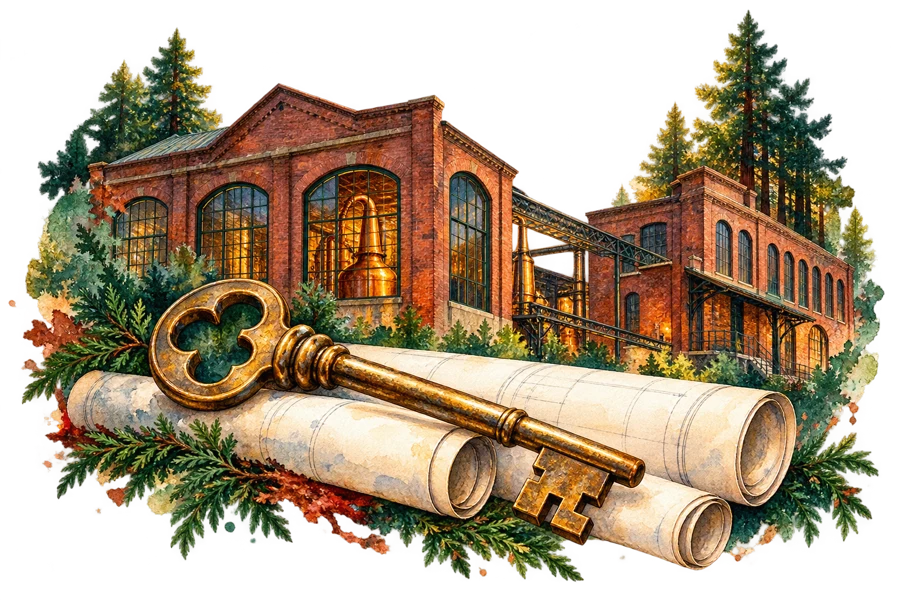
Symbolic illustration: The Mare Island acquisition is announced
December 20, 2024

The Mare Island acquisition is announced

Derek Benham announced purchase of Savage & Cooke's distillery, brand assets and visitor facilities. The companies had already worked together on supplementary whiskey production.[14]
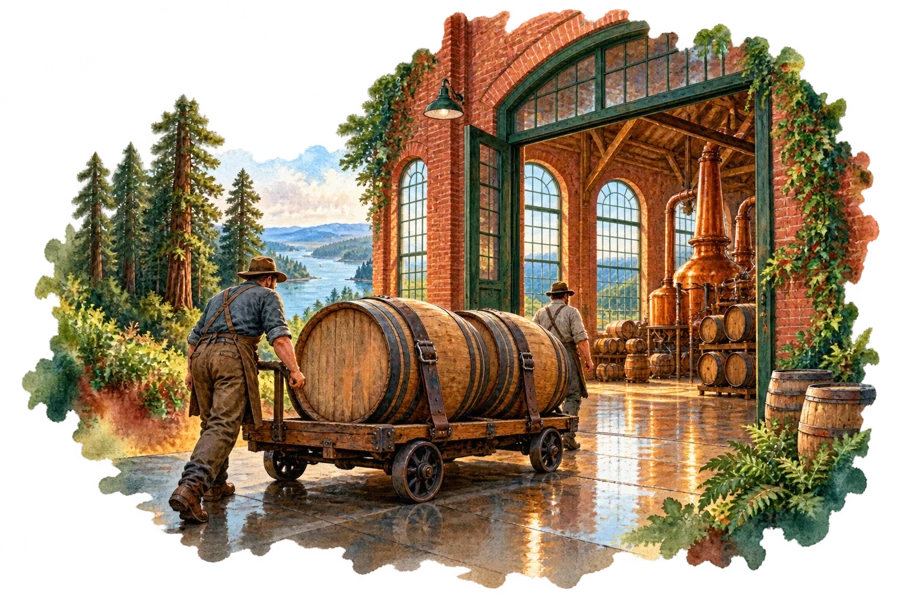
Symbolic illustration: Production moves from Graton to Mare Island
2025

Production moves from Graton to Mare Island

The official history dates the move from Graton to Mare Island to 2025. The new home gives production more room while the older estate barrels preserve the work of the Sonoma years.[1][14][16]
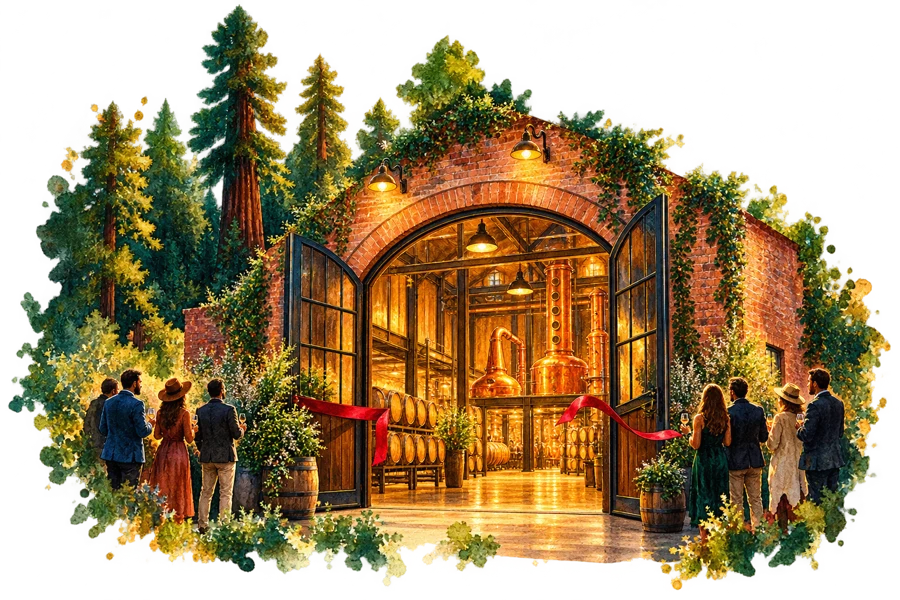
Symbolic illustration: A formal grand-opening celebration
September 13, 2025

A formal grand-opening celebration

Mare Island’s official event listing marks a formal grand-opening party. The celebration follows the production transition and the tasting room’s summer opening, each a different step in establishing the new home.[15][16]
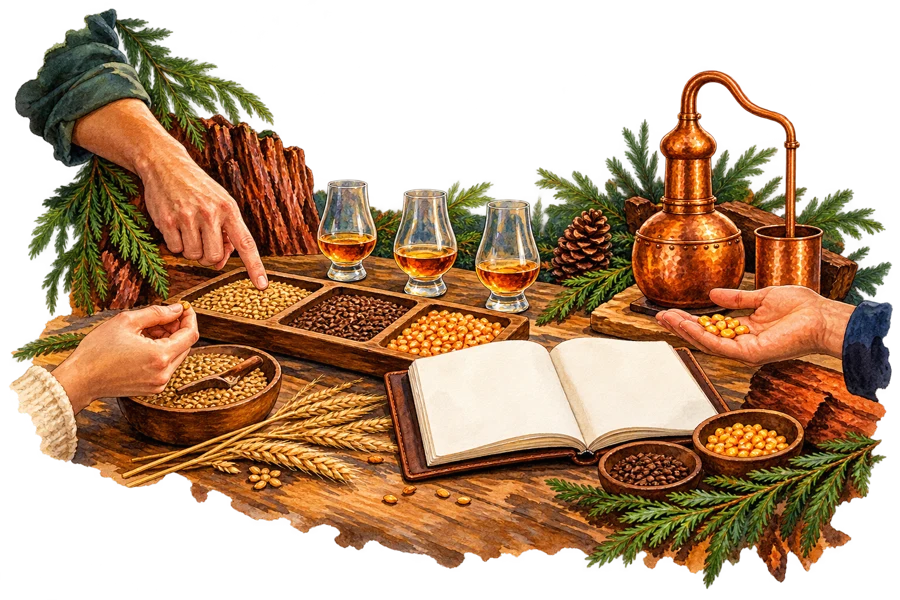
Symbolic illustration: Whiskey University broadens the experience
February 25, 2026

Whiskey University broadens the experience

A producer announcement introduced Lauren Patz's five-session educational series, with 90-minute classes covering production, bourbon, rye, wood and blending.[19][18]
Symbolic illustration: Colonel Armstrong expands the everyday range
June 25, 2026

Colonel Armstrong expands the everyday range

The new wheated bourbon explicitly blends the distillery's own spirit with four- to fourteen-year Kentucky and Indiana bourbon. It is a clear example of the brand's dual commitment to distillation and thoughtful sourcing.[20][21]
Symbolic illustration: The Hyperion introduces an annual frontier
August 21, 2026

The Hyperion introduces an annual frontier

The first annual Hyperion release combines bourbon, rye, wheat whiskey and single malt. Current specifications give seven- to fourteen-year components from California, Kentucky, Indiana and Tennessee at 110 proof.[22][23]

Original watercolor interpretations accompany the history. Buildings, objects and scenes are symbolic, not documentary reconstructions.
03 / Geography & roles

One name. Several places that matter.

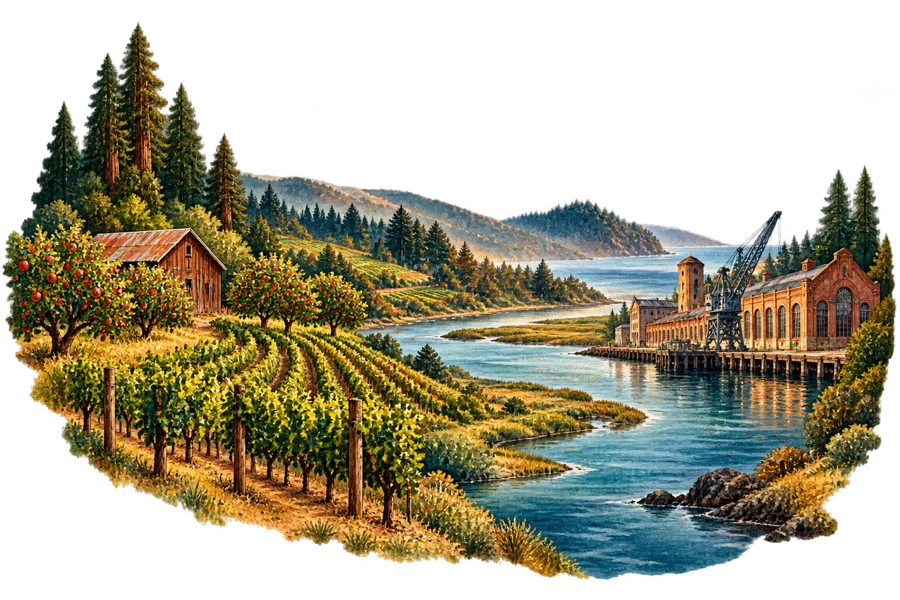
Symbolic Northern California landscape connecting Graton vineyards and Mare Island waterfront

Graton: the original working home

The first distillery stood on a former apple-processing property in western Sonoma County. Its custom micro-column equipment belongs to Redwood Empire’s original production chapter, distinct from the larger still acquired later.[2]

The Russian River Valley barrel chapter

The original bonded technical sheets identify Sonoma County production and Russian River aquifer water. These documents anchor the early estate releases to a specific place, rather than borrowing the address of the brand’s present visitor destination.[6]

Mare Island: industrial history becomes a whiskey home

The acquired facility occupies historic brick buildings on a former naval base north of San Francisco. Its scale and existing hospitality spaces offered room to expand production and build a destination around the whiskey.[14]

The forest behind the visual language

Pipe Dream takes its name from a tall coast redwood; Lost Monarch honors another monumental tree. These references create a connection to the surrounding region’s landscape without suggesting that the distillery stands inside either tree’s protected grove.[24][26]

A place for guided discovery

The official experiences page directs visitors to tours, tastings and educational sessions at Mare Island. Reservations and current offerings should be checked there, because a dated opening announcement cannot establish today’s walk-in service or hours.[18]

04 / The whiskey family

Understand the name on the label.

Trace the producer, its expression families and the distinct roles of collaborators and historical personnel.

Symbolic Redwood Empire whiskey family with grains, oak and a redwood sapling

Purple Brands and Redwood Empire

Parent company and whiskey brand

Purple Brands is the parent company identified in the acquisition announcement and later educational release. The brand’s relationship to wine-country entrepreneurship does not make every wine business with a familiar surname part of its ownership.[19]

Graton Distilling Company

Original production operation

The original distillery was part of Purple Wine + Spirits’ move into spirits. Its 2015 establishment belongs to the operating-company story, while the first Redwood Empire whiskey label followed two years later.[2]

Savage & Cooke

Acquired facility and prior production partner

The Mare Island acquisition included the distillery and spirits brand assets. The companies had previously worked together on supplementary production. That history should be preserved without treating every earlier bottle from either brand as the same whiskey.[14]

Other American distillers

Sourced components in specified releases

Redwood Empire has continued selecting mature whiskey beyond California. Colonel Armstrong explicitly brings Kentucky and Indiana bourbon together with its own spirit. Sourcing is part of the blend’s documented design, not an identity to conceal.[20]

The estate bonded family

Producer-distilled bourbon and rye

Grizzly Beast and Rocket Top make another relationship clear: the connection between the distillery and whiskey it produced entirely in house. Their season-specific records stand beside the wider sourced-and-estate blending portfolio.[9]

Lost Lantern

Independent bottling collaboration

The independent bottler’s July 2026 Discovery Club selected a five-year Redwood Empire bourbon. Its firsthand account recalls visiting Graton in 2018 and distinguishes the older estate whiskey from the newer Mare Island destination.[40]

Trees for the Future

Tree-funding partner

The nonprofit’s own sponsor record credits the whiskey brand with funding more than 1.8 million trees. Its agroforestry work should not be confused with a promise that every supported tree is a California redwood.[36]

Save the Redwoods League

California forest conservation partner

The conservation organization lists Redwood Empire among its corporate partners. This is a separate relationship supporting redwood protection and restoration, alongside the international tree-funding program.[38][37]

05 / Making & choosing

The choices behind the label.

Recipes, fermentation, oak and mingling shape the whiskey. Keep every specification tied to the expression and edition named.

Symbolic mash bills, yeast, copper and oak

Grain character starts before the barrel

The current process description emphasizes grain primarily from Sacramento Valley family farms, on-site milling and a library of mash recipes. Those choices give the team different building blocks before aging and blending begin.[17]

Two facilities, two equipment chapters

The early Rocket Top sheet describes a Headframe continuous-column still in Graton. The current production account describes a Vendome column followed by a doubler at Mare Island. Combining them into one timeless piece of equipment would obscure the move.[6][17]

Bonded whiskey preserves a season

The first estate bourbon and rye releases were distilled in spring 2016 and bottled five years later at 100 proof. Their records identify a season and a distillery, while the following batches show that the grain proportions can change.[7][8][9]

A blend can have a mash bill and a blend bill

Lost Monarch’s stated percentages describe rye whiskey and bourbon, not rye grain and corn. Hyperion’s four-part breakdown likewise describes categories of finished whiskey. Neither should be read as one mash going into a single still.[26][23]

Small Lot does not mean one production source

Foggy Burl and Devils Tower were introduced as grain-to-glass whiskeys. The same launch described Screaming Titan as a blended wheated bourbon. A series name is useful for exploring a range, but it cannot replace each release’s production record.[12]

Oak finishes can meet in the blend

For Triple Toasted, portions of Pipe Dream receive French, Hungarian and Garryana oak finishes before being married. The result is a combination of three wood treatments, rather than a claim that every drop passed through three successive finishing casks.[27]

Higher proof keeps its own identity

Pipe Dream 101 combines older stocks and a greater share of the distillery’s own whiskey with a higher bottling strength. Cask-strength releases are another branch, with edition-specific proofs. A familiar tree name alone does not identify the liquid.[28][10]

Scale changes while the barrels take their time

The current producer account describes more than twenty-two thousand aging barrels and an expanded production plant. These are the company’s scale claims. More new distillation does not instantly create mature whiskey or relocate the origin of barrels filled years earlier.[17][35]

06 / The details worth knowing

The details behind the redwood names.

The apple plant and the shipyard

Graton’s Sonoma setting and Mare Island’s naval-industrial buildings give the whiskey two different homes. The move expands a modern venture, rather than extending an imaginary distillery lineage back to the days of the shipyard.[40][18]

A bonded release can read like a time capsule

The original Grizzly Beast and Rocket Top sheets identify spring 2016 distillation and summer 2021 bottling. Their seasonal records let drinkers look back at a particular period of work, even after the people’s titles and the production address change.[7][8]

The grain family keeps branching

The Small Lot range makes room for malt, rye and wheat to take different roles. Foggy Burl uses malted barley alone; Van Duzen retains a rye identity while giving malted barley a substantial supporting share.[31][32]

A single barrel is a different kind of portrait

The modern Haystack Needle program isolates individual estate bourbon and rye barrels. Its identity is the selected barrel’s own balance of grain and age. Earlier Haystack releases still require their own records; the name is not a guarantee of one origin across all years.[29]

Teaching makes the process visible

Whiskey University turns production and blending into a sequence of guided subjects. Lauren Patz’s curriculum moves from fundamentals to bourbon, rye, wood and assembly, giving visitors tools to understand the decisions behind a glass.[19]

Two ways to help forests

Tree funding and old-growth conservation answer different needs. The brand’s nonprofit relationships connect international agroforestry with protection and restoration in California. Neither partnership, by itself, establishes that whiskey production has no environmental impact.[36][38]

07 / Selected expressions

Different ways into the whiskey family.

A curated reading of the whiskey family, selected for its role in the story. This is not an exhaustive current catalog.

Pipe Dream

The bourbon is the range’s familiar high-corn expression, combining barrel selection with the brand’s California aging and blending identity. Its standard presentation should remain distinct from Pipe Dream 101, cask-strength and finished editions.[24][28]

Emerald Giant and Lost Monarch

Emerald Giant follows the rye path; Lost Monarch combines rye whiskey with bourbon. Current web specifications are not substitutes for an older bottle’s label, particularly where the producer’s own recipe descriptions have changed or conflict.[25][26]

Grizzly Beast and Rocket Top

The estate bonded pair gives bourbon and rye separate seasonal expressions. The current batch-five pages point to spring 2020 distillation and August 2025 bottling. These mature whiskeys originated before the move to Mare Island.[34][35]

Foggy Burl and Devils Tower

Single malt and high-rye bourbon explore different grain balances. Current lots are larger than their initial Small Lot releases, and Devils Tower’s rye share has changed. The batch number remains part of the identity.[31][33]

Screaming Titan and Van Duzen

A wheated bourbon and a malt-rich rye widen the Small Lot family in different ways. Their current technical pages describe separate grain proportions and lot sizes; they should not be combined into a general four-grain recipe for the whole distillery.[30][32]

Haystack Needle

The current bourbon-and-rye single-barrel program is expressly grain-to-glass. Its estate identity should not be projected backward onto every earlier sourced or finished bottle that carried the Haystack Needle name.[29][13]

Colonel Armstrong

The 2026 wheated bourbon adds a ninety-four-proof expression assembled from California spirit and selected Kentucky and Indiana bourbon. Its conservation-inspired name joins the blending story to the forest imagery without implying nineteenth-century distilling continuity.[21][20]

The Hyperion

The inaugural annual release explores four straight-whiskey categories in one blend. Its seven- to fourteen-year components include the distillery’s own single malt and whiskey from other states. Future editions are conceived as distinct explorations, rather than a permanent repeat of the first recipe.[23][22]

08 / The Reserve connection

Continue from the story to the bottles.

Redwood Empire Whiskey in The Thelen Reserve

4 physical bottle records connect this story to the collection. Each keeps its own proof, barrel, batch, pick and release details.

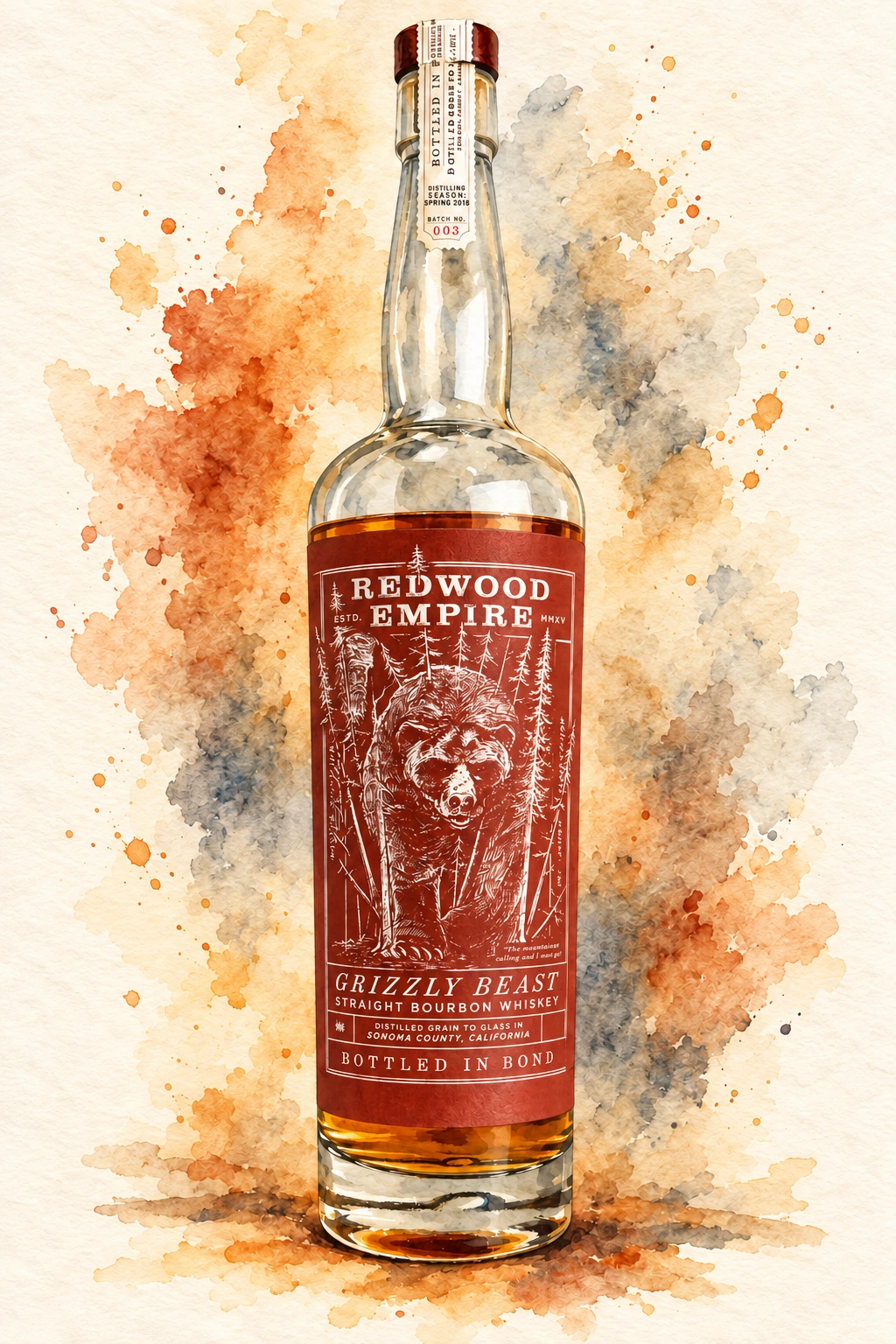
Approved watercolor of Redwood Empire Grizzly Beast Bottled in Bond Batch 003

Redwood Empire Grizzly Beast Bottled in Bond Batch 003

W0388 · 100 proof · Batch 3

Batch 3 of the estate bottled-in-bond bourbon.

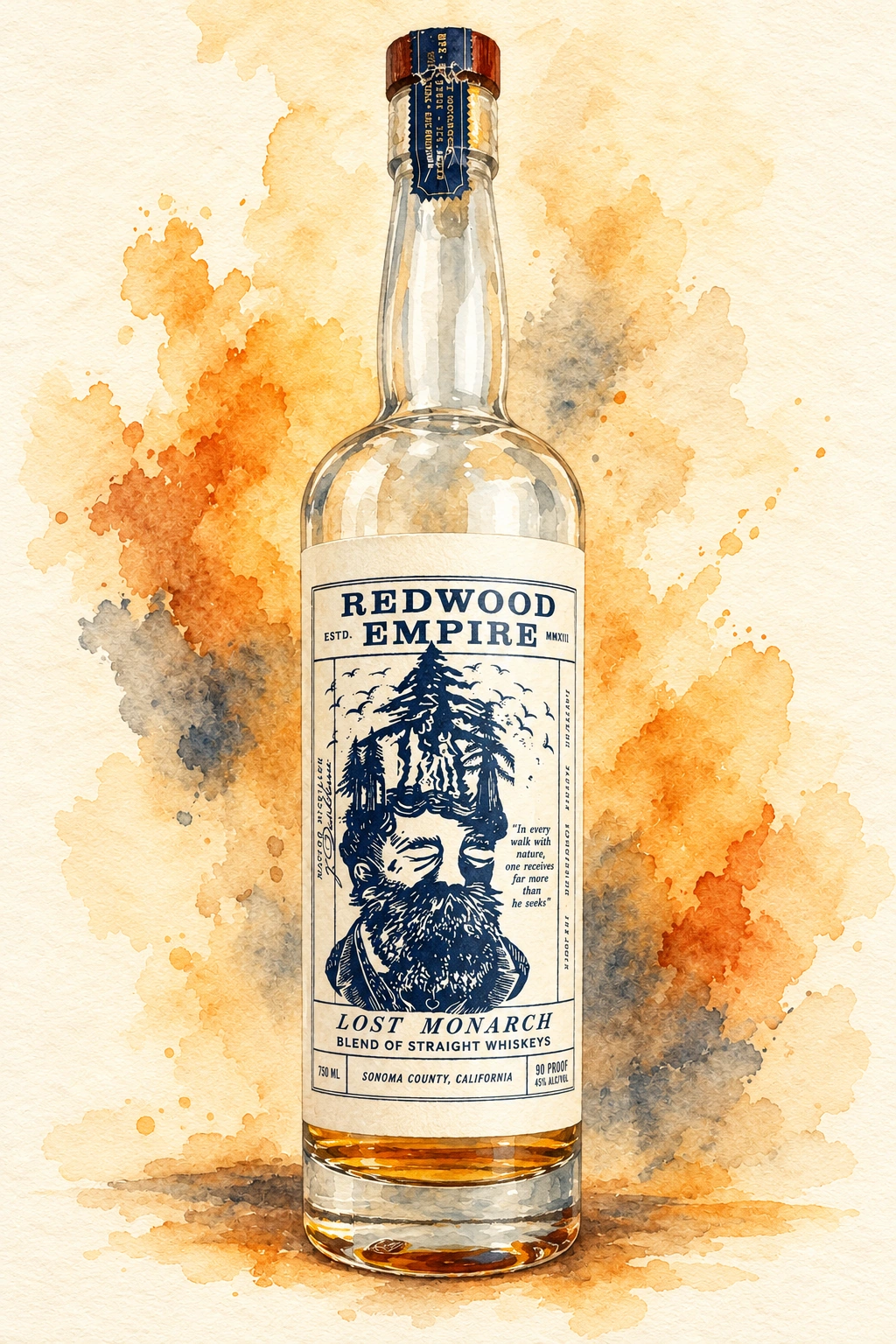
Approved watercolor of Redwood Empire Lost Monarch

Redwood Empire Lost Monarch

W0389 · 90 proof

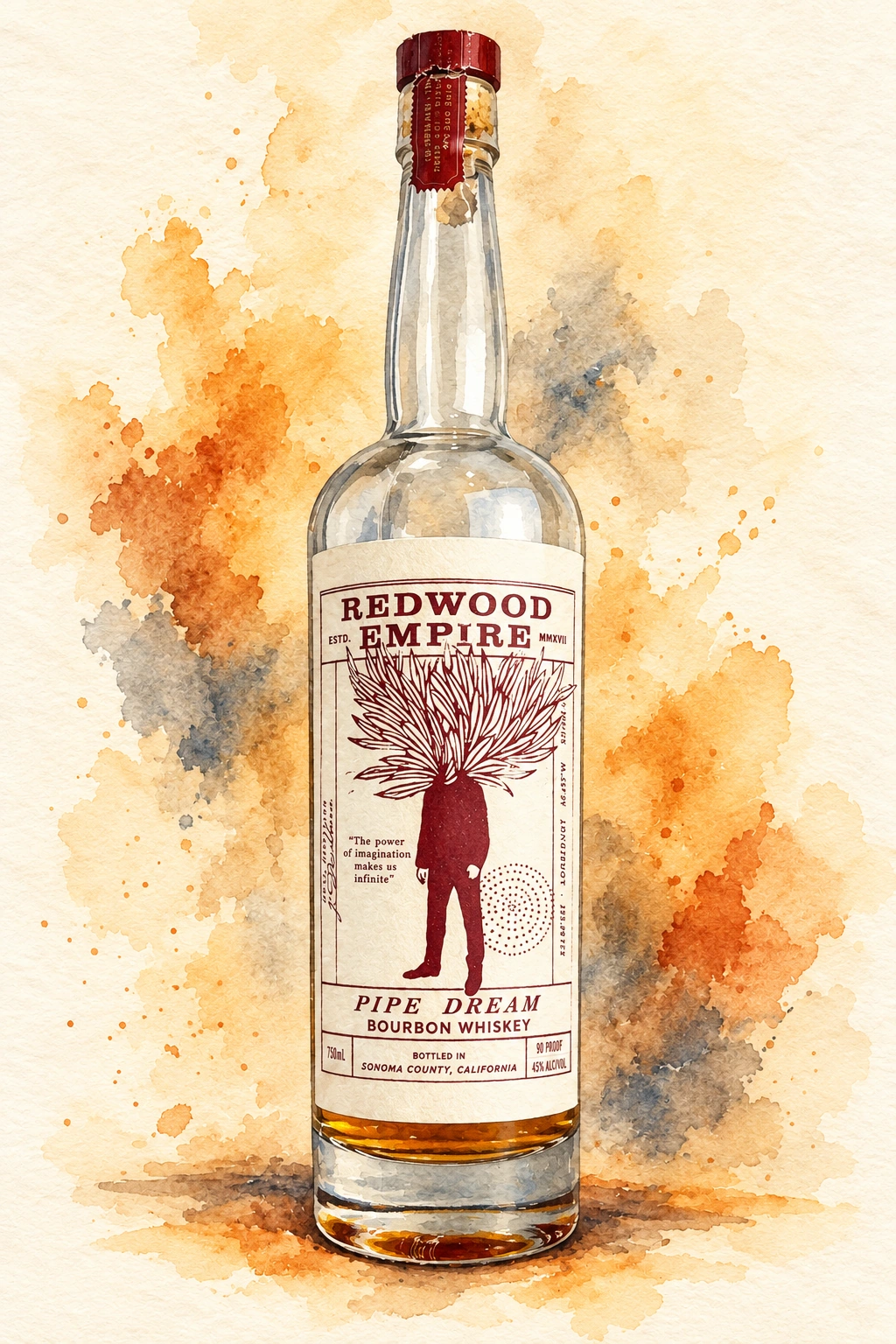
Approved watercolor of Redwood Empire Pipe Dream

Redwood Empire Pipe Dream

W0390 · 90 proof

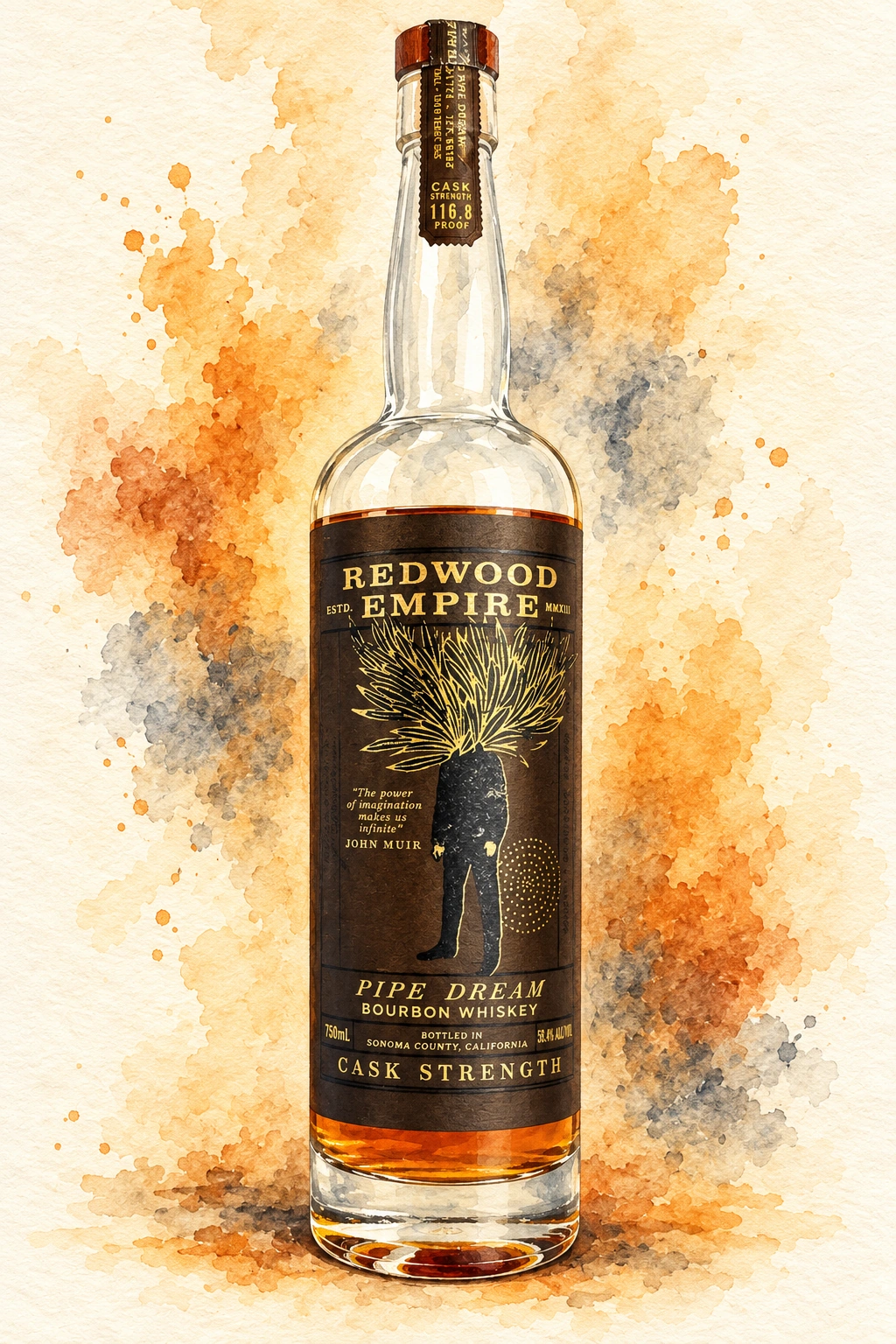
Approved watercolor of Redwood Empire Pipe Dream Cask Strength

Redwood Empire Pipe Dream Cask Strength

W0391 · 116.8 proof

Cask strength varies by batch. This bottle is recorded at 116.8 proof.

Collection snapshot: October 25, 2026. Four physical records, each linked to its own inventory entry. Batch and proof distinctions are preserved.

Redwood Empire Whiskey three-page guide cover
The illustrated companion

Redwood Empire Whiskey, in three pages.

Origins and people, history and places, whiskey and stories. A concise companion to this complete profile, with linked research sources.

Sources & research notes

Researched October 17, 2026. Official brand and company pages, dated announcements and clearly identified supporting sources are distinguished in the research. Product specifications are release- and market-specific.

Research qualifications

  • Origin accounts differ: a 2011 project, 2013 idea and 2014 founding are separate producer narratives, not interchangeable anniversaries.[1][14]
  • The December 2024 transition forecast is not proof of an exact completed-move date. Production relocation in 2025, summer visitor opening and the September 13 celebration are distinct.[16][15]
  • Current titles are Master Distiller/General Manager Jeff Duckhorn and Master Blender Lauren Patz. Her historical Head Distiller title belongs to its own period.[5]
  • Graton Headframe equipment and current Mare Island Vendome equipment are separate chapters. Pre-move estate barrels retain their original distilling place; sourced and contract production remain distinct.[6][17]
  • Capacity and inventory rankings are attributed company claims. Reported figures vary with date and should not be treated as independent audits.[1][35]
  • Proof, recipe, age and lot size are edition-specific. Emerald Giant has conflicting current specifications; Van Duzen’s batch001 URL currently describes batch002.[25][32]
  • Lost Monarch and Hyperion proportions are whiskey blend bills, not single grain mash bills. Estate status must be verified release by release, including older Haystack editions.[26][23][29]
  • Colonel Armstrong’s launch describes four- to fourteen-year components, not a fourteen-year minimum. The Hyperion launch was posted August 21, 2026; later reprints have different publication dates.[21][22]
  • Published oak-seasoning ranges differ. Historical water reclamation, spent-grain reuse and efficiency descriptions are not automatically verified current Mare Island practices.[27][39]
  • The nonprofit reports trees funded. It does not promise all are California redwoods, guarantee seedling survival or certify the whiskey carbon-neutral. Tree rankings and ages are not independently audited here.[36][38]
  • Check current official reservations for visitor offerings. Dated opening descriptions do not establish present walk-in bar, restaurant service or fixed hours.[18]
  • Van Duzen references a river; Grizzly Beast combines two tree names. Forest history is distinct from corporate history.[32][35]
  • Original watercolor scenes are symbolic interpretations, not exact buildings, equipment layouts or documentary portraits.

Full sources

  1. History & FoundationCurrent 2013 idea, Graton beginnings and 2025 Mare Island move; capacity account. Note: Origin dates and approximate capacity wording differ in dated releases.
  2. Inaugural American Whiskey launchInaugural September 2017 label; Graton company and original equipment. Note: Historical release specifications are not universal portfolio claims.
  3. Earth Month announcement2015 production start and distinct 2017 label/2019 core-family launches. Note: Named trio launch is distinct from the earlier label.
  4. Duckhorn promotion and Patz appointmentMarch 2021 Duckhorn promotion and Patz appointment; 2015 operating start. Note: Patz's historical Head Distiller title later changed.
  5. Current teamCurrent team, titles and individual professional backgrounds. Note: Current titles do not rewrite earlier credited roles.
  6. Rocket Top Batch001 2021 technical sheetRocket Top first batch: spring 2016, Graton equipment and historical process. Note: Historical Graton process is distinct from Mare Island equipment.
  7. Grizzly Beast Batch001 2021 technical sheetGrizzly Beast first batch: spring 2016 distillation and summer 2021 bottling. Note: First-batch specifications do not describe every later season.
  8. First Bottled-in-Bond collectionFirst bonded collection announcement and in-house production. Note: A quoted Grizzly Giant typo is not propagated.
  9. Second Bottled-in-Bond batchSecond bonded season, entirely in-house bourbon and rye; changed recipes. Note: Seasonal editions remain separate.
  10. Second cask-strength releaseOctober 2022 cask debut and May 2023 second release. Note: Proof changes by edition.
  11. One million trees milestone2019 tree initiative and July 2023 million-tree milestone. Note: Tree funding is not exclusively California redwood planting.
  12. Small Lot Series launchJanuary 2024 Small Lot launch and different production descriptions. Note: Estate claims are release-specific, not series-wide.
  13. Haystack Needle single-barrel program launchNovember 2024 estate single-barrel program and design collaboration. Note: Earlier Haystack releases retain their original sourced/finished identities.
  14. Savage & Cooke acquisitionAcquisition, previous supplementary production, assets, facility and transition forecast. Note: Forecast transition date is not verified completion.
  15. Mare Island official grand opening eventSeptember 13, 2025 formal grand-opening event. Note: Ceremony differs from operational and tasting-room openings.
  16. FAQ2015–2025 Sonoma distillation and subsequent Mare Island home. Note: Visitor copy may lag current availability.
  17. Current productionCurrent grain, equipment, barrel-entry, oak and attributed scale descriptions. Note: Scale and process benefits are producer claims.
  18. Tours and experiences / Whiskey UniversityCurrent guided experiences, reservations and educational program. Note: Check current bookings; fixed hours are not promised.
  19. Whiskey University announcementFebruary 2026 Whiskey University announcement and parent-company relationship. Note: Historical hospitality copy does not establish present walk-in service.
  20. Colonel Armstrong launchJune 2026 Colonel Armstrong launch and California/Kentucky/Indiana components. Note: Four-to-fourteen-year blend is not a fourteen-year minimum.
  21. Colonel Armstrong current productColonel Armstrong proof, blend size and four-grain proportions. Note: Ambiguous age phrasing resolved by dated launch.
  22. The Hyperion inaugural launchAugust 21, 2026 Hyperion launch and explicitly estate single malt. Note: Later media reprints have different publication dates.
  23. The Hyperion current productHyperion whiskey proportions, ages, proof and component states. Note: Spirit blend percentages are not grain percentages.
  24. Pipe Dream bourbonPipe Dream bourbon blend and namesake tree. Note: Aggregate mash bill is not necessarily one distillation recipe.
  25. Emerald Giant ryeEmerald Giant rye and inconsistent recipe/age descriptions. Note: Physical release label controls collection identity.
  26. Lost Monarch blendLost Monarch bourbon–rye blend proportions and naming. Note: Spirit blend percentages are not grain percentages.
  27. Pipe Dream Triple ToastedTriple Toasted's separately finished portions and oak treatments. Note: Stave-seasoning descriptions differ from general production page.
  28. Pipe Dream101Pipe Dream 101's older stocks, increased own spirit and proof. Note: Current details do not supersede older labels.
  29. Haystack Needle current programCurrent estate Haystack program; historical four-barrel wording. Note: Old capacity wording is not current facility evidence.
  30. Screaming TitanCurrent Screaming Titan wheated-bourbon specifications. Note: Not automatically entirely in-house merely because it is Small Lot.
  31. Foggy BurlFoggy Burl current batch and single-malt identity. Note: Current batch differs from original lot.
  32. Van DuzenVan Duzen malt-rich estate rye and river name. Note: URL retains batch001 while content shows batch002.
  33. Devils TowerDevils Tower current batch; changes from first lot. Note: Current recipe differs from first batch.
  34. Rocket Top currentRocket Top batch five season, bottling and recipe. Note: Distilled before the Mare Island move.
  35. Grizzly Beast currentGrizzly Beast batch five season, bottling and recipe. Note: Distilled before the Mare Island move.
  36. TREES sponsor recordNonprofit's cumulative trees-funded record and bottle-linked commitment. Note: Funded count is not survival or carbon-neutral certification.
  37. Official partnershipsCurrent distinct forest conservation and agroforestry partnerships. Note: Separate partners perform different environmental work.
  38. Save the Redwoods corporate partnersConservation nonprofit's own corporate-partner listing. Note: No precise contribution period or certification inferred.
  39. Historical sustainability narrativeEarlier sustainability descriptions and their uncertain facility scope. Note: Undated claims are not verified current Mare Island specifications.
  40. Lost Lantern July 2026 Redwood Empire Discovery ClubFirsthand Graton visit and July 2026 independent bourbon selection. Note: Collaborating bottler account; sourced products require separate provenance.
↑