Behind the Bottles / An Oregon grain-to-glass story
Oregon Spirit Distillers
Last updated Last researched
Bend, Oregon / Bourbon, rye, wheat & malt
High-desert grain. A whiskey made from the ground up.
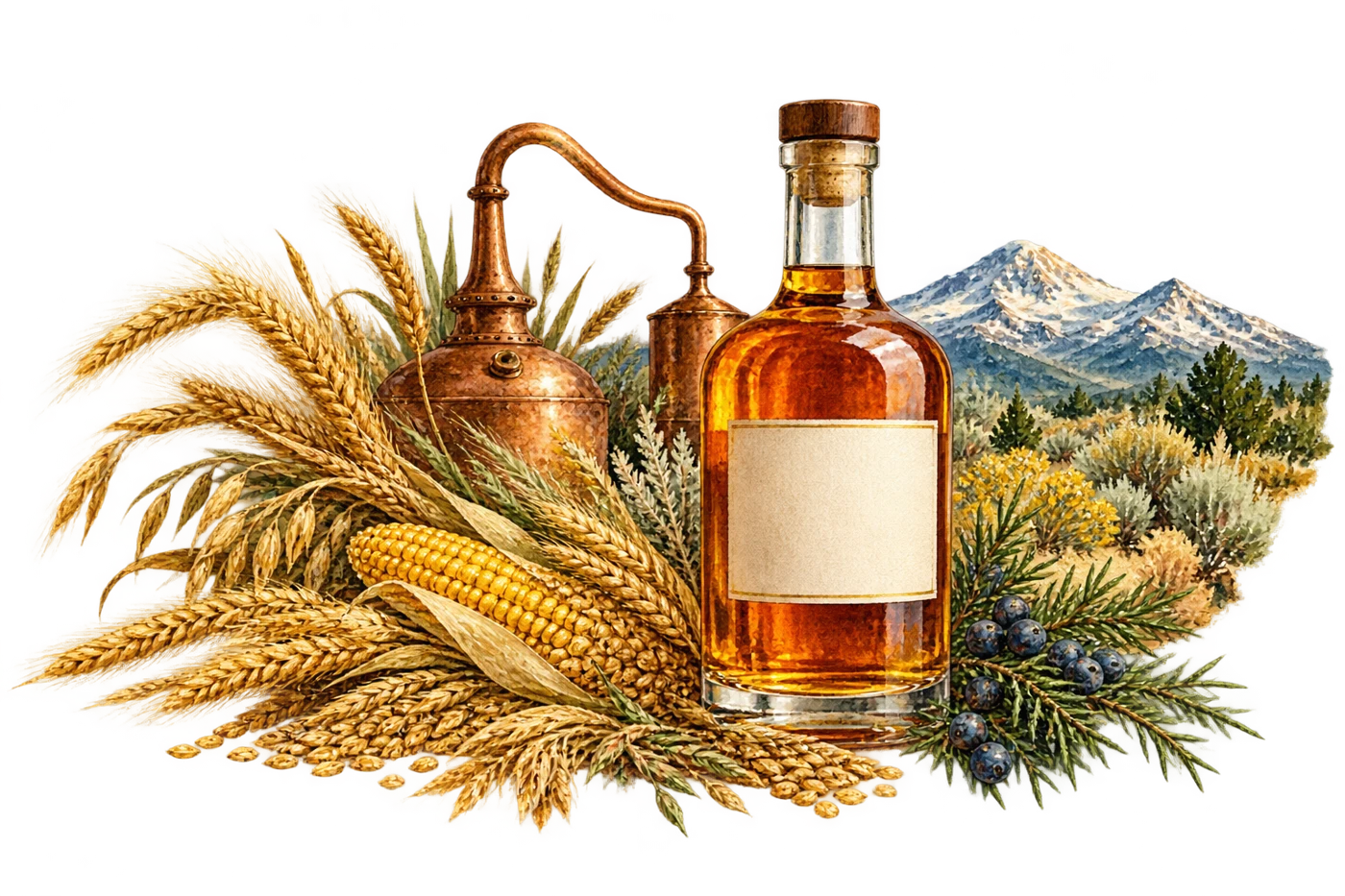
In Bend, the Oregon Spirit story begins with the grain. Bourbon, rye, wheat and malt offer different routes through one distillery’s work. Behind the bottles are a founding partnership, regional agriculture and a long commitment to making whiskey before it can be sold.[22]
Brad Irwin’s years serving whiskey made differences in flavor a practical fascination. Early reporting follows that curiosity from bartending into experimental grain recipes, then into a small commercial warehouse operation.[17]
A partnership built around Oregon
Brad and Kathy founded the distillery in 2009. The company still describes itself as family-owned. Its identity is closely tied to Bend, with regional ingredients and hands-on work forming the center of the story.[1]
The patience behind the promise
The 2019 anniversary account describes both founders keeping outside jobs while running the distillery. Whiskey’s years in oak made patience a business requirement.[18]
Brad Irwin
Founder / distillation
Owner and master distiller. The current team page notes his return to the production floor in 2025, putting hands-on process work back at the center of his day.[2]
Kathy Irwin
Founder / family ownership
Co-founder and co-owner. Her role belongs in the founding story, beyond a supporting cameo: this was a family venture from its beginning.[1]
Steve Denfeld
Blending / barrel selection
Master blender. He marries mature barrels for consistency and selects others for individual-barrel expressions, bringing another kind of judgment to the finished whiskey.[2]
Gary Bishop & the regional growers
Agricultural relationships
A 2019 profile recalls a reunion with farmer Gary Bishop becoming a grain-supply relationship. This historical account gives regional sourcing a human connection.[18]
02 / The illustrated history
The long view from Bend.
Follow the people, partnerships and documented releases. Dates of reporting and partner offerings remain distinct from founding and release dates.
2007–2008
The plan takes shape
Brad’s 2017 interview recalls two planning years before the commercial license. Curiosity becomes a business plan.[16]
2009
A distillery begins in Bend
Brad and Kathy Irwin establish Oregon Spirit Distillers. The company’s own history places its founding in 2009.[1]
Late 2010
Early spirits meet the public
Brad dates Wild Card absinthe and Merrylegs genever to late 2010, while the whiskey matures.[16]
2012–2013 / early reports
The first bourbon reaches drinkers
A 2013 report describes an initial C.W.Irwin barrel opened the previous fall; Brad later dates the bourbon release to 2013.[17][16]
2014 / expansion chapter
A larger home for the long game
The Irwins acquire the larger site. Later accounts describe a phased conversion and hospitality build-out, with different recollections of its duration.[18]
2016
Rye takes its place
Brad dates J.Becher rye to 2016; the rye page records that year’s San Francisco Double Gold.[16][6]
2017
The audience widens
Brad anticipates national retail distribution and refreshed packaging. The bourbon page records 2017 competition recognition.[16][4]
December 2019 / reporting
A decade of grain and barrels
An anniversary profile describes ten years of growth, a larger team and bottles reaching customers beyond Oregon.[18]
March 21, 2020
Production serves a community need
Kathy Irwin’s campaign documents bulk sanitizer being supplied to local agencies and community members during the pandemic.[19]
September 2021
Oregon whiskey gathers in Bend
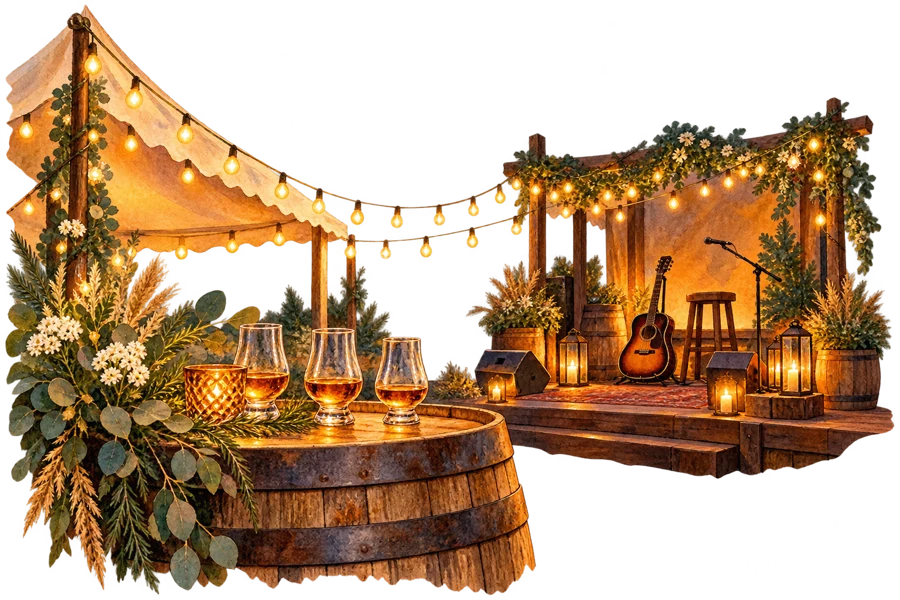
The inaugural festival is reported at Oregon Spirit, bringing together distillers and drinkers around whiskey made in the state.[20]
2022–2024
Wheat earns recognition
Producer sources record an American Distilling Institute category award in 2022 and a San Francisco Double Gold in 2024.[7][15]
2025 / team-page update
Back on the production floor
The current team page says Brad has returned to hands-on production, continuing to refine processes and products.[2]
April 16, 2026 / agenda
A voice for Oregon craft spirits
The OLCC agenda lists Brad alongside New Deal’s Tom Burkleaux for a presentation on Oregon’s craft-distilling sector.[21]
September 18–19, 2026 / schedule
The festival returns to the homeplace
The organizer schedules a Friday pre-party and Saturday festival at the Bend distillery, with regional producers, music and food.[14]
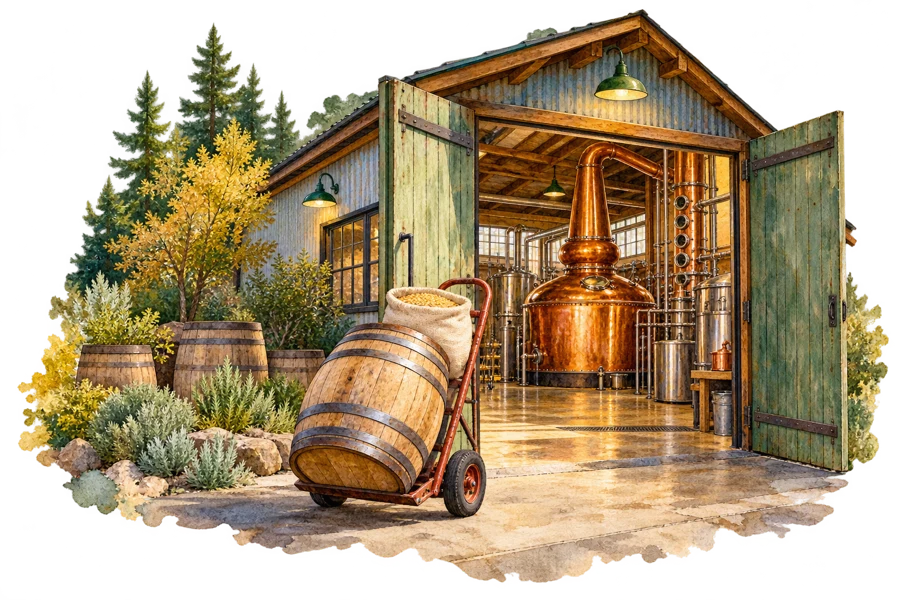
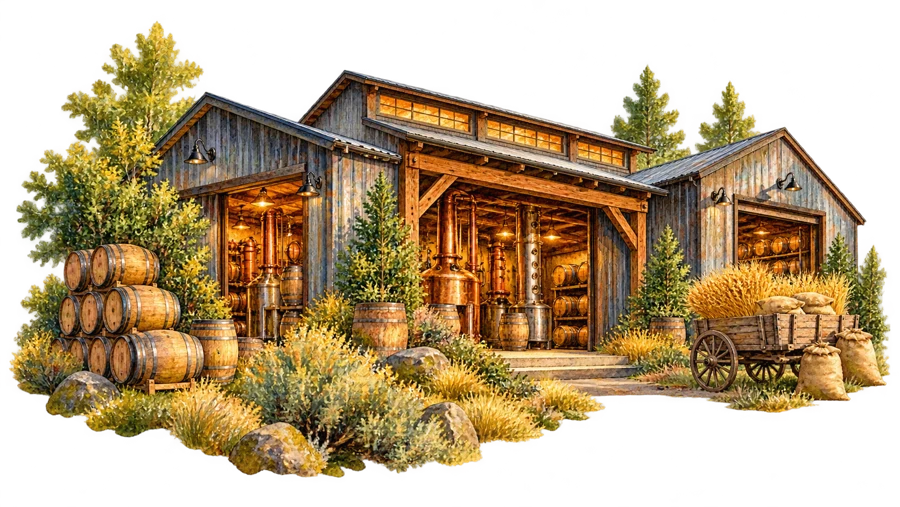
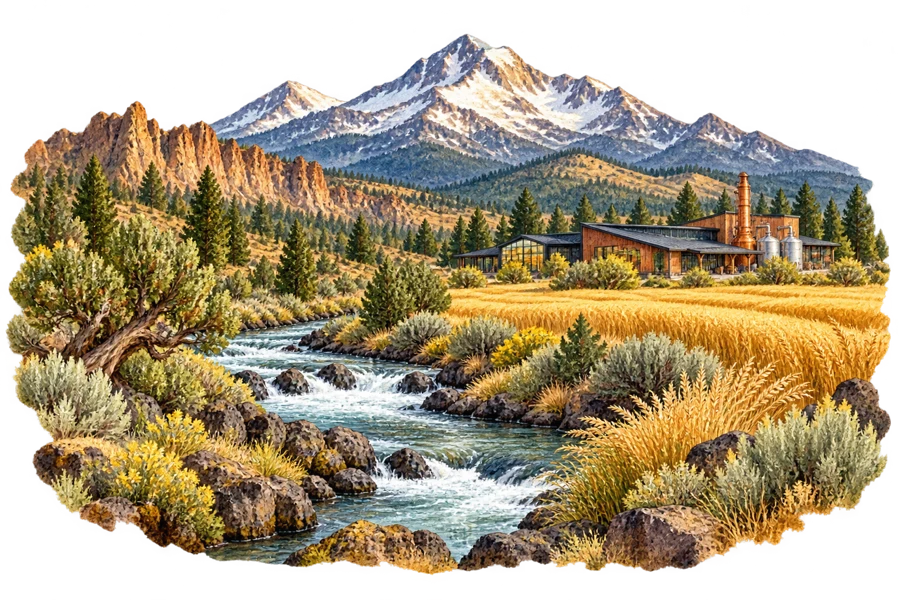
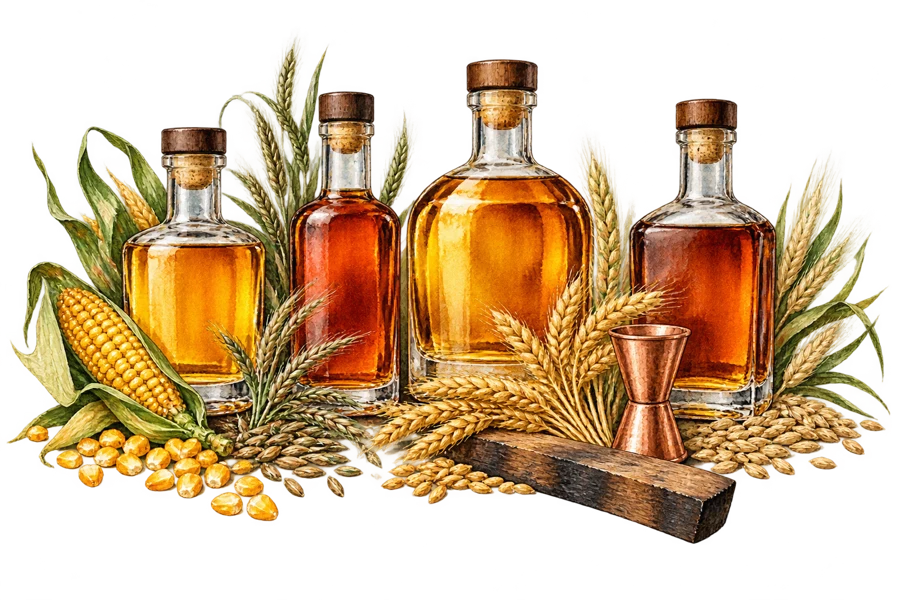
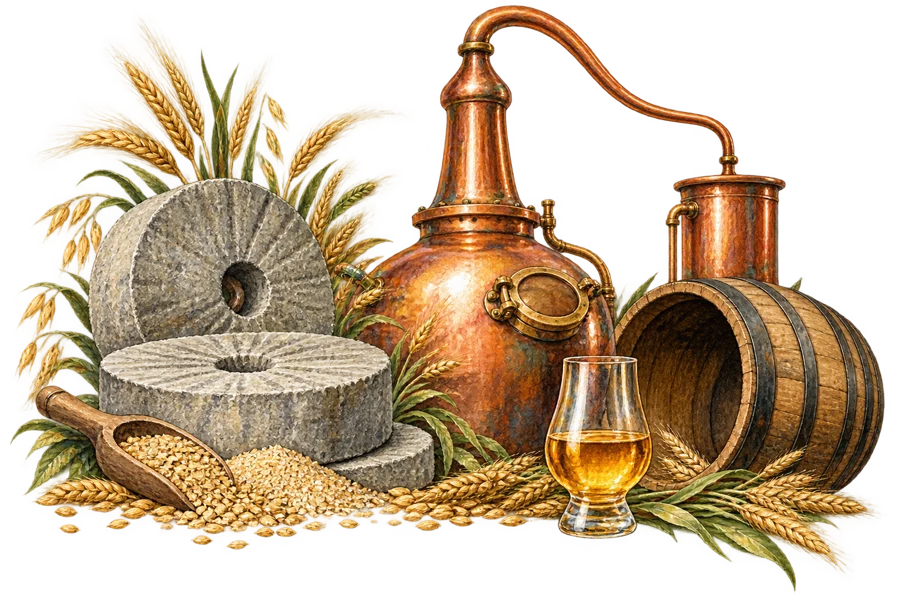
Original watercolor interpretations accompany the history. Buildings, objects and scenes are symbolic, not documentary reconstructions.
03 / Geography & roles
One name. Several places that matter.
Bend · the working distillery
The current visitor address is 740 NE First Street. Production and public hospitality belong to the same Bend home, rather than separate invented campus locations.[13]
The first industrial workspace · an earlier chapter
Early reporting places the business in a modest eastside warehouse. It belongs to the origin story; a verified historical street address has not been established here.[17]
High-desert farms · ingredients before the still
The 2024 media kit reports 95% of grain purchases from Oregon, with the balance from Idaho or Washington. Those are dated sourcing figures, rather than an audited permanent percentage.[15]
Madras · malt with a specific origin
The malt whiskey page identifies Mecca Grade Estate Malt as the source of 30% of its malt, with the rest also Oregon-grown. This is an ingredient relationship, not another Oregon Spirit distillery.[8]
NE Hawthorne & First · neighborhood experiments
The Hawthorne Series takes its name from the distillery’s corner. Regional casks and collaborations give the bottle shop another role: a place for small releases alongside the core whiskeys.[12]
04 / The whiskey family
Understand the name on the label.
Trace the producer, its expression families and the distinct roles of collaborators and historical personnel.
Oregon Spirit Distillers
Producer / distillery
The Bend distillery and producer. Its own media kit says it mashes, ferments and distills its whiskey on site, rather than purchasing finished whiskey.[15]
The Irwin family
Founding / ownership
Brad and Kathy remain the named owners in the current company account. Family ownership describes the business; it does not erase the contribution of a wider production team.[1]
Oregon Spirit whiskey
Whiskey family
The shared name covers distinct grain-led expressions. Bourbon, rye, wheat and malt should be read as different recipes and categories within the producer’s range.[11]
The bonded single-barrel range
Expression families
Bourbon, rye and wheat each have their own 100-proof bonded expression. Individual barrel codes keep these selections identifiable instead of making every bottle interchangeable.[5][9][10]
Kelvin Cooperage
Barrel supplier
The production account names Kelvin as its barrel maker. This is a cooperage relationship, not an ownership link or a second production address.[3]
Hawthorne Series collaborators
Local release collaborations
Coffee roasters, winemakers and reused regional casks help shape limited projects. These are collaborations attached to particular releases, rather than a claim that every whiskey receives a wine finish.[12]
Oregon Whiskey Festival participants
Community / event partners
The 2026 organizer list includes other Oregon producers. Sharing the festival tent establishes participation in an event, not a corporate family or a common distilling source.[14]
05 / Making & choosing
The choices behind the label.
Recipes, fermentation, oak and mingling shape the whiskey. Keep every specification tied to the expression and edition named.
Grain is milled at the distillery
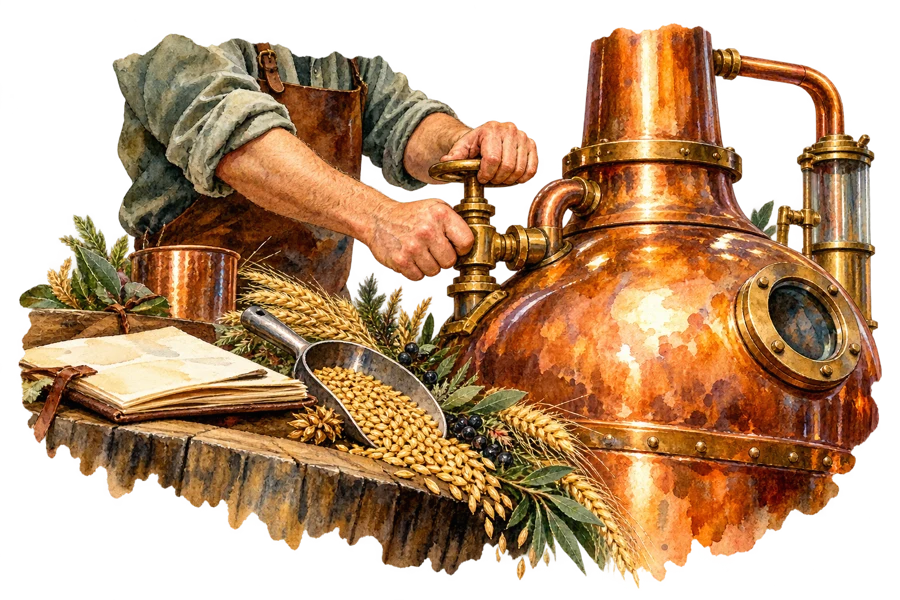
The process begins with regional grain arriving at the mill. Milling prepares it for mashing, where water and later yeast turn a raw ingredient into the beginning of a spirit.[3]
Two runs, followed by judgment
The producer describes a stripping run, then redistillation of the low wines with cuts. The important editorial point is selection: the whiskey is shaped before it enters wood.[3]
Four grains in the bourbon
Corn, rye, wheat and malted barley appear in the current bourbon description. It specifies four years in new American white oak and marriage of barrels before bottling at 94 proof. Exact percentages are not inferred from the four-grain description.[4]
Rye with a clear grain identity
The standard rye is described as 100%Oregon-grown rye, four years old and 90 proof. That recipe differs from the bourbon even though both are made by the same team in Bend.[6]
Winter wheat with supporting grains
The current wheat page lists winter wheat, rye and malted barley, with a five-year age and 90 proof. Its wording about touches of grain concerns the recipe; it does not establish a finishing-cask treatment.[7]
Malt with an Oregon address
The malt whiskey combines two Oregon malt sources, including Mecca Grade in Madras. The page describes four years of maturation and 88 proof. Grain provenance adds detail beyond the broad word malt.[8]
Marriage and individual character
The blender’s profile explains a working pattern in which most mature barrels are married for consistency and one is retained for the bonded program. Read this as the producer’s process account, not a fixed guarantee for every historical batch.[2]
Time in an arid landscape
The production page attributes part of maturation’s character to temperature swings and dry conditions, and says barrels are not topped off. It offers a place-based explanation, without quantifying a universal shortcut to age.[3]
06 / The details worth knowing
The stories inside the barrels.
A brother behind an early name
The 2013 reporting explains C.W.Irwin Bourbon as a tribute to Brad’s younger brother, who supplied important early capital. A family name on an old label can carry a business story as well as a tasting identity.[17]
Wheat was part of the ambition early
Brad dates Ottis Webber wheat whiskey to 2014. The current page records a 2022 American Distilling Institute category award, reflecting a longer commitment to this grain.[16][7]
A building that needed imagination
The 2019 account recalls a well-used property converted for distilling and hospitality. The restaurant later became a tasting room.[18]
The distillery looked outward in 2020
The sanitizer campaign names local public agencies and home-health organizations among recipients. This chapter records a historical community response; it is separate from whiskey production and from any current fundraising request.[19]
A festival becomes an education
The first festival report emphasizes makers pouring their own whiskey and answering questions. A glass under a tent becomes a way to compare grains and maturation with the people responsible for them.[20]
Single barrel and cask strength answer different questions
The portfolio includes a seven-year single-barrel bourbon at cask strength, described around 116 proof. One term identifies a barrel’s identity; the other concerns bottling strength. The approximate number must not replace a particular bottle’s proof.[11]
A neighborhood can be a release idea
Hawthorne projects use local materials and regional collaborators. The page’s numbered gin and amaro releases also show why the series should not be described as whiskey-only.[12]
Craft extends beyond the still
The April 2026 commission agenda gives Brad a public industry role as well as a distillery role. A scheduled sector presentation is evidence of involvement, while the agenda alone cannot tell us what he ultimately said.[21]
07 / Selected expressions
Different ways into the whiskey family.
A curated reading of the whiskey family, selected for its role in the story. This is not an exhaustive current catalog.
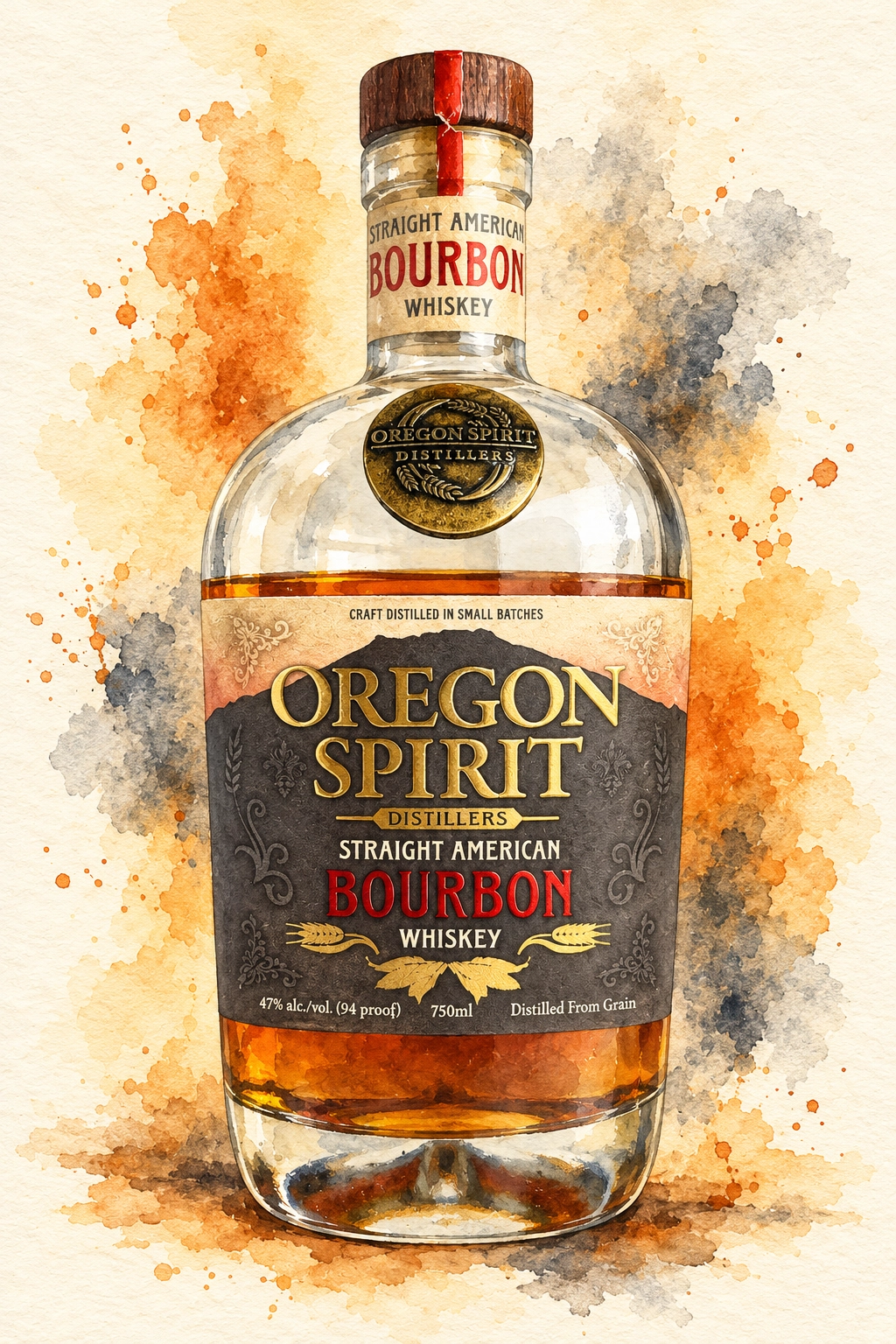
Straight American Bourbon ·94 proof
A four-grain, four-year introduction to the house’s grain-and-oak approach. The standard bottling marries barrels for a consistent profile.[4]
Bottled in Bond Bourbon ·100 proof
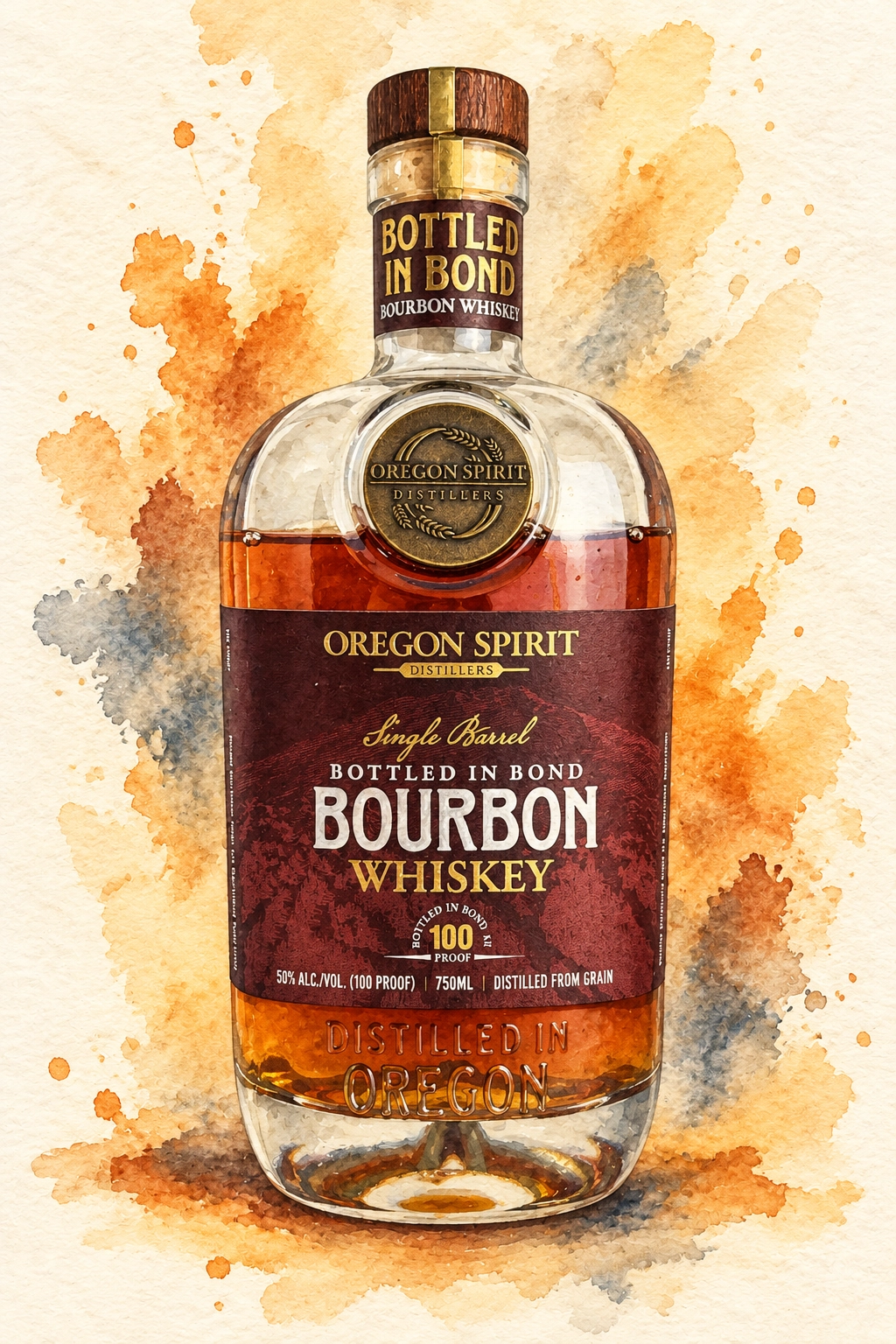
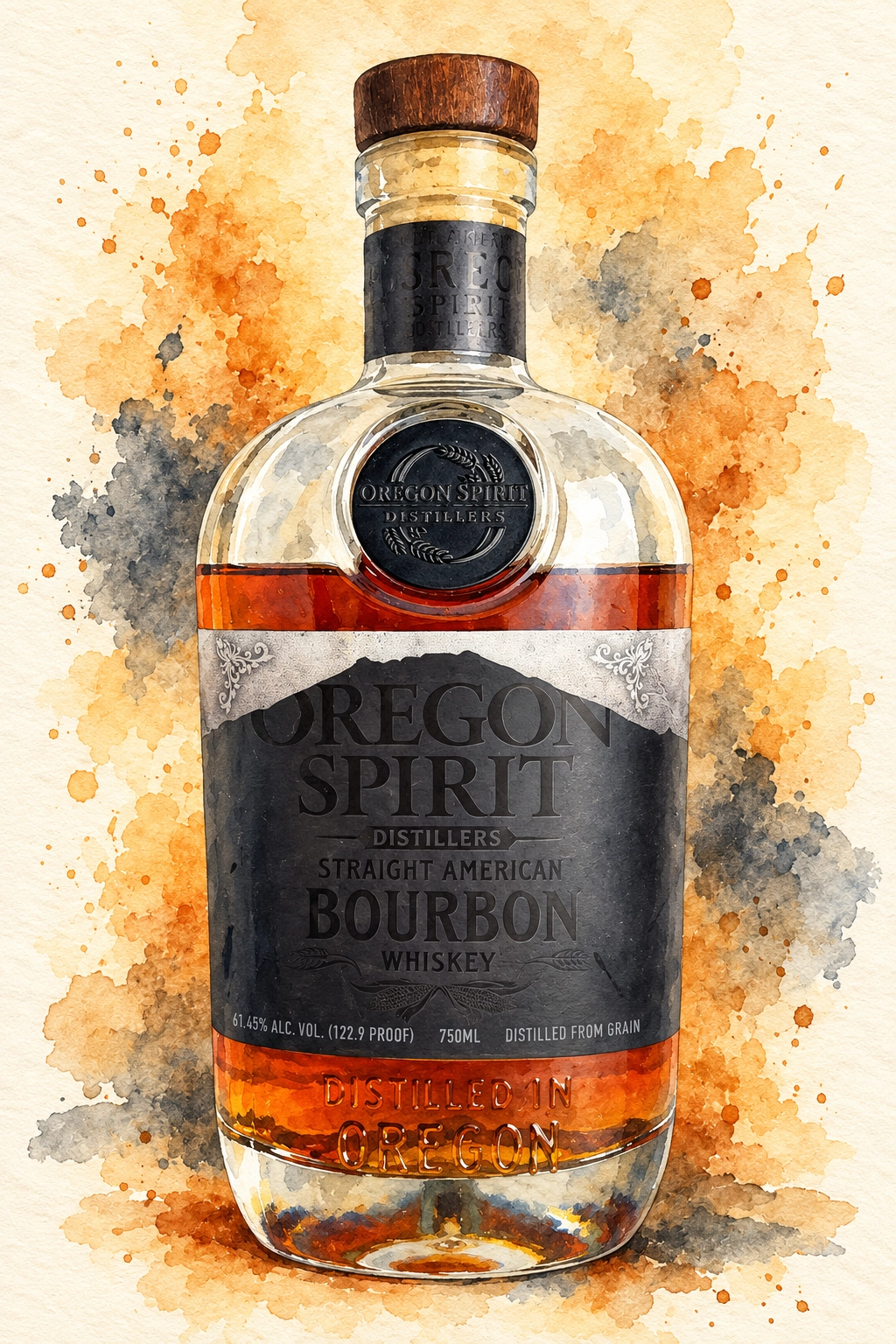
An individual barrel selection identified by its barrel code. The maker’s current page presents this as a 100-proof expression; the barrel remains part of the bottle’s identity.[5]
Straight American Rye ·90 proof
A 100%rye recipe from Oregon-grown grain. Its four-year maturation offers another way to compare the distillery’s grain choices.[6]
Straight American Wheat ·90 proof
The current five-year expression puts winter wheat at the center, supported by rye and malted barley. It deserves attention as its own whiskey family.[7]
Straight American Malt ·88 proof
An Oregon-malt expression with a stated Mecca Grade component. It broadens the range beyond corn-led bourbon and rye.[8]
Bonded Rye & Bonded Wheat ·100 proof
Two separately selected families in the single-barrel program. Neither is interchangeable with the bourbon simply because all carry the bonded name.[9][10]
Seven-year single-barrel bourbon
A stronger, older route through the portfolio. Proof varies, so the actual bottle label is more precise than the producer’s approximate 116-proof description.[11]
08 / The Reserve connection
Continue from the story to the bottles.
Oregon Spirit Distillers in The Thelen Reserve
Approved watercolor artwork is shown wherever an exact physical record or confirmed release match is available. Each physical bottle keeps its own verified details.
Researched October 17, 2026. Official brand and company pages, dated announcements and clearly identified supporting sources are distinguished in the research. Product specifications are release- and market-specific.
Research qualifications
First-in-region claims vary across sources. This profile uses the verified 2009 founding without asserting a regional first.[1]
Early bourbon dates differ:2013 reporting refers to the prior fall; Brad’s 2017 interview gives 2013. The timeline keeps 2012–2013.[17][16]
Accounts agree on 2014 expansion; build-out duration differs. Purchase, move and opening remain distinct.[18]
The inaugural festival article is dated September 2021. Its body and event box disagree on the day; this profile uses month/year.[20]
The current portfolio’s seven-year bourbon links to the malt page through Learn More. The written bourbon description is cited without treating that destination as a matching product page.[11]
The 2024 kit is a dated statement of grain sourcing and awards. Production totals and size rankings are not carried forward as current facts. Current expression ages do not establish the age of older physical bottles.[15]
The 2026 festival is described as scheduled by the organizer. The OLCC agenda establishes a planned presentation, not a verified transcript or completed attendance record.[14][21]
Full sources
About the family-owned distilleryFounders, 2009, Bend and family ownership. Note: First-in-region language is a producer claim; omitted as a superlative.
Meet our distillersCurrent roles, blending and 2025 return. Note: Team page contains a 2025 update, not a dated appointment notice.
ProductionMilling, fermentation, two runs, spent grain, Kelvin barrels and climate. Note: Producer explanation; no quantified maturation advantage inferred.
Straight American BourbonFour grains, four years, 94 proof and 2017 awards. Note: Specifications describe the current standard expression.
Bottled in Bond BourbonSingle barrels, unique barrel codes and 100 proof. Note: Its not-less-than 100 proof explanation is imprecise; no legal definition repeated.
Straight American RyeOregon-grown 100%rye, four years, 90 proof and 2016 recognition. Note: Current expression, not every historical release.
Straight American WheatWinter wheat, rye, barley, five years, 90 proof and 2022 category award. Note: Touches of grain describes recipe ingredients, not a cask finish.
Straight American Malt70/30 malt sourcing, Mecca Grade, four years and 88 proof. Note: No launch date or additional regulatory category inferred.
Bottled in Bond RyeIndividual barrel selection and 100 proof rye. Note: Read exact bottle labels for release identity.
Bottled in Bond WheatIndividual barrel selection and 100 proof wheat. Note: Current family description is not a universal age statement.
Whiskey portfolioSeven-year single-barrel cask strength and broad grain-led range. Note: Seven-year item has a mismatched Learn More link; approximate 116 proof is not fixed.
Hawthorne distillery exclusivesNeighborhood name, regional cask collaborations and numbered limited releases. Note: Undated listings do not establish launch years or current stock.
Visit the Bend distilleryCurrent address, tasting room, bottle shop and tours by appointment. Note: Seasonal hours and availability require direct confirmation.
2026 Oregon Whiskey FestivalOrganizer schedule September 18–19, 2026 and Bend host location. Note: Schedule supports an announced event, not independent confirmation of attendance.
2024 producer media kitRegional grain buying, own production, 2024 wheat recognition. Note: Historic 600-barrel/scale claims not presented as current audited totals.
Early Bend distillery reporting /2013Bartending, bourbon namesake and early release. Note: 2013 article with later metadata; launch-date conflict retained.
A decade in Bend /2019Tenth anniversary, Gary Bishop, facility expansion and historical team. Note: Recollections differ on build-out timing and first whiskey; keep dates qualified.
Kathy Irwin sanitizer campaign /2020March 21, 2020 community sanitizer campaign and named local recipients. Note: Historical campaign; no current donation request or medical guidance.
Inaugural whiskey festival /2021September 2021 inaugural festival, producer participation and education. Note: Body and event box disagree on day; use month and year.
OLCC April 2026 commission agendaBrad Irwin listed for an Oregon craft-sector presentation April 16. Note: Agenda establishes scheduled participation, not a transcript.
Oregon Spirit homeRegional ingredients and whiskey identity. Note: Producer account.