TJ THELEN'S COLLECTION
The Thelen Reserve
Behind the Bottles / A Kentucky flavor vision

Maker’s Mark

Last updated Last researched

Loretto, Kentucky / Bourbon, oak & wheat whisky

One red seal. An expanding world of flavor.

A Maker’s Mark bottle announces itself before the first pour. Behind that red wax is a story of two complementary founders, a Kentucky homeplace and a remarkably durable flavor idea. The later chapters ask how much oak, maturation and grain can change while a recognizable identity remains.[4][17]

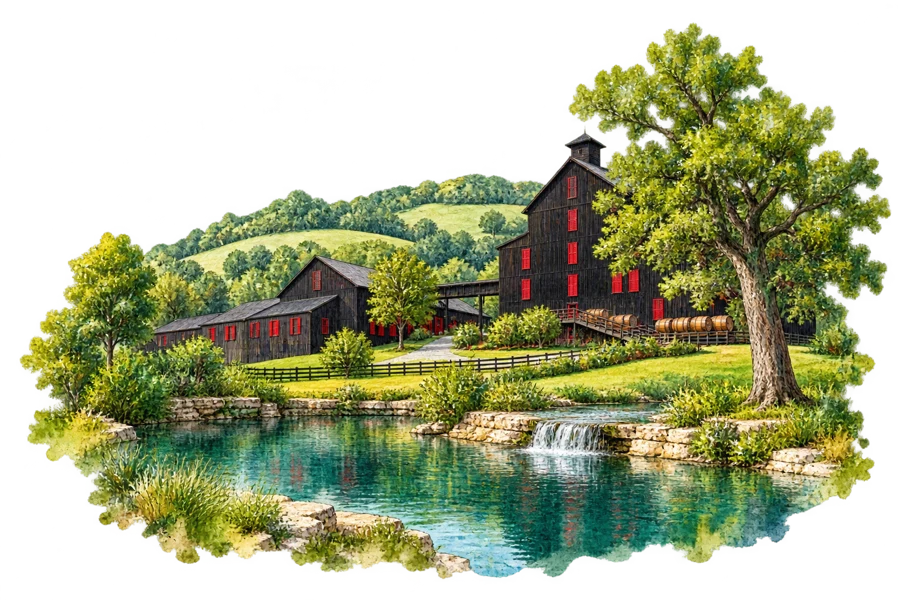
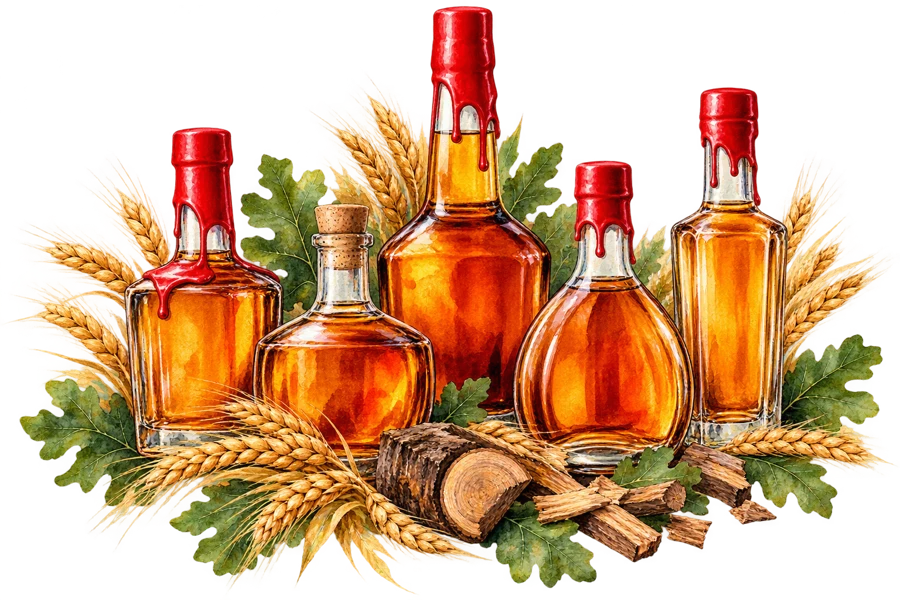
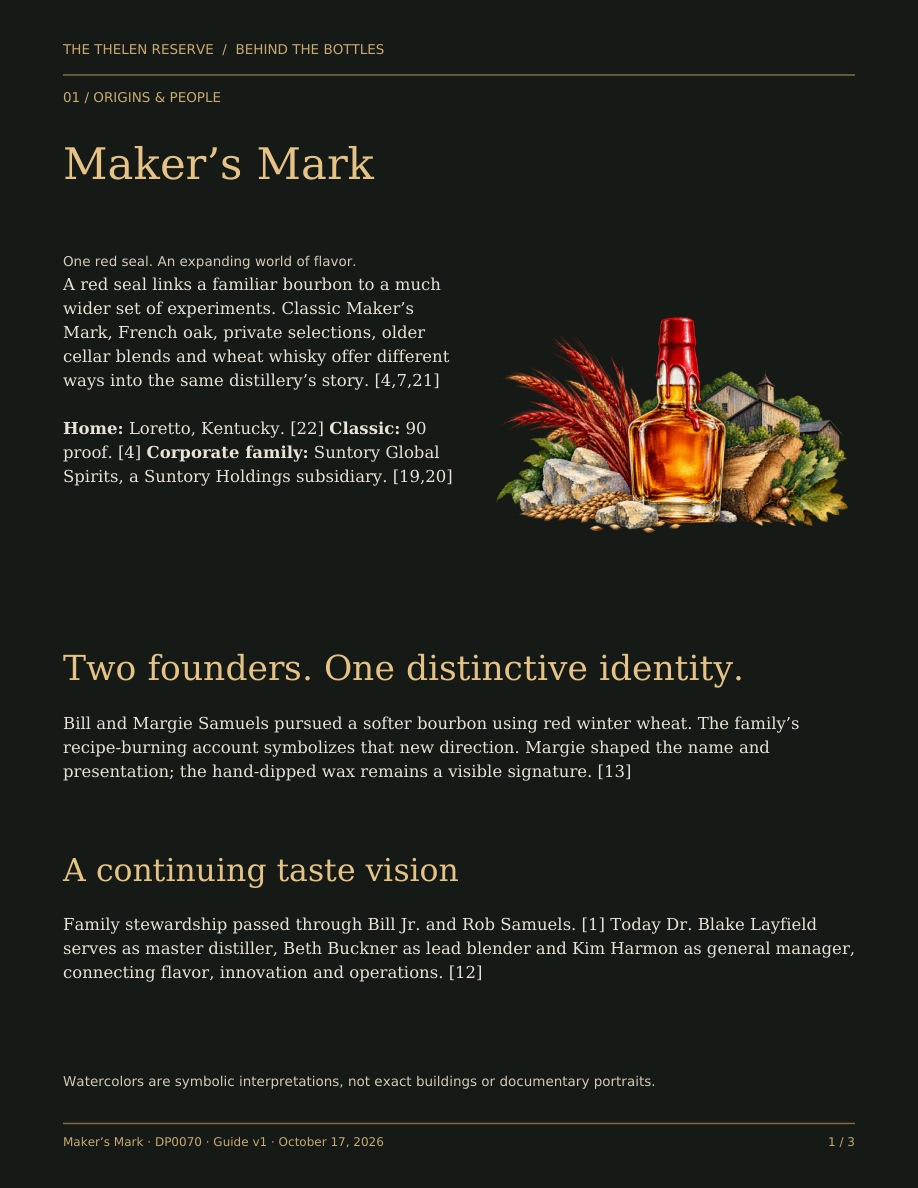
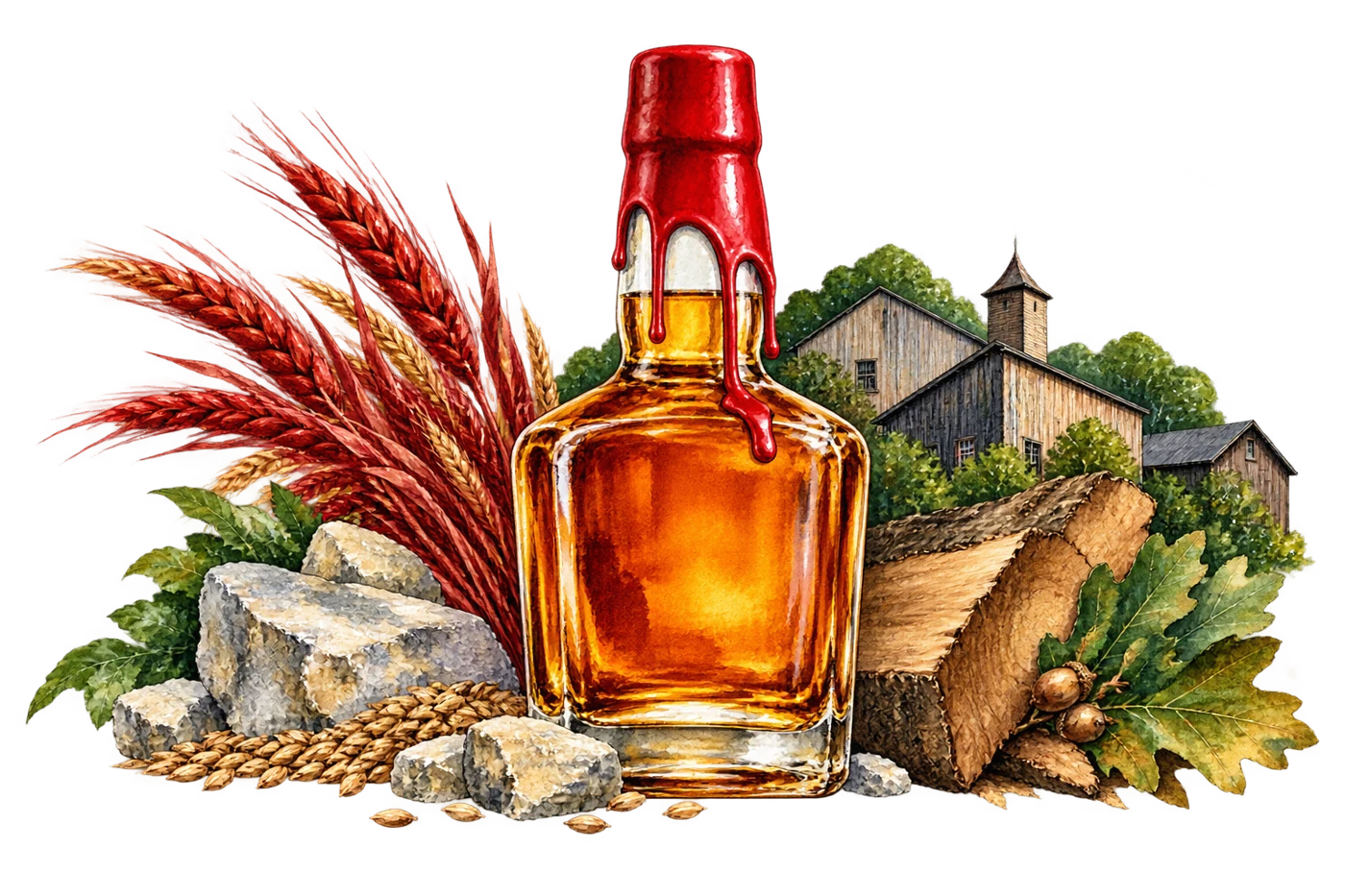
Symbolic red-wax bourbon bottle, wheat, oak and Kentucky distillery
Homeplace
Loretto, Kentucky[22]
Brand founding
1953 · first bottles 1958[10][1]
Master distiller
Dr. Blake Layfield[12]
Parent company
Suntory Global Spirits[20]
01 / Origins & people

A flavor vision. A mark of its own.

A different starting point

Bill and Margie Samuels built a new identity around a bourbon they wanted to drink. The brand’s recipe-burning account presents the decision as a deliberate break with inherited expectations, rather than the continuation of one unchanged ancestral whiskey.[13]

The kitchen before the warehouse

The company describes Bill testing grain ideas through bread baking. It is an origin story about finding a preferred flavor, not a substitute for fermentation, distillation and years in oak.[2]

A design with a point of view

Margie’s work joined the name, bottle, label and red wax into one recognizable presentation. The creative identity was part of the product’s proposition, not a decoration added after the whiskey was finished.[2]

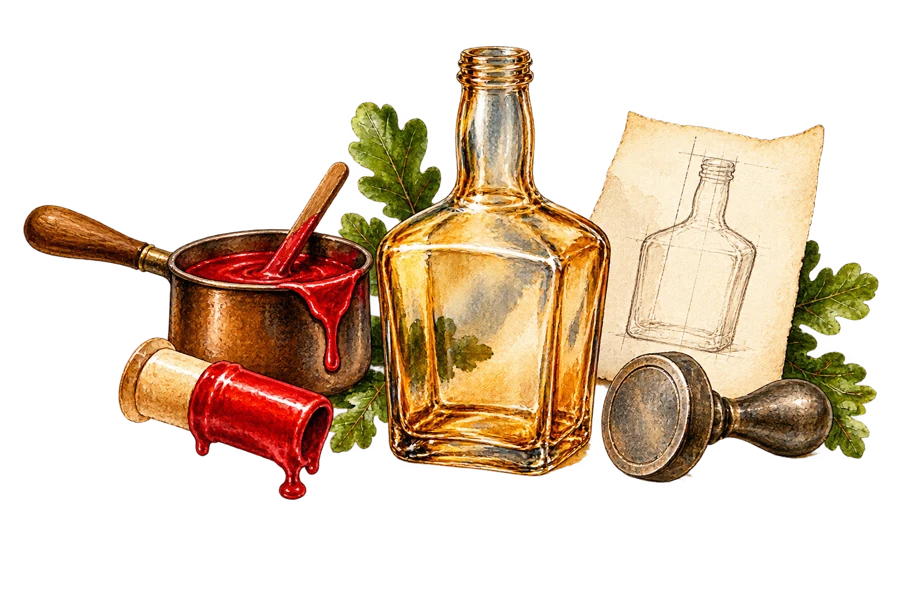
Symbolic bottle-design workbench with wax, a sketch and pewter stamp

Bill Samuels, Sr.

Co-founder · original flavor vision

The founder’s engineering background and flavor ambition anchor the brand’s account of its beginnings. Soft red winter wheat became the defining alternative to a rye-led bourbon recipe.[10]

Margie Samuels

Co-founder · name and design

Co-founder and creator of the bottle’s visual identity. The Kentucky Distillers’ Association lists her in its 2014 Hall of Fame class, recognizing a contribution that extended well beyond packaging.[24]

Bill Samuels, Jr.

Second-generation steward · Maker’s 46

His contribution was both stewardship and experimentation. Maker’s 46 turned the existing bourbon into the starting point for a different experience through French oak finishing.[5]

Rob Samuels

Managing director · eighth-generation whisky maker

The founders’ grandson is identified as managing director. His current work connects the homeplace, agriculture and whiskey, while preserving a distinction between family stewardship and corporate ownership.[21][19]

Dr. Blake Layfield & Beth Buckner

Distillation, flavor and blending

The November 2024 appointment announcement identifies Layfield as master distiller and Buckner as lead blender. Their responsibilities connect consistency with new expressions rather than treating those goals as opposites.[12]

Kim Harmon

General manager · operations

The same announcement identifies Harmon as general manager overseeing operations. It also credits her role in the 2022 B Corp milestone, making operational leadership part of the modern story.[12]

02 / The illustrated history

From the old hollow to a wider world.

Follow the people, partnerships and documented releases. Dates of reporting and partner offerings remain distinct from founding and release dates.
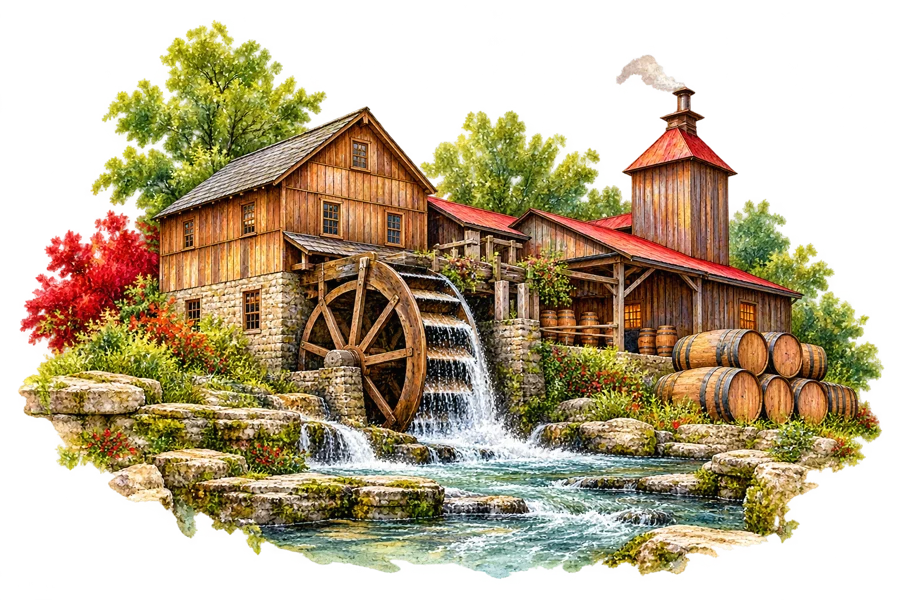
Symbolic illustration: Burks’ distillery takes its enduring shape
1889 / older site

Burks’ distillery takes its enduring shape

The National Park Service record describes rebuilding in the late 1880s. This is site history, preceding the Maker’s Mark brand.[18]
Symbolic illustration: A new flavor vision begins
1953

A new flavor vision begins

Bill and Margie’s founding story centers on abandoning an old recipe and creating a distinctive new bourbon identity.[10]
Symbolic illustration: The red seal reaches a finished bottle
1958

The red seal reaches a finished bottle

The brand dates its first completed, hand-dipped bottles to 1958.[1]
Symbolic illustration: Stewardship passes to Bill Jr.
1975

Stewardship passes to Bill Jr.

Bill Samuels, Jr. takes over the brand’s stewardship from his father.[1]
Symbolic illustration: A business newspaper broadens the audience
1980 / brand chronology

A business newspaper broadens the audience

The brand chronology credits a Wall Street Journal article with introducing Maker’s Mark to a wider audience.[1]
Symbolic illustration: Ambassadors become part of the story
2000

Ambassadors become part of the story

An Ambassador program creates closer connections with the brand’s supporters.[1]
Symbolic illustration: French oak gives Maker’s a second voice
2010

French oak gives Maker’s a second voice

Maker’s 46 enters the market under Bill Jr.’s direction, opening a major wood-finishing chapter.[1]
Symbolic illustration: A third generation takes stewardship
2011

A third generation takes stewardship

Rob Samuels takes over from his father, continuing the family’s involvement in the brand.[1]
Symbolic illustration: The corporate family becomes global
2014

The corporate family becomes global

Suntory’s acquisition of Beam brings Maker’s Mark into the group later named Suntory Global Spirits.[19]
Symbolic illustration: Cask Strength reaches early drinkers
October 21, 2014 / reporting

Cask Strength reaches early drinkers

A contemporary Bourbon Review report documents the new cask-strength release and its limited initial distribution. The date is the report’s publication.[25]
Symbolic illustration: Private Select is announced
October 6, 2015

Private Select is announced

The dated announcement distinguishes the program’s November pilot from participant bottles expected in March 2016.[8]
Symbolic illustration: A limited series explores the wood
September 11, 2019

A limited series explores the wood

The RC6 announcement launches a nationally available limited edition, with American oak staves developed alongside Independent Stave Company.[9]
Symbolic illustration: A wider measure of responsibility
January 26, 2022

A wider measure of responsibility

Maker’s Mark announces B Corp certification, covering workplace, community, governance, customer and environmental performance.[10]
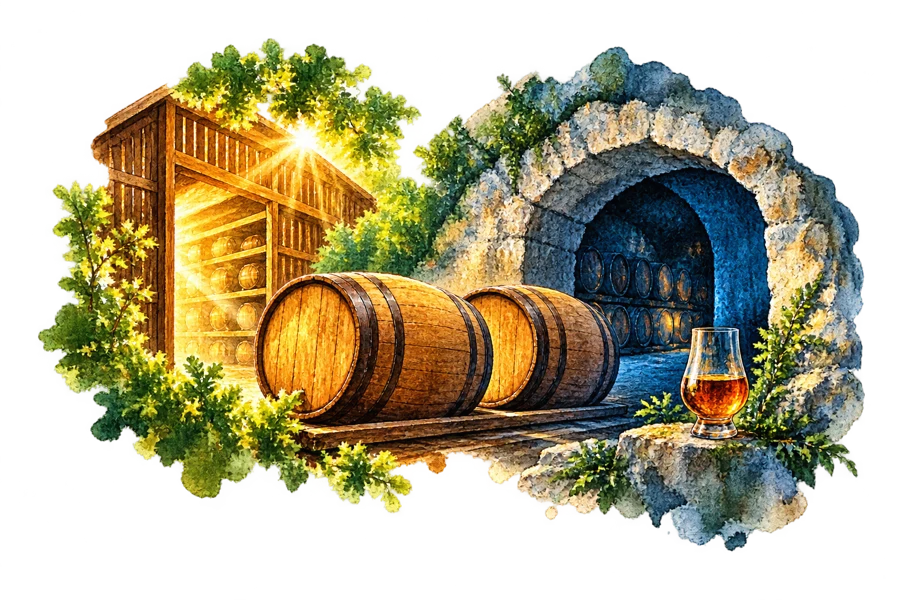
Symbolic illustration: An older expression changes the environment
August 16, 2023

An older expression changes the environment

Cellar Aged debuts with eleven- and twelve-year bourbon matured across traditional warehouses and the cooler limestone cellar.[11]
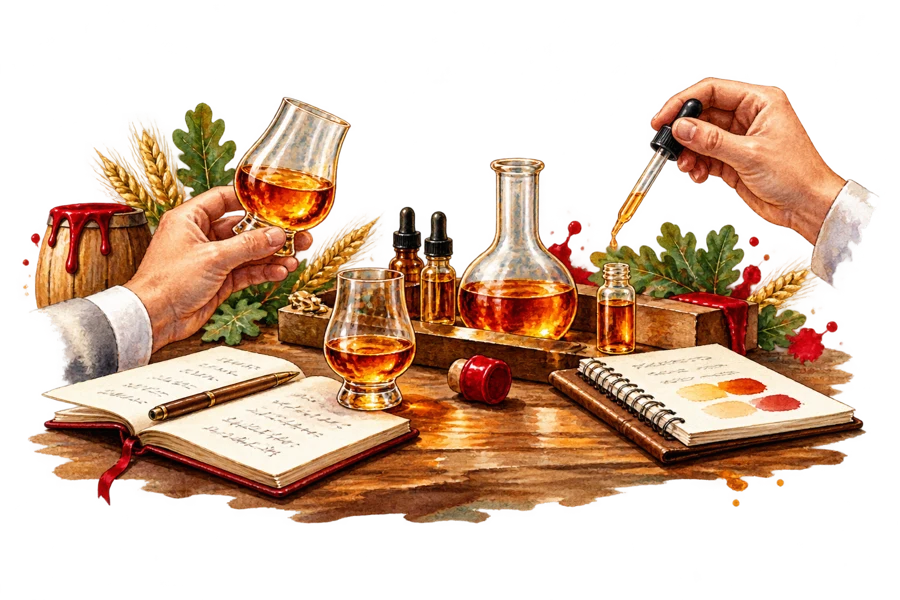
Symbolic illustration: New flavor leadership is named
November 12, 2024

New flavor leadership is named

The company announces Layfield as master distiller and Buckner as lead blender, with Harmon continuing to oversee operations.[12]
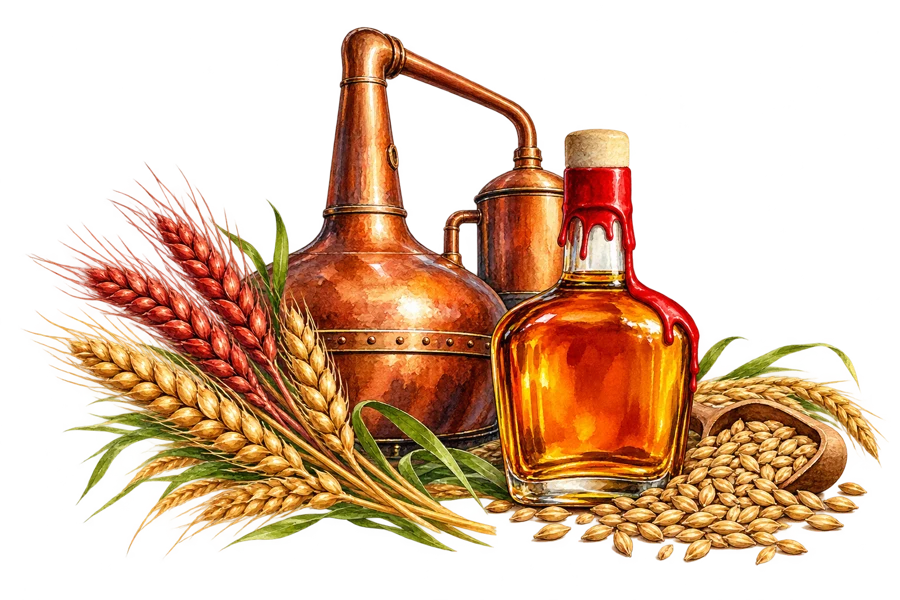
Symbolic illustration: Wheat whisky opens a different category
2025

Wheat whisky opens a different category

Star Hill Farm Whisky debuts as an American wheat whisky. Its grain recipe is distinct from the classic bourbon.[21]
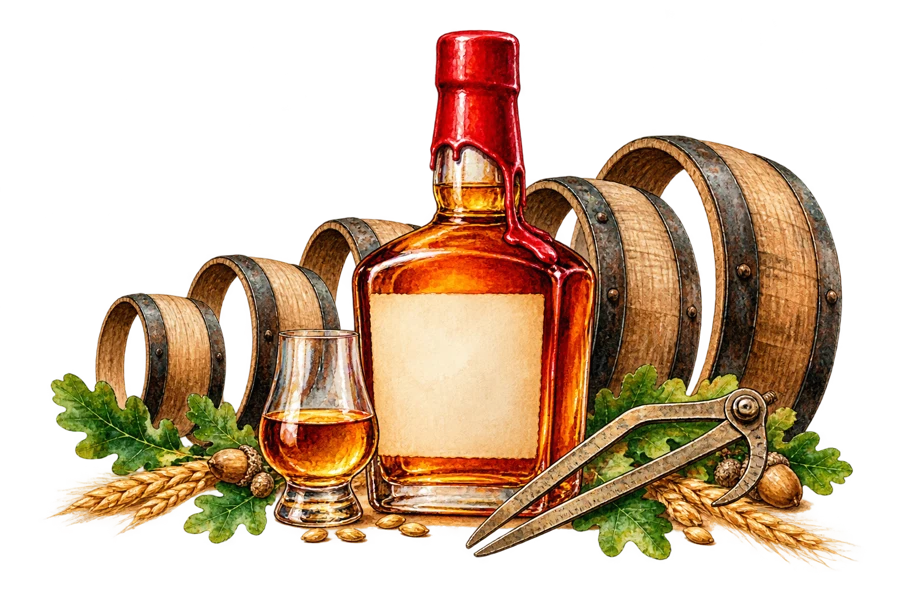
Symbolic illustration: Cask Strength adds age transparency
January 21, 2026

Cask Strength adds age transparency

New packaging carries a precise batch age statement. The announcement describes seven-to-eight-year batches with varying barrel proofs.[13]
Symbolic illustration: The Stewards recognize the operations team
March 9, 2026

The Stewards recognize the operations team

The second Wood Finishing Series continues its people-centered theme, following the Heart and Keepers releases.[14]
Symbolic illustration: Star Hill Farm widens its grain palette
April 22, 2026

Star Hill Farm widens its grain palette

The second annual wheat whisky introduces hard red and hard white wheat alongside the familiar soft red winter variety.[15]
Symbolic illustration: Cellar Aged returns with a new blend
August 18, 2026

Cellar Aged returns with a new blend

The announcement specifies eleven-, twelve- and fourteen-year components, bottled at 112.1 proof.[16]
Symbolic illustration: World Wood takes the experiment abroad
October 6, 2026

World Wood takes the experiment abroad

Expedition 01 joins individually finished Japanese, French and American oak components in a travel-retail-exclusive blend.[17]

Original watercolor interpretations accompany the history. Buildings, objects and scenes are symbolic, not documentary reconstructions.
03 / Geography & roles

One name. Several places that matter.

Symbolic Kentucky landscape and barrel-selection connections

Star Hill Farm · the working homeplace

The current visitor address is 3350 Burkes Spring Road, Loretto. Distilling, hospitality and the brand’s landscape come together here. Tour and access details should be checked directly before a visit.[22]

Happy Hollow · the older industrial site

The historic nomination traces a much older milling and distilling landscape. Its description of the 1889 complex explains why a modern Maker’s Mark tour also encounters architecture from another whiskey era.[18]

The limestone cellar · a different maturation climate

The cooler cellar gives already mature bourbon another environment. Its role in Cellar Aged is extended maturation; it should not be confused with adding finishing staves to every Cellar Aged barrel.[11]

Warehouses · the Keepers’ working landscape

The 2025 Keepers announcement places the warehouse team at the center of consistency. Moving barrels and evaluating their development are human decisions, even when the bottle looks familiar.[26]

Farm and watershed · ingredients before the still

The 2023 certified-barrel announcement connects regenerative grain sourcing with new distillate. A newly filled barrel is a future whiskey project, not evidence that every older bottle already carries the same certification.[23]

04 / The whiskey family

Understand the name on the label.

Trace the producer, its expression families and the distinct roles of collaborators and historical personnel.

Symbolic Maker’s Mark bourbon and wheat-whisky family

Suntory Global Spirits

Current corporate parent

Maker’s Mark appears in its whiskey portfolio. The relationship places the brand alongside other whiskeys without making them one distillery or interchangeable liquid.[20]

Suntory Holdings

Parent of the global spirits company

The group’s 2024 announcement explains the corporate chain and the change from Beam Suntory to Suntory Global Spirits. A renamed parent is not a new founding of the Kentucky distillery.[19]

The Samuels family

Founding and continuing stewardship

Bill Sr., Margie, Bill Jr. and Rob occupy distinct chapters in the brand’s development. Family involvement and corporate ownership are different kinds of continuity.[2][19]

Maker’s Mark & Maker’s 46

Classic bourbon and French oak expression

The 90-proof original provides a reference point; Maker’s 46 adds a French oak finishing treatment and is presented at 94 proof. The number 46 identifies a stave profile, not alcohol strength.[4][5]

Private Selection

Partner-specific finishing program

Individual retailers and restaurants choose finishing-stave combinations. A shared family name does not make two picks identical; proof and stave recipe belong to the individual selection.[7]

Wood Finishing Series

Limited experimental releases

The original limited editions explored flavor through wood. The second series emphasizes the people responsible for the whiskey, including distilling, warehouse and operations teams.[9][14]

Independent Stave Company

Oak research collaborator

The RC6 announcement credits the cooperage partner in developing its American oak treatment. This is a wood-development relationship, not ownership of Maker’s Mark.[9]

Star Hill Farm Whisky

American wheat whisky from the Maker’s Mark distillery

This family expands beyond bourbon. Its annual wheat-focused blends must be described separately from the corn-led base whiskey used for classic Maker’s Mark.[21]

05 / Making & choosing

The choices behind the label.

Recipes, fermentation, oak and mingling shape the whiskey. Keep every specification tied to the expression and edition named.

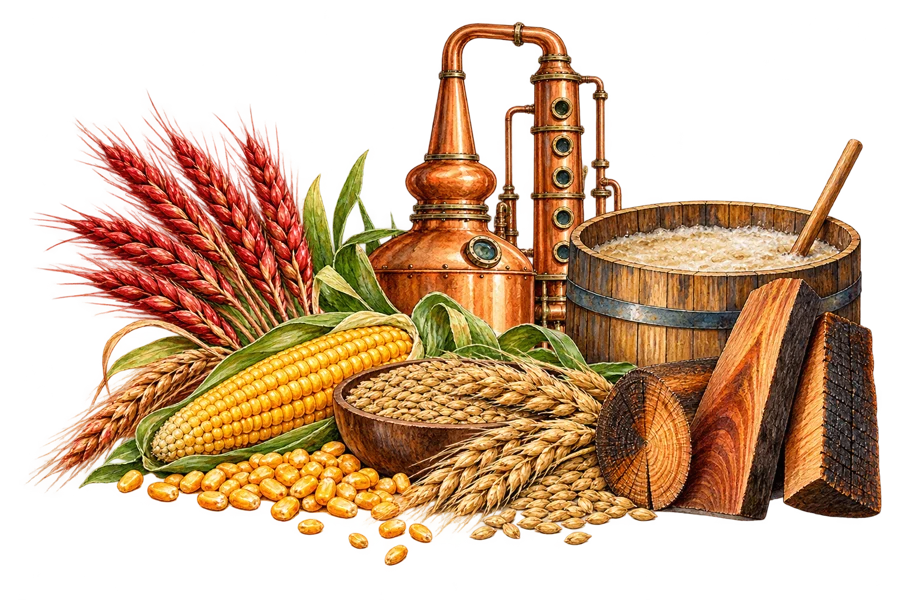
Symbolic mash bills, yeast, copper and oak

Wheat changes the flavor direction

Soft red winter wheat replaces rye in the classic bourbon’s flavor framework. That choice sits alongside water, yeast, distillation and maturation, rather than explaining the whole whiskey on its own.[3]

Water and a continuing yeast culture

The process account emphasizes limestone-influenced water and a protected yeast strain: continuing production choices at the Kentucky homeplace.[3]

Copper and two distillations

Maker’s Mark describes copper column stills and double distillation. Controlled separation prepares the spirit for oak, rather than creating the final aged profile by itself.[3]

The warehouse is managed, not merely watched

The producer describes hand rotation to balance exposure to warehouse temperatures. Its usual six-to-seven-year process estimate is not a universal age statement for every expression or historic bottle.[3]

A stave finish starts with mature bourbon

Maker’s 46 adds ten seared French oak staves after conventional maturation. That is an additional wood treatment, with its own flavor objective, rather than a different original grain recipe.[5]

Private Selection makes the wood choice explicit

The current page describes ten finishing staves, five available types and another nine weeks in the limestone cellar. The combination varies by selection. Current program details should not overwrite an older bottle’s label.[7]

Cellar Aged changes the pace of development

The inaugural release moved mature bourbon from warehouses into a cool limestone environment. Temperature changes the relationship between further development and wood extraction. Blend ages and percentages remain specific to each annual release.[11]

Star Hill Farm starts with different recipes

For 2026, the producer discloses a malted-wheat recipe and a wheat-and-malted-barley recipe. The resulting blend is a wheat whisky, with no corn in those disclosed recipes, rather than a finished version of the flagship bourbon.[15]

06 / The details worth knowing

The stories inside the barrels.

A maker’s mark before a brand logo

The company links Margie’s aesthetic to collected bottles, pewter and period furniture. The package communicated a handmade identity through objects a drinker could recognize before tasting.[2]

A dip is also a human signature

The producer describes different dipping styles on the bottling line and labels cut on a 1935 Chandler & Price press. The little irregularities in presentation make the human work visible.[3]

46 is not the proof

The name refers to Independent Stave Company’s profile number. Separating that name from its 94-proof specification prevents a particularly easy misreading of the label.[5]

A pilot is not a national launch

Private Select’s 2015 announcement scheduled an initial pilot before retail bottles in 2016. Later histories sometimes compress this sequence. Both dates make sense when the events are kept distinct.[8]

The Keepers are people, not a storage technique

The 2025 edition honors the warehouse team. That theme explains the name without turning it into a new legal whiskey category or assuming every bottle has one universal warehouse location.[26]

A certificate and a future crop are different claims

The first certified regenerative barrel was announced in 2023. Those newly distilled contents still needed maturation. Certification language should stay attached to the farm, supply chain or release actually identified.[23]

An older blend can still be a new edition

Cellar Aged 2026 combines 49% eleven-year, 33% twelve-year and 18% fourteen-year bourbon. Those figures describe that blend; the oldest component does not make every drop fourteen years old.[16]

Three oaks do not mean three successive finishes

Expedition 01 blends separately finished whiskeys using Japanese Mizunara, French and American white oak staves. The announcement describes individual components followed by blending, not one whiskey moving through three consecutive finishes.[17]

07 / Selected expressions

Different ways into the whiskey family.

A curated reading of the whiskey family, selected for its role in the story. This is not an exhaustive current catalog.

Maker’s Mark Kentucky Straight Bourbon

The 90-proof original is the most direct reference for the house’s intended balance. It also provides a useful point of comparison before moving into stronger bottlings, oak treatments and alternate grain recipes.[4]

Maker’s 46 French Oaked

The 94-proof expression explores seared French oak. Its profile number and finishing method are more useful clues to its identity than assuming 46 is an age or strength.[5]

Maker’s Mark Cask Strength

The current product page describes a minimum seven-year maturation and 107–114 proof. The 2026 packaging announcement adds precise age labels. Earlier bottles retain their own batch specifications.[6][13]

Private Selection

A selection-specific expression shaped by a finishing-stave recipe. The label’s proof, partner name and stave breakdown matter; a nickname alone is not a complete production specification.[7]

Wood Finishing Series · The Stewards 2026

The operations-themed release follows Heart 2024 and Keepers 2025. The announcement identifies two proofs, 109.6 and 113.3; its inconsistent ABV pairing is retained as a research qualification rather than repeated.[14]

Cellar Aged · 2026

An eleven-, twelve- and fourteen-year blend at 112.1 proof. The dated announcement scheduled U.S. availability from September 1, with other markets following. These details belong to the 2026 edition.[16]

Star Hill Farm Whisky · 2026

The second wheat-whisky release combines seven- and eight-year components at 116.4 proof. Its derived blend contains 27% wheat, 62% malted wheat and 11% malted barley, illustrating a different direction from the classic bourbon.[15]

World Wood Collection · Expedition 01

Announced October 6, 2026 for global travel retail, the one-liter expression is 47.5% ABV. It widens the wood-finishing vocabulary without becoming a general replacement for Maker’s 46 or Private Selection.[17]

08 / The Reserve connection

Continue from the story to the bottles.

Maker’s Mark in The Thelen Reserve

3 physical bottle records connect this story to the collection. Each keeps its own proof, barrel, batch, pick and release details.

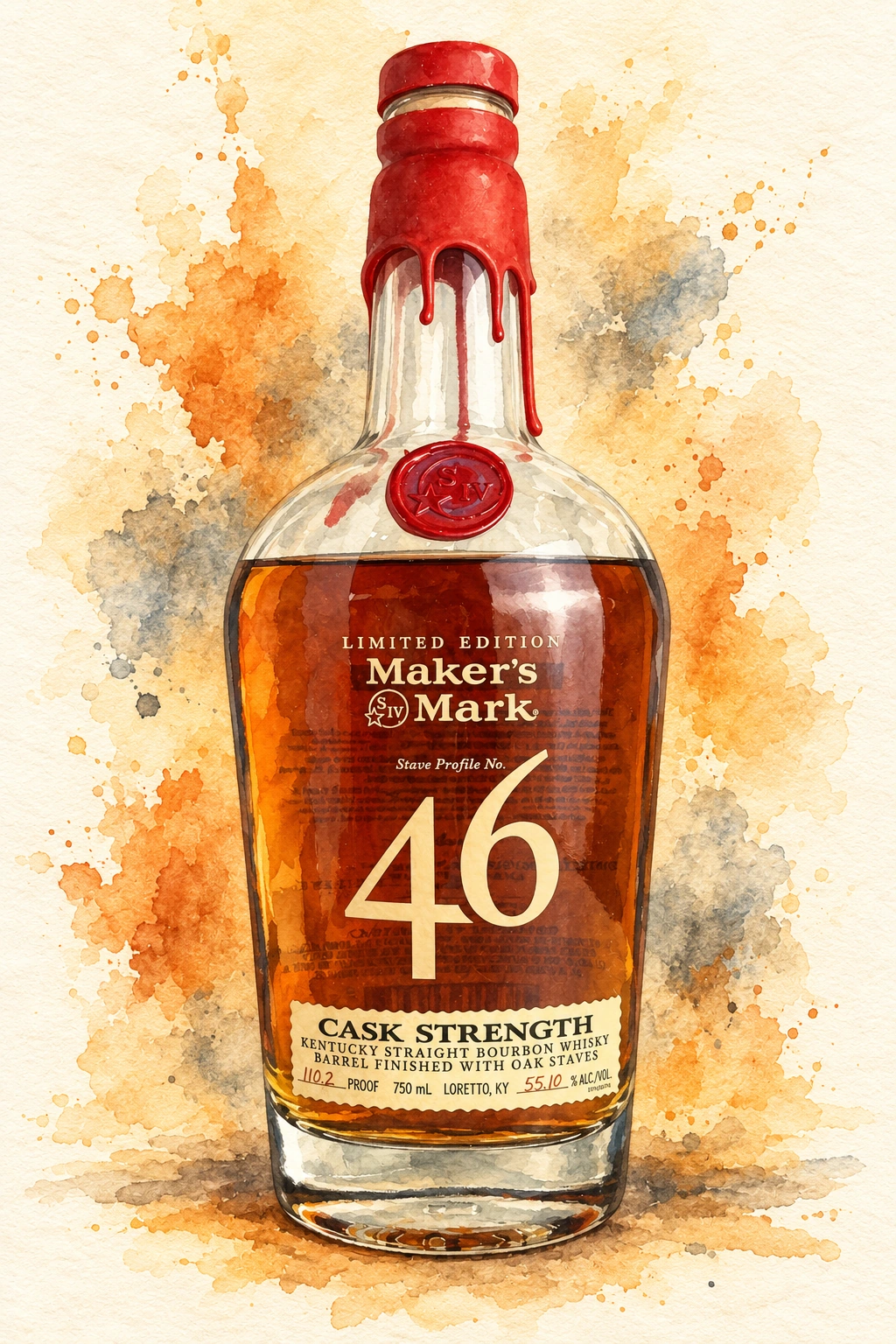
Approved watercolor of Maker's Mark 46 Cask Strength

Maker's Mark 46 Cask Strength

W0307 · 110.2 proof

Physical label: Stave Profile No. 46; 110.2 proof. No numeric age, batch ID or exact release date is shown.

Approved watercolor of Maker's Mark Private Selection - Fireside Spice

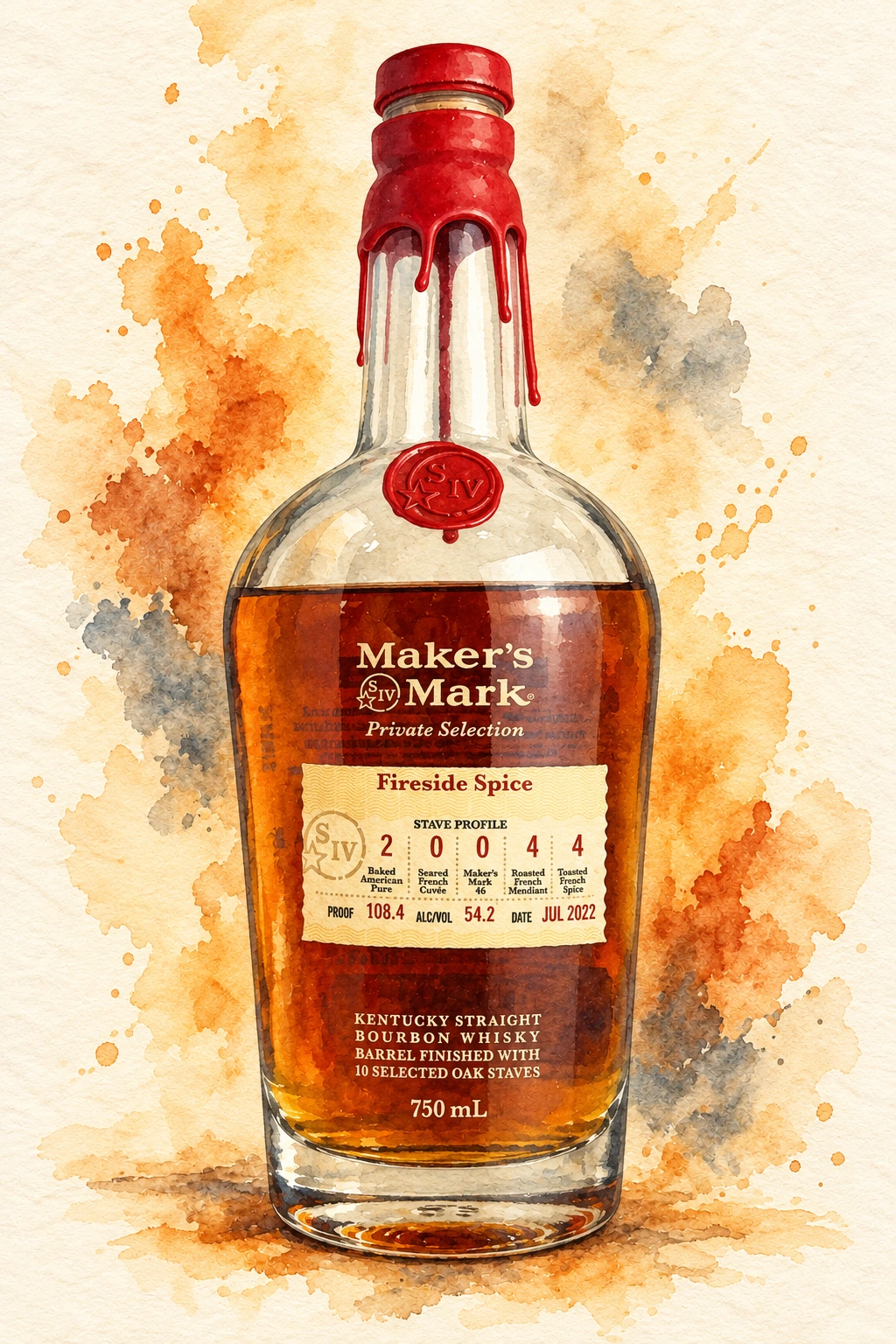
Maker's Mark Private Selection - Fireside Spice

W0308 · 108.4 proof · Pick Total Wine & More

Fireside Spice; Total Wine & More pick. The producer label date is July 2022; no exact day is inferred.

Approved watercolor of Maker's Mark Private Selection - The Butterscotch Effect - IBN

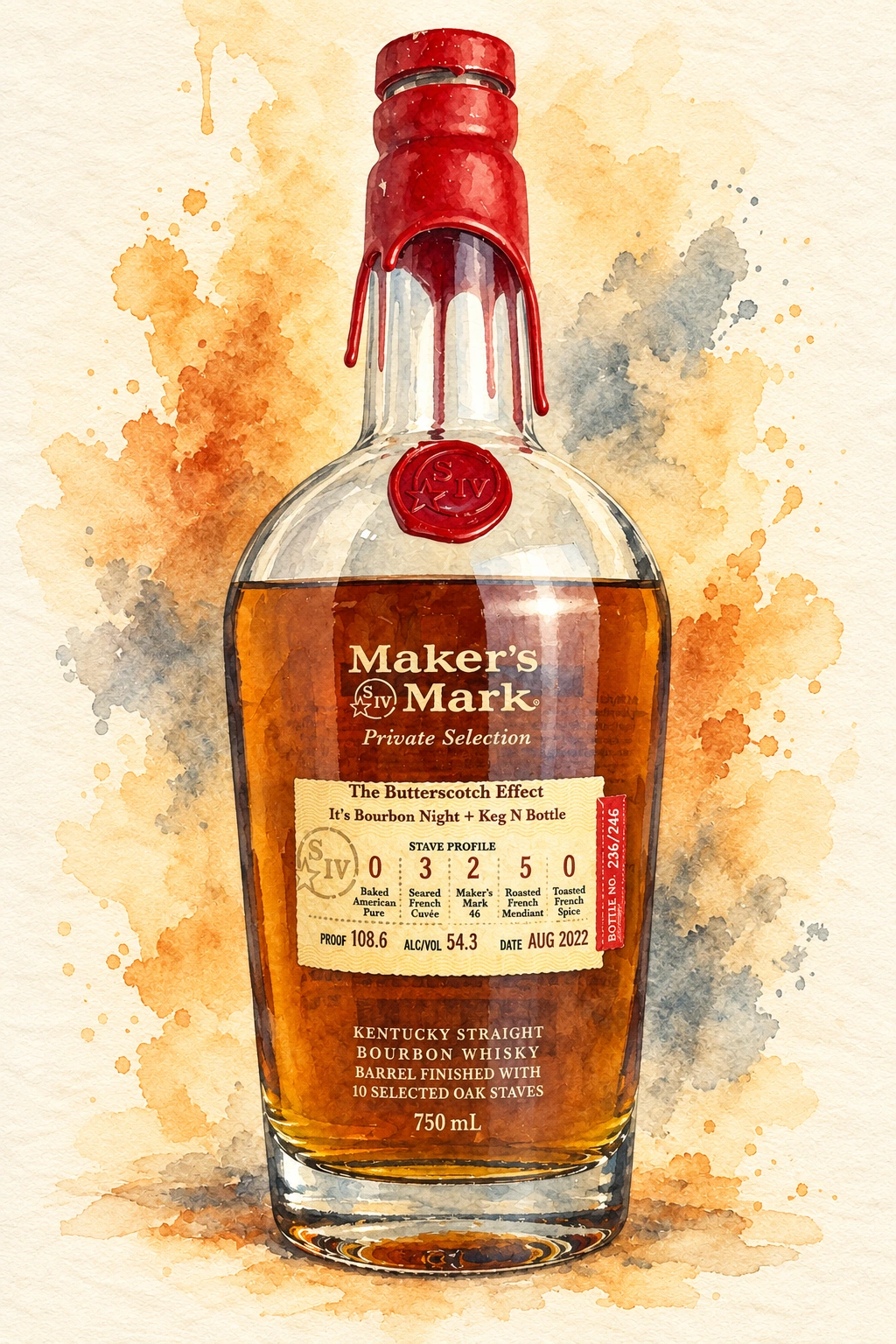
Maker's Mark Private Selection - The Butterscotch Effect - IBN

W0309 · 108.6 proof · Bottle 236/246 · Pick It's Bourbon Night + Keg N Bottle

Physical label: The Butterscotch Effect; It’s Bourbon Night + Keg N Bottle; bottle236/246; AUG2022. Stave recipe0/3/2/5/0: Baked American Pure, Seared French Cuvée, Maker’s Mark46, Roasted French Mendiant, Toasted French Spice.

Collection snapshot: October 23, 2026. Three physical records, each linked to its own inventory entry. Batch and proof distinctions are preserved.

Maker’s Mark three-page guide cover
The illustrated companion

Maker’s Mark, in three pages.

Origins and people, history and places, whiskey and stories. A concise companion to this complete profile, with linked research sources.

Sources & research notes

Researched October 17, 2026. Official brand and company pages, dated announcements and clearly identified supporting sources are distinguished in the research. Product specifications are release- and market-specific.

Research qualifications

  • Current timelines include a 1952 site-start entry; corporate histories use 1953 for Maker’s Mark’s founding. The Burks site, brand and 1958 finished bottles remain separate events.[1][18][10]
  • Private Select chronology: the original October 2015 announcement specifies a November pilot and participant bottles from March 2016. This profile preserves that sequence instead of choosing one blanket launch year.[8]
  • Margie Samuels: the KDA’s own class list gives 2014. A corporate brand-DNA page says 2017; the association record is preferred for the induction year.[2][24]
  • The Stewards 2026 announcement pairs 109.6 proof with 59.4% ABV, which is mathematically inconsistent. This profile uses its stated proofs and omits that mismatched ABV. Cellar Aged 2026 specifications come from the article body, not its generic footer.[14][16]
  • Annual and market-specific specifications do not identify older private selections. Cask Strength packaging changed in 2026; Star Hill Farm wheat whisky and Cellar Aged blends also change by edition. Research checked October 17, 2026.[7][13][15]

Full sources

  1. Our family’s storyBrand chronology, first bottles and family stewardship. Note: 1952 site-start entry conflicts with corporate 1953 founding framing.
  2. Maker’s Mark brand DNAFounders, bread trials and Margie’s creative work. Note: Promotional history; induction year conflicts with KDA.
  3. How it is madeWheat, water, yeast, copper, rotation, hand work and typical maturation. Note: Typical process estimates are not all-release age statements.
  4. Classic Kentucky Straight BourbonCurrent flagship presentation and 90 proof.
  5. Maker’s 46 French OakedTen French staves, profile name and 94 proof.
  6. Cask Strength productCurrent barrel-proof expression and minimum age. Note: Current specifications do not backdate earlier editions.
  7. Private Selection productSelection-specific finishing, ten staves and nine weeks. Note: Stave menu can change; older labels remain authoritative.
  8. Private Select launch announcement2015 pilot and 2016 retail timeline. Note: Contemporaneous announcement preferred over compressed later histories.
  9. RC6 / first national limited release2019 RC6, Independent Stave Company and Jane Bowie’s historical role. Note: Historical release specifications, not a current universal formula.
  10. B Corp certification announcement2022 certification and areas assessed.
  11. Cellar Aged debut2023 debut and warehouse-to-cellar maturation. Note: Its later Private Selection summary compresses the earlier pilot/retail dates.
  12. Master distiller and leadership appointmentsLayfield, Buckner, Harmon and their responsibilities.
  13. Cask Strength’s new look2026 packaging, precise age label and batch range.
  14. The Stewards 2026Operations-team theme, series chronology and two stated proofs. Note: 109.6-proof /59.4%-ABV pairing is inconsistent; ABV omitted.
  15. Star Hill Farm Whisky 2026Second release, grain recipes, blend, ages and 116.4 proof.
  16. Cellar Aged 2026Blend percentages, ages, 112.1 proof and availability. Note: Article-body specifications preferred over generic footer.
  17. World Wood Collection / Expedition 01Three separately finished oak components, blend and travel-retail release.
  18. Burks’ Distillery historic nominationOlder site history and late-1880s fabric. Note: Historical nomination, not a present-day operations inventory.
  19. Beam Suntory becomes Suntory Global Spirits2014 Beam acquisition, 2024 rebrand and corporate chain.
  20. Suntory Global Spirits whiskey portfolioCurrent Maker’s Mark corporate portfolio relationship.
  21. Star Hill Farm Whisky product2025 debut context, current wheat-whisky identity and estate certification. Note: Current page is primarily the 2026 edition.
  22. The Loretto distillery and visitsCurrent homeplace address and visitor role. Note: Booking and access can change; check before travel.
  23. First certified regenerative barrel2023 newly filled certified barrel and farming work. Note: New distillate is not already-mature bottled whiskey.
  24. Kentucky Bourbon Hall of FameKDA lists Margie Samuels in 2014. Note: Association record preferred to conflicting brand-DNA year.
  25. Maker’s Mark Cask Strength / contemporary reportDocuments early release and limited distribution in 2014. Note: Publication date is not asserted as exact first sale.
  26. The Keepers Release 2025Warehouse-team theme and series context.
↑