TJ THELEN'S COLLECTION
The Thelen Reserve
Behind the Bottles / Kentucky bourbon

Four Roses

Last updated Last researched

Ten recipes / Two Kentucky homes

Ten recipes. Two Kentucky homes. A bourbon that found its way back.

Four Roses makes variety part of its foundation. Different grains and yeasts become a library of bourbons, then selection gives each expression its character. Its history spans straight bourbon abroad, a blended American identity and a determined return to the home market.[1][28]

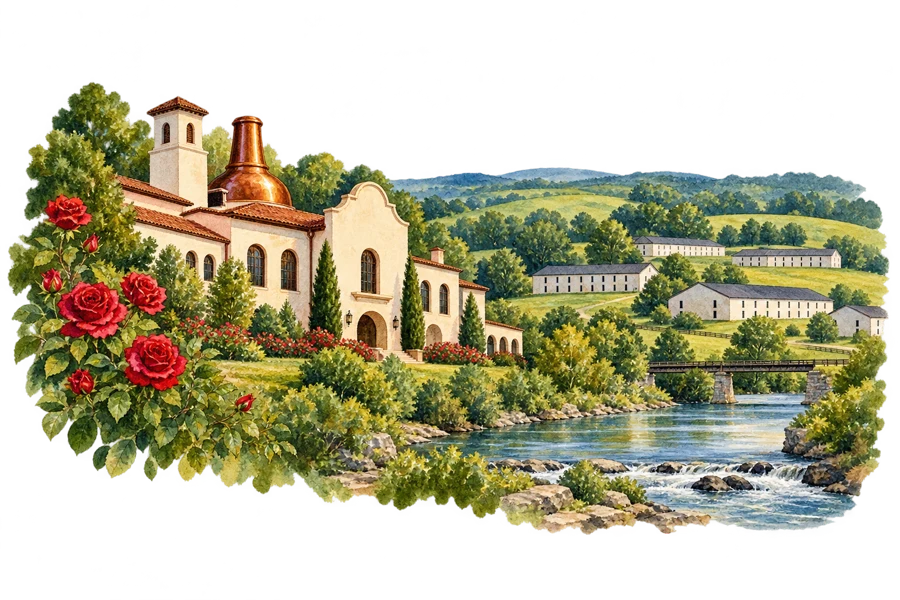
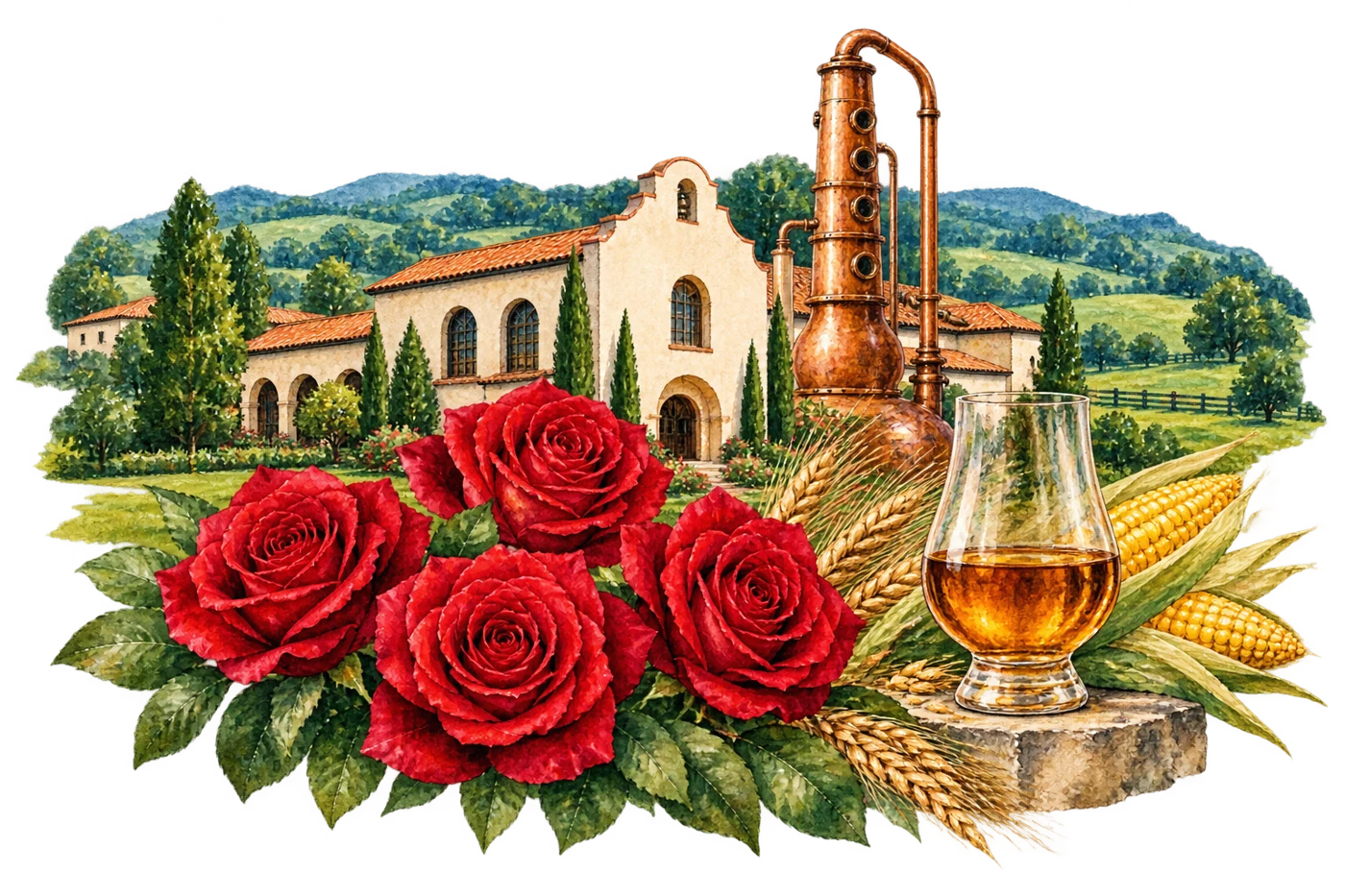
Symbolic Spanish Mission distillery, Kentucky hills, red roses and bourbon
Brand landmark
1888 trademark[2]
Distilling home
Lawrenceburg, Kentucky[31]
Maturation & bottling
Cox’s Creek, Kentucky[32]
Current owner
Gallo · since April 2026[18]
01 / Origins & people

A familiar name. An unexpected journey.

A business before a legend

Paul Jones Jr. arrived in Louisville in 1884. The brand traces its formal beginning to his 1888 trademark. On Whiskey Row, 136 East Main Street served the Paul Jones Company as a gathering and distribution center, part of a trading business rather than the present Kentucky distillery.[2]

Four roses, worn as an answer

The producer tells of a marriage proposal answered when a woman arrived at a ball wearing four roses. It is an enduring piece of brand lore: a romantic explanation of the name, kept distinct from the documented trademark and the later industrial site.[19]

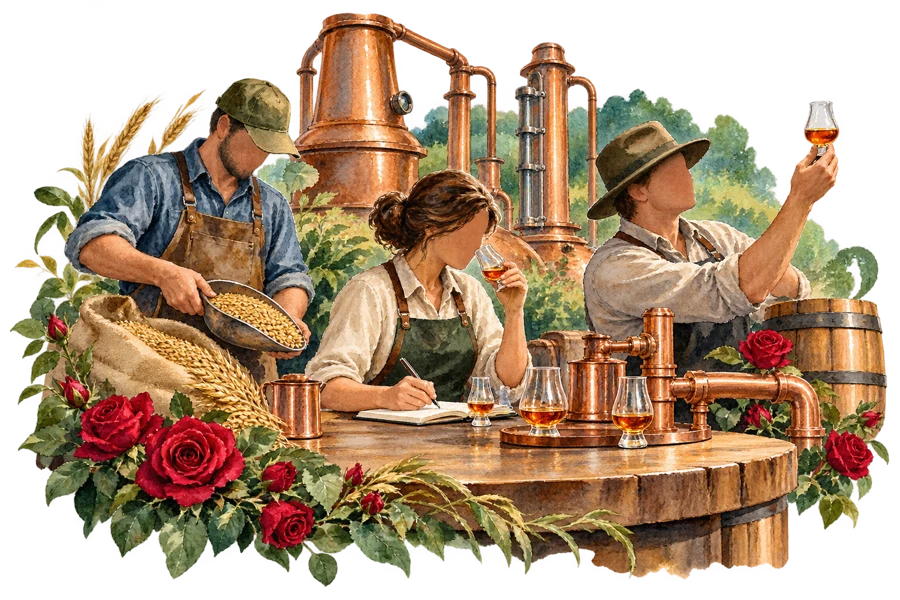
Symbolic distillery team, tasting glasses and grain

Paul Jones Jr.

Founder and brand identity

The founder’s Louisville business and trademark gave Four Roses a durable commercial identity. Its rose imagery survived changing owners, labels and markets.[2]

Ova Haney and Jim Rutledge

The path to revival

Haney preceded Rutledge as master distiller. Rutledge’s path ran from Seagram research work in 1966 through a return to Kentucky in 1992, followed by leadership at Four Roses and a persistent campaign to restore its straight bourbon at home.[1][8]

Al Young

Historian and ambassador

Young joined in 1967, became distillery manager and later carried its history to drinkers as ambassador and author. His archives and 2010 book preserved the bottles, advertisements and stories that a changing company could otherwise have lost.[7][33]

Brent Elliott

Master distiller

Elliott joined in 2005 with an analytical chemistry background. A decade working with Rutledge preceded his 2015 succession. His work connects laboratory discipline, sensory judgment and the task of making individual barrels serve a consistent blend.[11][9]

The team behind the title

Production and continuity

In his five-year reflection, Elliott credited the wider Four Roses team and mentors as part of the achievement. The master distiller’s decisions depend on people tending fermentation, maintaining equipment, moving barrels and bringing the finished bourbon to its bottle.[34]

02 / The illustrated history

The long road home.

Follow the brand, the Kentucky sites and the people who brought the bourbon home. Brand, facility and product histories have their own beginnings.
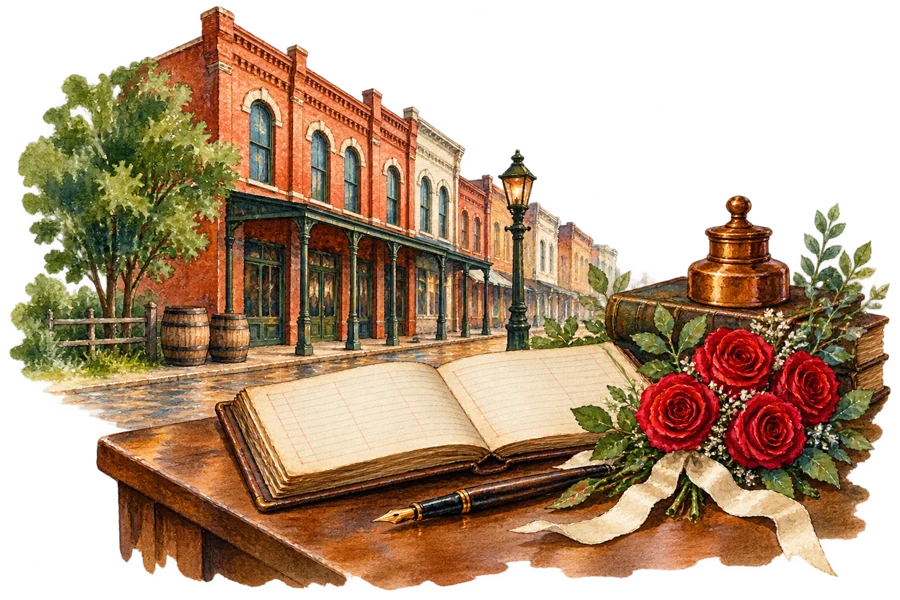
Symbolic illustration: A Louisville name takes root
1884–1888

A Louisville name takes root

Jones moves his business to Louisville in 1884 and trademarks Four Roses in 1888. Whiskey Row is the early commercial home, years before the present distillery buildings.[1][2]
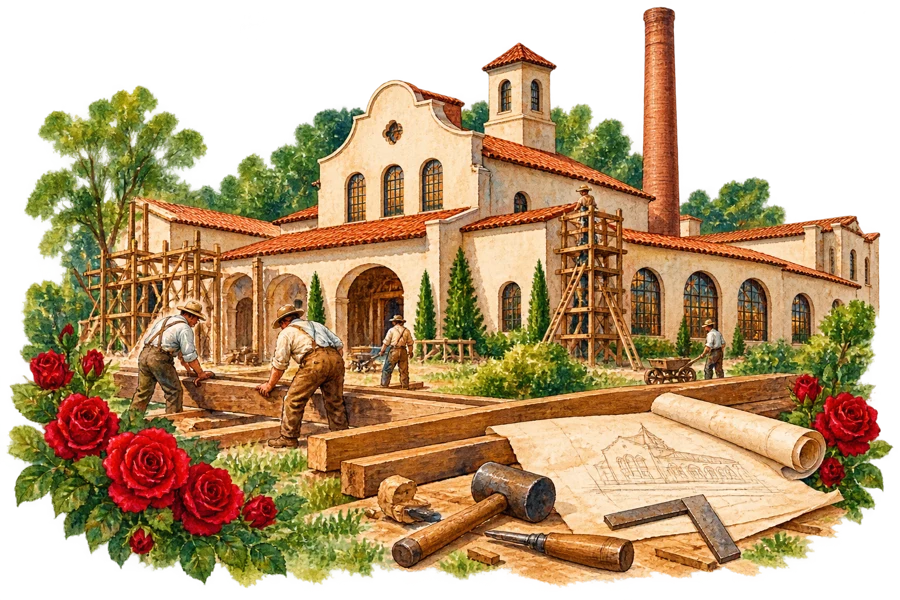
Symbolic illustration: The future distillery takes shape
1910–1912

The future distillery takes shape

Spanish Mission industrial architecture gives the Old Prentice site its distinctive form. This early-twentieth-century facility becomes the later distilling home of Four Roses, separate from the brand’s nineteenth-century beginning.[3]
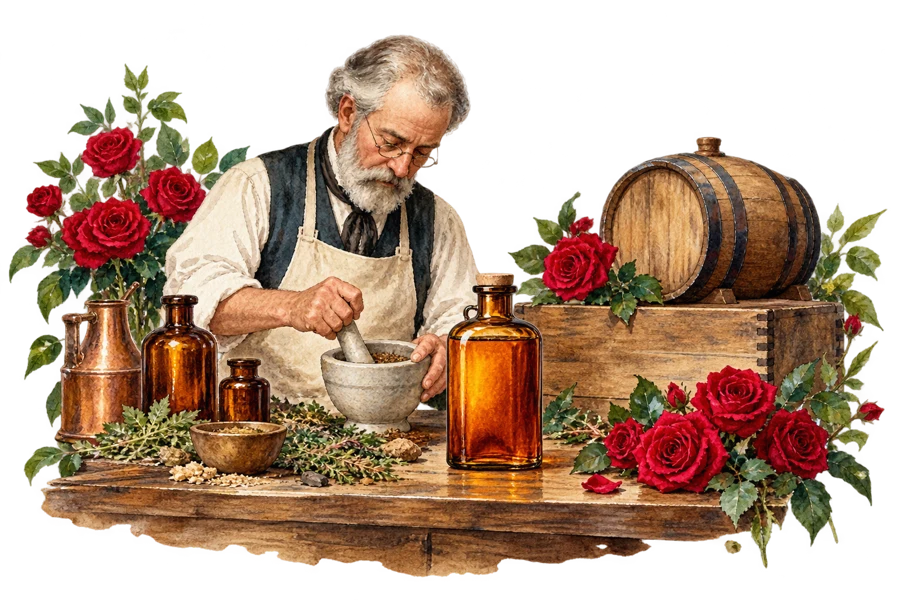
Symbolic illustration: A route through Prohibition
1922

A route through Prohibition

The Paul Jones Company acquires Frankfort Distilling. Medicinal whiskey sales help the Four Roses name survive Prohibition, while special packaging protects what reaches the customer.[1][4]
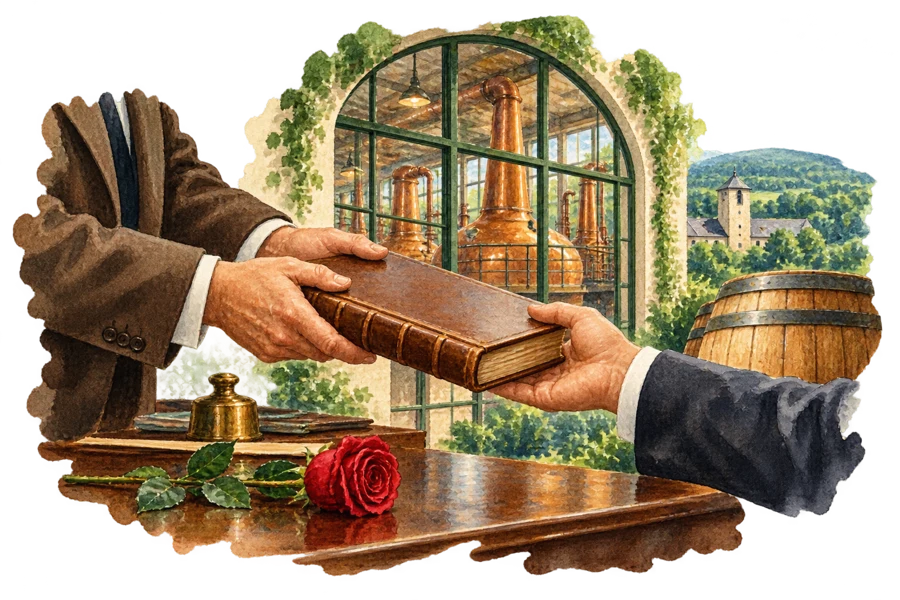
Symbolic illustration: Seagram acquires the brand
1943

Seagram acquires the brand

Seagram purchases Frankfort Distilling and its prized Four Roses name. The corporate transaction concerns the brand business; the present Lawrenceburg site has its own separate ownership history.[5][6]
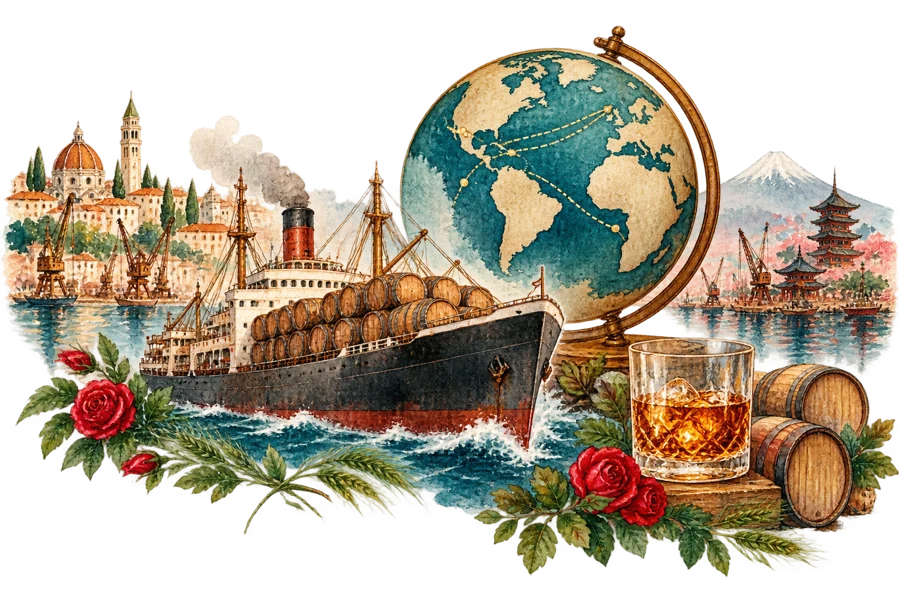
Symbolic illustration: The straight bourbon travels abroad
Mid-twentieth century

The straight bourbon travels abroad

Seagram directs Four Roses Kentucky straight bourbon toward Europe and Asia, while the American name becomes associated with blended whiskey. One familiar name comes to mean different bottles in different markets.[1]
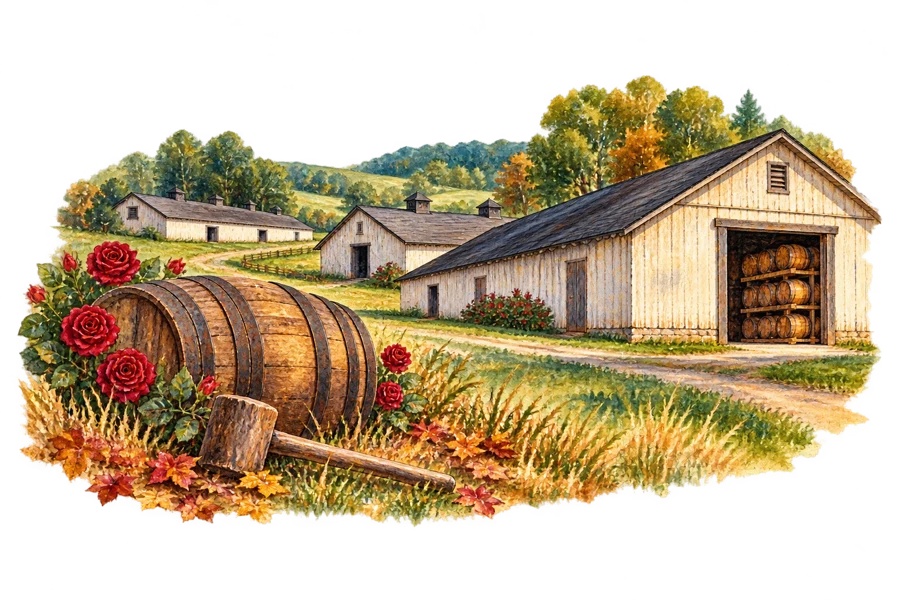
Symbolic illustration: Low warehouses, a lasting choice
December 1960

Low warehouses, a lasting choice

The Cox’s Creek campus is completed with single-story warehouses. Their low racks are designed to reduce temperature differences between upper and lower barrels, establishing a distinctive maturation setting.[7]
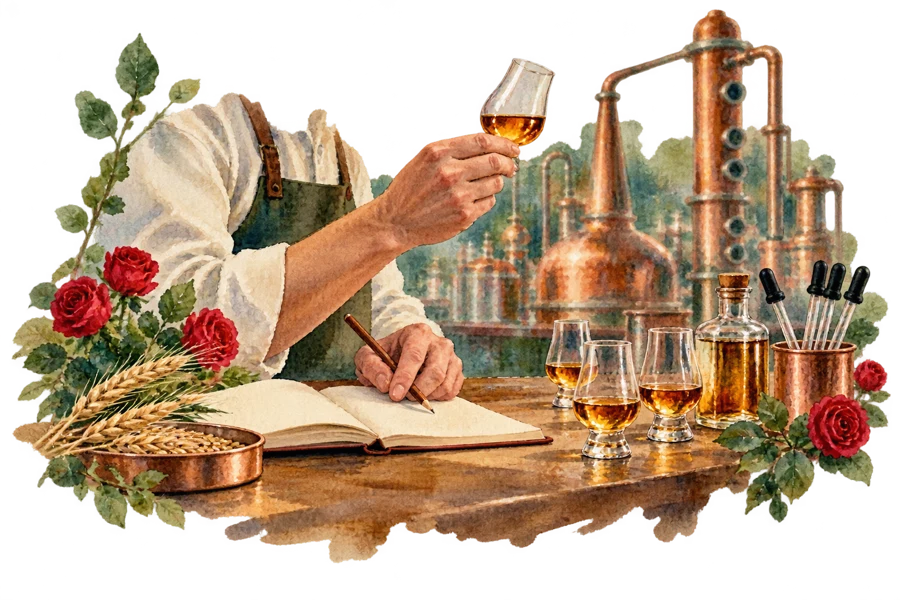
Symbolic illustration: Rutledge works toward a homecoming
1966–1995

Rutledge works toward a homecoming

Rutledge’s career begins in Seagram research and leads back to Kentucky. A 1992 festival tasting and limited Kentucky sales by late 1994 precede the wider revival under new ownership.[8]
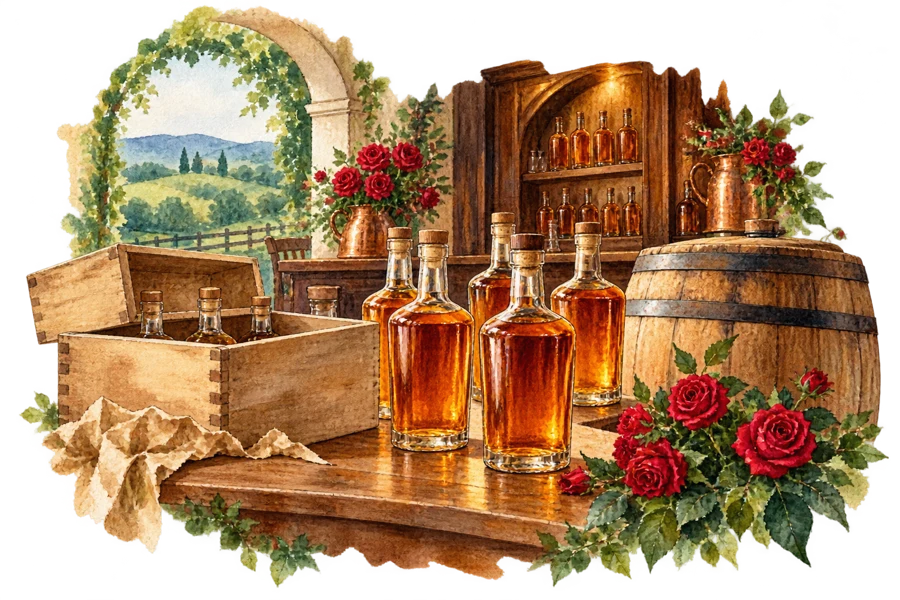
Symbolic illustration: Kirin backs a broader return
February 2002

Kirin backs a broader return

Kirin acquires Four Roses worldwide. The blended domestic product is withdrawn and Kentucky straight bourbon returns to a wider U.S. audience, building on the earlier Kentucky foothold.[9]
Symbolic illustration: Two ways to explore the stock
2004–2006

Two ways to explore the stock

Single Barrel launches in 2004, followed by Small Batch in 2006. One spotlights an individual barrel; the other turns several recipes into a deliberately composed expression.[9][10]
Symbolic illustration: The storyteller preserves the evidence
2007–2010

The storyteller preserves the evidence

Al Young becomes ambassador and publishes The Return of a Whiskey Legend in 2010. His work gives vintage bottles, advertising and distillery memories a lasting place in the brand’s story.[33]
Symbolic illustration: A decade of preparation becomes leadership
August 2015

A decade of preparation becomes leadership

Brent Elliott succeeds Jim Rutledge after ten years together. Quality work and hands-on recipe selection provide the foundation for his next responsibility: maintaining familiar bourbons while developing new ones.[1][9]
Symbolic illustration: Expansion meets a new expression
April 2019

Expansion meets a new expression

A multi-year expansion doubles production capacity and adds facilities across both Kentucky sites. Small Batch Select joins the permanent range at 104 proof, bringing six recipes into a new non-chill-filtered blend.[13]
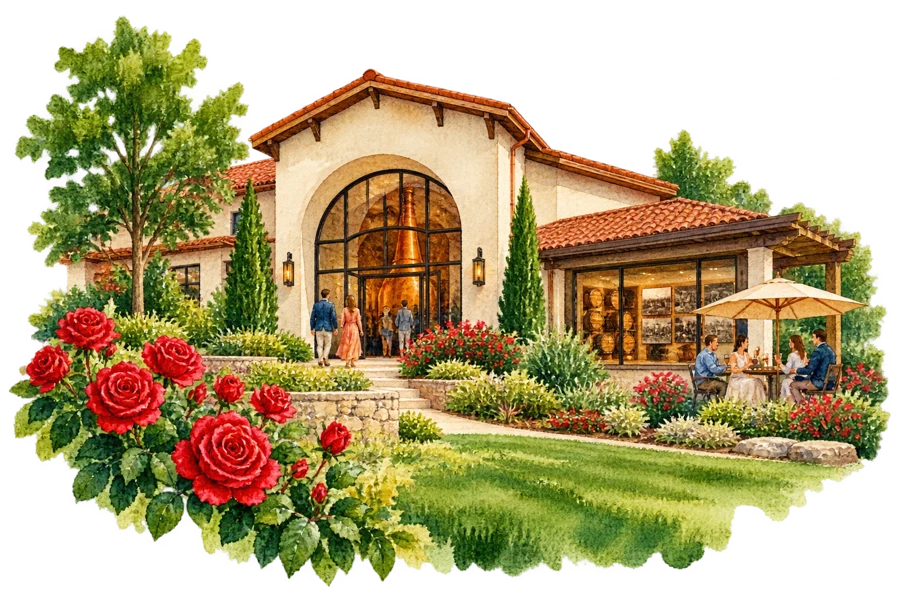
Symbolic illustration: A larger welcome takes shape
2021

A larger welcome takes shape

The visitor-center expansion is designed around tasting rooms, an archive, indoor and patio seating and a bar. Hospitality grows around the working distillery rather than becoming a separate production claim.[14]
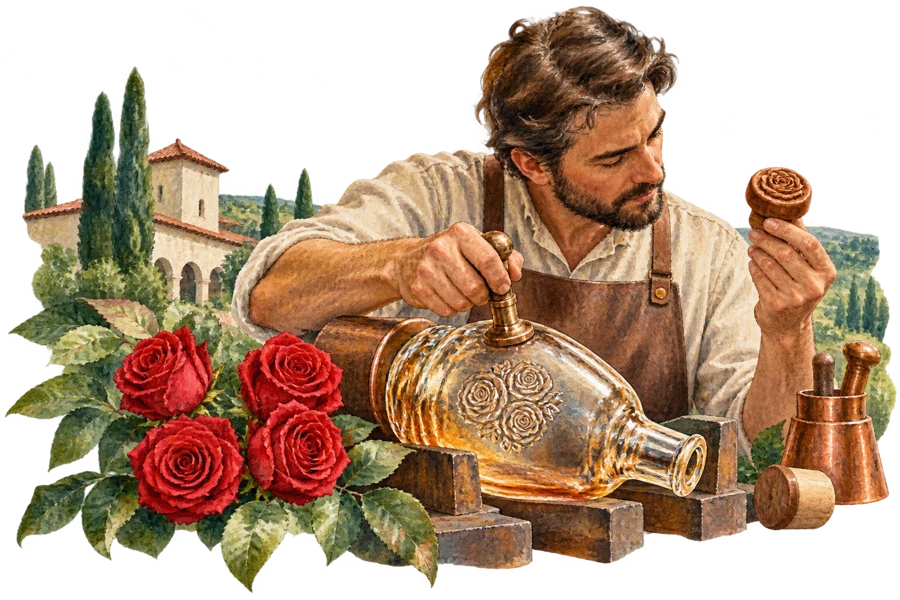
Symbolic illustration: The roses receive a new presentation
June 2023

The roses receive a new presentation

A brand refresh renews the rose emblem, labels and engraved stopper. The accompanying Ten Recipe Tasting Experience makes the individual recipes available together in a limited tasting kit.[15]
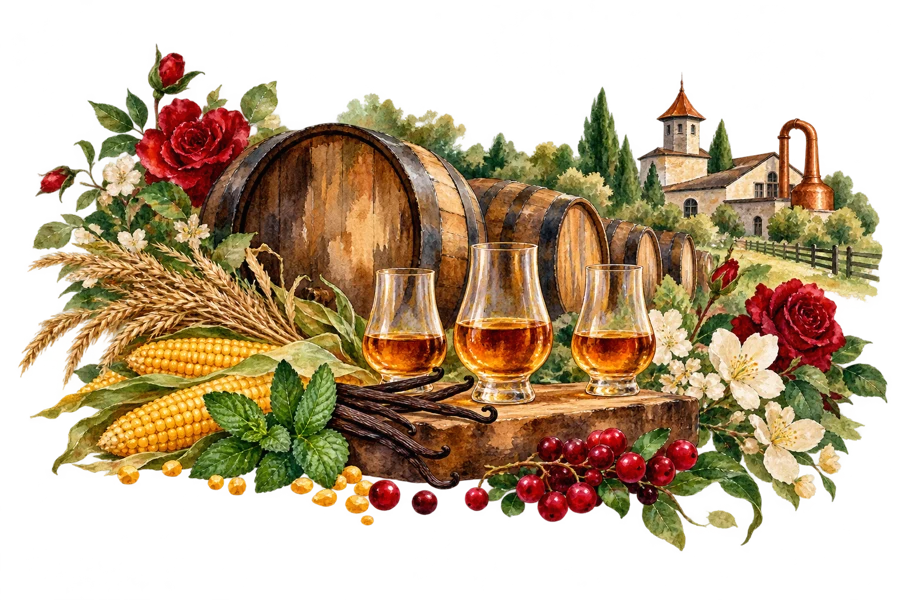
Symbolic illustration: Single Barrel becomes a rotating collection
2024–2026

Single Barrel becomes a rotating collection

A November 2024 announcement introduces additional recipes for early 2025. The collection continues with annual selections alongside flagship OBSV, letting drinkers compare different recipe identities at 100 proof.[16][17]
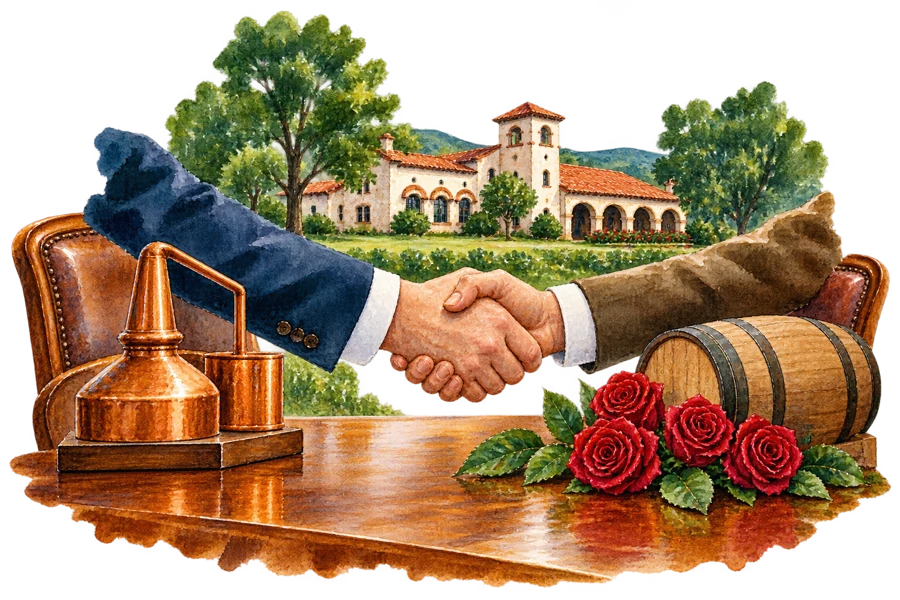
Symbolic illustration: Gallo completes the acquisition
April 2, 2026

Gallo completes the acquisition

Gallo announces completion of its purchase from Kirin. The new owner commits to continuity in the liquid, production, traditions and people, including Elliott and the existing Four Roses team.[18]
Symbolic illustration: Anthology opens its first chapter
June–July 2026

Anthology opens its first chapter

Chapter One: Origin is announced in June for a July launch. The 21-year OBSF single barrel connects rare mature stock to the brand’s origin story, with proof stated as up to 124.9.[19]
Symbolic illustration: An experimental route through oak
July–September 2026

An experimental route through oak

The Experimental Series explores Mizunara finishing, followed by honey-seasoned barrels. These limited releases extend the recipe library through additional cask influences while retaining their own identities and specifications.[20][21]
Symbolic illustration: The river remains part of the story
September 2026

The river remains part of the story

Four Roses announces its tenth annual Salt River Cleanup with the Kentucky Waterway Alliance. A selected OESQ barrel supports the partnership, connecting whiskey production with a local waterway.[22]
Symbolic illustration: The annual blend returns to the recipes
October 2026

The annual blend returns to the recipes

The 2026 Limited Edition Small Batch is scheduled for October 10. Four batches, aged 14 to 23 years, use three recipe codes and are mingled into a 109.2-proof bourbon.[23]

Original watercolor interpretations accompany the history. Buildings, objects and scenes are symbolic, not documentary reconstructions.
03 / Geography & roles

One name. Several places that matter.

Symbolic Lawrenceburg distillery and Cox’s Creek single-story warehouses

Whiskey Row: the commercial beginning

At 136 East Main Street in Louisville, the early company gathered and distributed whiskey. The address belongs to the brand’s commercial story, not to a claim that today’s bourbon is distilled there.[2]

Lawrenceburg: where distillation happens

The working distillery is at 1224 Bonds Mill Road. Its visitor center includes archives, tastings and Bar 1888, allowing the public to encounter production and hospitality at the same site.[31]

Cox’s Creek: where barrels wait

The separate campus at 624 Lotus Road houses warehousing and bottling. Its own visitor experience helps explain the stages that follow distillation rather than presenting the two addresses as interchangeable.[32]

The Salt River: a working resource

Water links the operation to its landscape. The producer describes cooling-water reuse introduced during the 2019 expansion and an employee cleanup tradition, giving the river a practical place in the whiskey story.[27]

Old Prentice: a building with an earlier life

The National Register nomination documents a Spanish Mission industrial site with an early-1910s history. Its earlier names and owners are a facility lineage, distinct from the Four Roses trademark story.[3]

04 / The whiskey family

Understand the name on the label.

Trace the producer, its expression families and the distinct roles of collaborators and historical personnel.

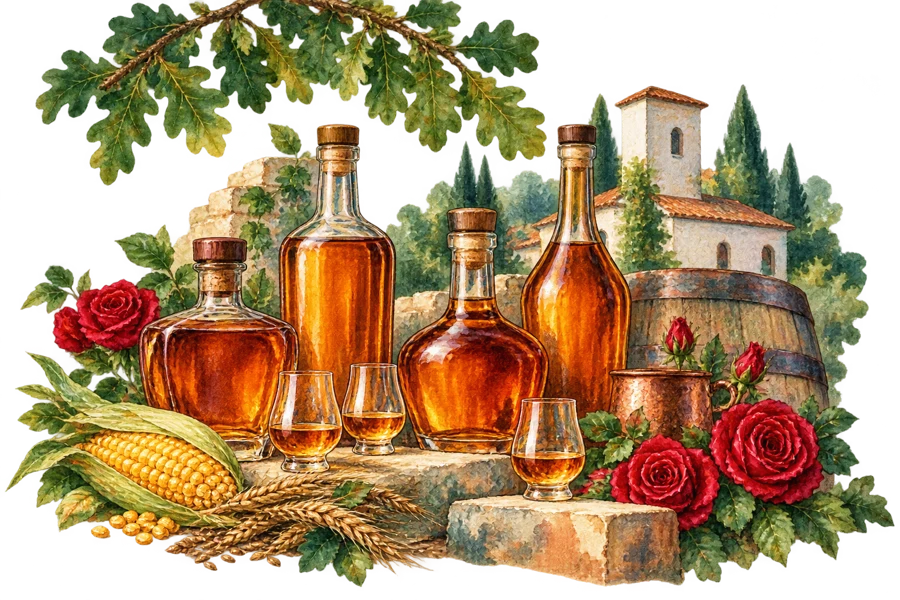
Symbolic Four Roses whiskey family with grain, glasses and roses

Four Roses / Gallo

Current ownership

Four Roses is a Kentucky bourbon producer within Gallo’s portfolio following the completed April 2026 acquisition. Ownership changes the corporate relationship; the announced plan preserves the Kentucky operation and team.[18]

Kirin

Former owner and revival chapter

Kirin’s ownership began in 2002 and supported the straight bourbon’s broader U.S. return. It is a defining historical chapter that ended with the 2026 sale.[9][18]

Seagram and Frankfort Distilling

Historical corporate and yeast connections

The 1943 acquisition placed the brand within Seagram. Its network of Kentucky distilleries is part of the producer’s account of the five yeast strains’ ancestry, rather than a list of brands Four Roses owns today.[6]

Four Roses Bourbon

Core mingled bourbon

The namesake expression brings all ten recipes together. The current product page lists both 80- and 100-proof options, so the familiar former Yellow Label identity should not be treated as the only current presentation.[28]

Small Batch and Small Batch Select

Two deliberately different blends

These are distinct expressions. Small Batch uses four recipes focused on K and O yeasts; Select uses six recipes including V and F. The difference is a composition choice as well as a proof difference.[26]

Single Barrel Collection

Individual-barrel expression family

Flagship OBSV anchors a collection of rotating recipe bottlings. A recipe name identifies one grain-and-yeast combination; an individual barrel adds its own maturation character.[17]

Limited Edition and Anthology

Distinct limited-release programs

The annual Limited Edition Small Batch explores mingling mature stocks; Anthology opens a narrative-led rare-release series. Each edition has its own recipes, ages and proof.[23][19]

Experimental Series and local partners

Finishing and community collaborations

Mizunara and honey-seasoned casks introduce additional finishing choices. Bohman Bee Company and the Kentucky Waterway Alliance appear through specific collaborations, not through distilling or ownership relationships.[20][21][22]

05 / Making & choosing

The choices behind the label.

Recipes, fermentation, oak and mingling shape the whiskey. Keep every specification tied to the expression and edition named.

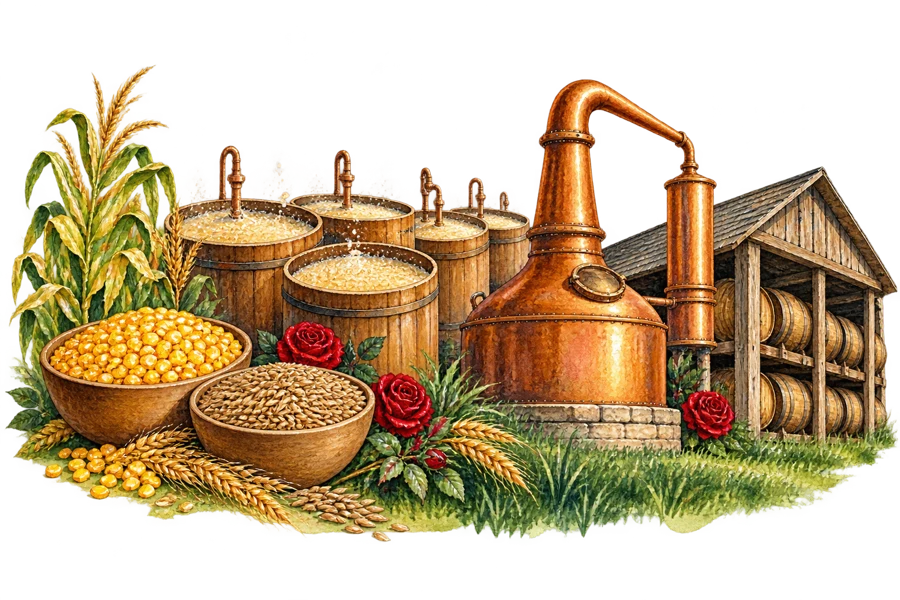
Symbolic mash bills, yeast, copper and oak

A recipe code is a useful key

In OBSV, O identifies Four Roses distillation and S denotes straight whiskey. The second letter selects the mash bill; the last identifies yeast. Ten codes describe related bourbons made within one system.[24]

Fermentation before copper

The producer’s virtual tour follows grain cooking and yeast propagation into fermentation, then column distillation and a second pass through a doubler. Samples and quality checks connect the stages before the new spirit travels to Cox’s Creek.[25]

Maturation close to the ground

Single-story warehouses reduce the height difference across racks. Four Roses still evaluates individual barrels as they develop; a more consistent environment does not erase the differences between barrels.[7][25]

Mingling begins with samples

Representative samples from prospective batches are combined and assessed before the bourbon is dumped. Several trial blends allow the team to adjust the composition rather than treating a recipe count as a finished flavor.[10]

Four recipes and six are different choices

Elliott describes the balance of O and K yeasts in Small Batch and the additional fruit-and-herbal interplay of V and F in Select. More components do not automatically mean a better bourbon; they provide a different set of choices.[26]

Finishing opens another variable

Experimental No. 001 pairs six-year OBSK with Mizunara oak. No. 002 uses barrels that previously held bourbon-barrel-aged honey. Their finishing treatments belong to those releases, separate from the core range.[20][21]

Read the ten-recipe system

Mash bill percentages are by grain recipe. Yeast cues describe the producer’s flavor vocabulary.[24]

Two mash bills
CodeCornRyeMalted barley
B60%35%5%
E75%20%5%
Five yeasts × two grain recipes
YeastProducer cueB recipeE recipe
VDelicate fruitOBSVOESV
KSlight spiceOBSKOESK
ORich fruitOBSOOESO
QFloral essenceOBSQOESQ
FHerbal notesOBSFOESF

First O: Four Roses distillation. Third S: straight whiskey. The final O, when present, identifies the rich-fruit yeast.

06 / The details worth knowing

The stories behind the familiar name.

The homecoming began before 2002

The producer recalls a borrowed card table at the 1992 Kentucky Bourbon Festival and limited Kentucky sales by the end of 1994. The later Kirin relaunch broadened a return that already had a small local foothold.[8]

A bottle before a job interview

Elliott recalls buying Single Barrel on his way to interview in 2005. Tasting it in his hotel room helped convince him that a move into bourbon could connect his chemistry experience with work he cared about.[11]

Archives make a changing brand tangible

Young’s preserved collection included medicinal whiskey packaging, old advertisements and unusual bottles. It provides physical evidence of the different products and public faces that have carried the Four Roses name.[33]

A giant sign in the city

The brand’s account describes a Times Square sign operating from 1938 to 1945, with illuminated spirals of roses. It places the whiskey in the visual culture of a very different American drinking era.[5]

The old oak is an ingredient in a blend

The 2026 annual edition combines 14-year OBSK, 14-year OESK, 15-year OESV and 23-year OESK batches. Four batches therefore do not mean four different recipes, and the oldest component does not become the age of the whole blend.[23]

A barrel can have another working life

For the honey finish, bourbon barrels went to a local honey producer and returned for another bourbon fill. The producer describes a cycle of reuse in which the cask carries part of its previous contents’ character.[21]

Recognition belongs to the people, too

Elliott’s 2020 Icons of Whisky America award recognized distilling and blending. In the accompanying statement he credited the team, a reminder that the name on a label stands above a much larger daily operation.[12]

07 / Selected expressions

Different ways into the whiskey family.

A curated reading of the whiskey family, selected for its role in the story. This is not an exhaustive current catalog.

Four Roses Bourbon

The core mingling of ten recipes is the broadest introduction to the house. Current 80- and 100-proof options make checking the exact bottle’s label worthwhile.[28]

Small Batch

At 90 proof, Small Batch combines OBSK, OBSO, OESK and OESO. It is a four-recipe blend with a different purpose from a single barrel or the six-recipe Select.[29]

Small Batch Select

The 104-proof, non-chill-filtered expression brings OBSV, OBSK, OBSF, OESV, OESK and OESF together. Introduced in 2019, it adds another way to explore the distillery’s recipe palette.[30][13]

Single Barrel Collection

Flagship OBSV and annually rotating recipes present individual barrels at 100 proof. The current collection includes 2025 and 2026 selections; year and recipe matter when comparing bottles.[17]

2026 Limited Edition Small Batch

Four mature batches, three recipe codes and 109.2 proof define this edition. Its 14–23-year components demonstrate the role of selection and mingling across different ages.[23]

Anthology: Chapter One / Experimental Series

Anthology begins with 21-year OBSF, while the Experimental Series explores additional cask influences. One investigates rare stock and story; the other deliberately changes the maturation conversation.[19][20]

08 / The Reserve connection

Continue from the story to the bottles.

Four Roses in The Thelen Reserve

Four physical bottles connect this story to the Reserve: Single Barrel, Small Batch and two separately tracked Small Batch Select bottles. Each retains its own W-ID and recorded details.

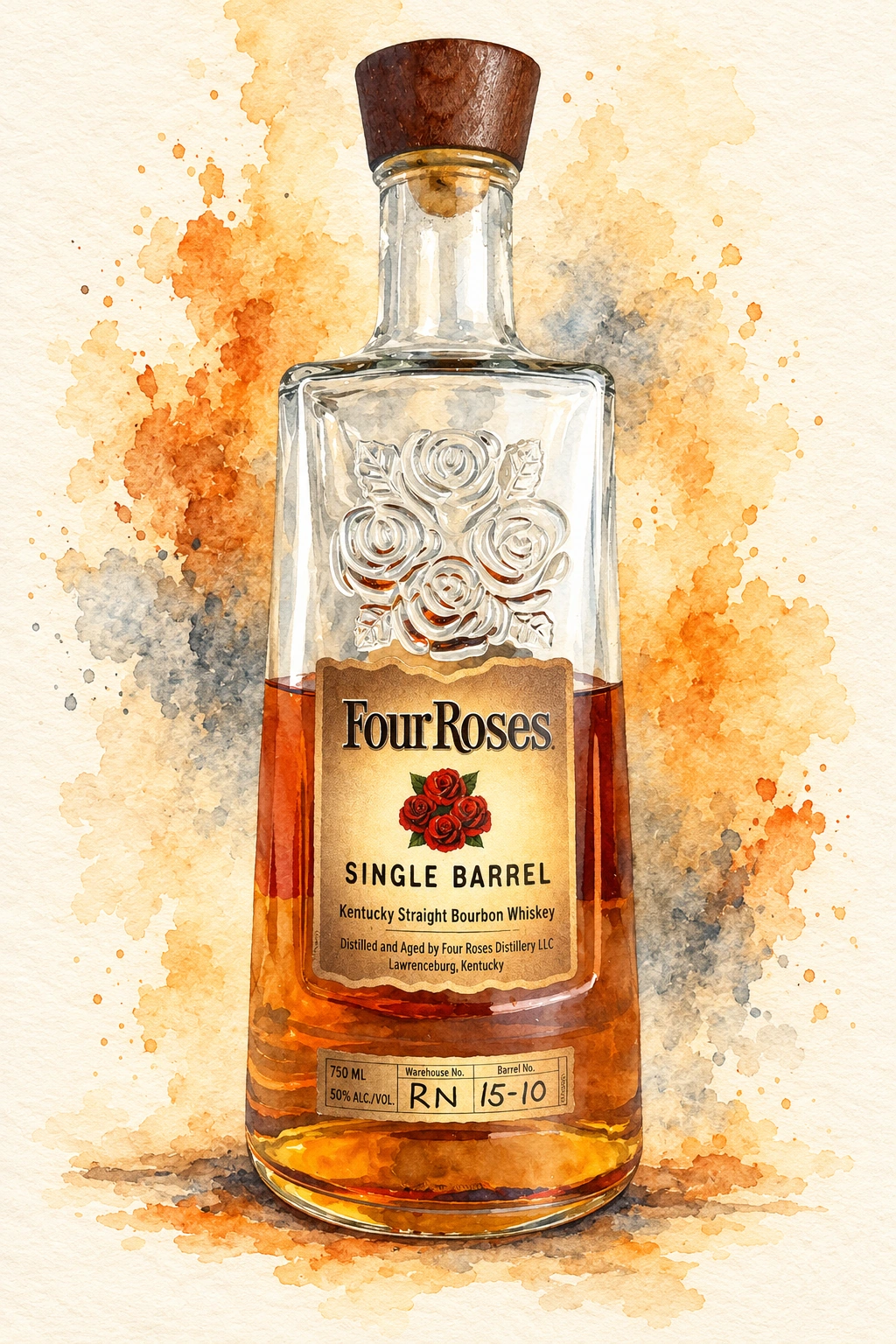
Approved watercolor of Four Roses Single Barrel

Four Roses Single Barrel

W0197 · 100 proof · Barrel 15-10

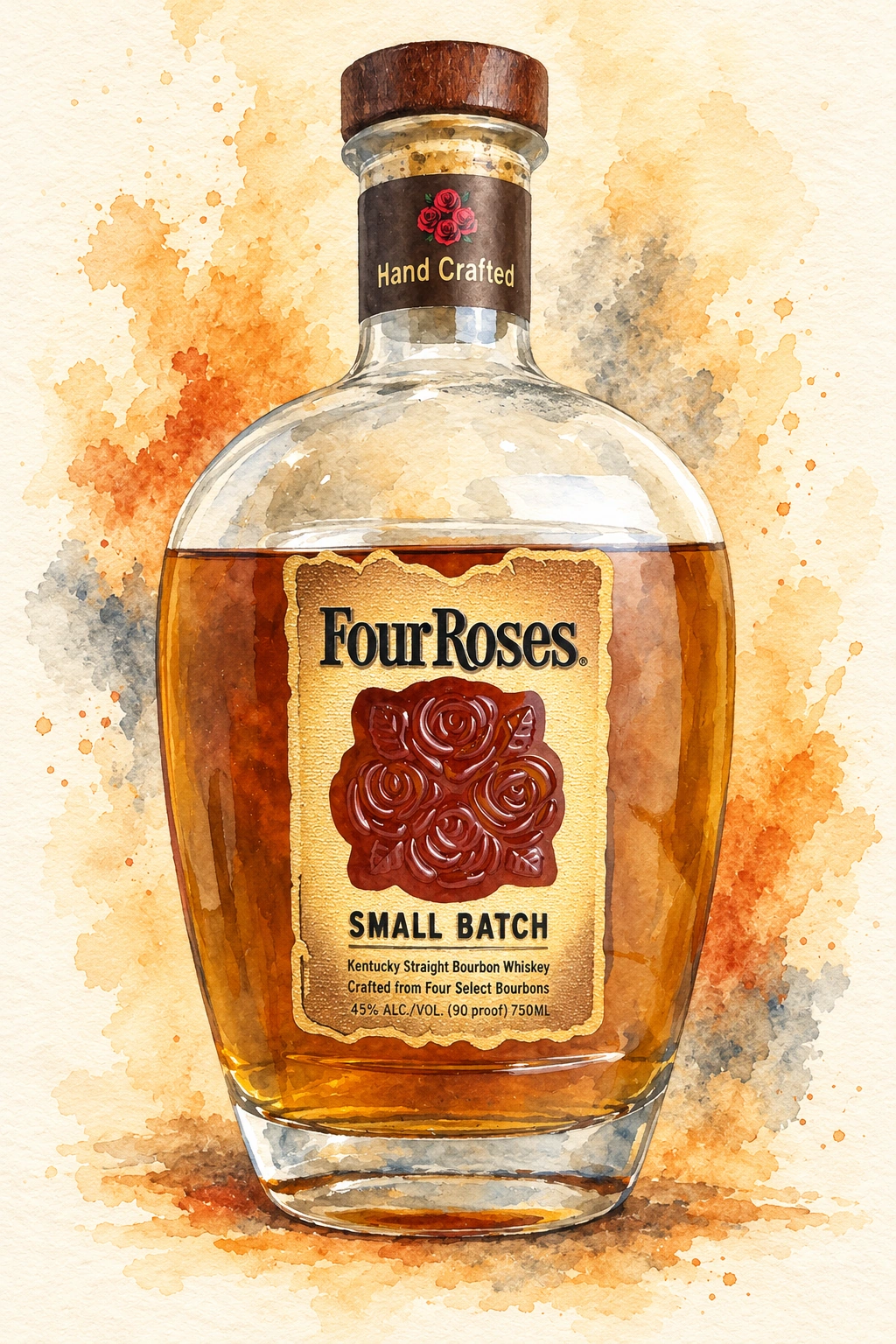
Approved watercolor of Four Roses Small Batch

Four Roses Small Batch

W0198 · 90 proof

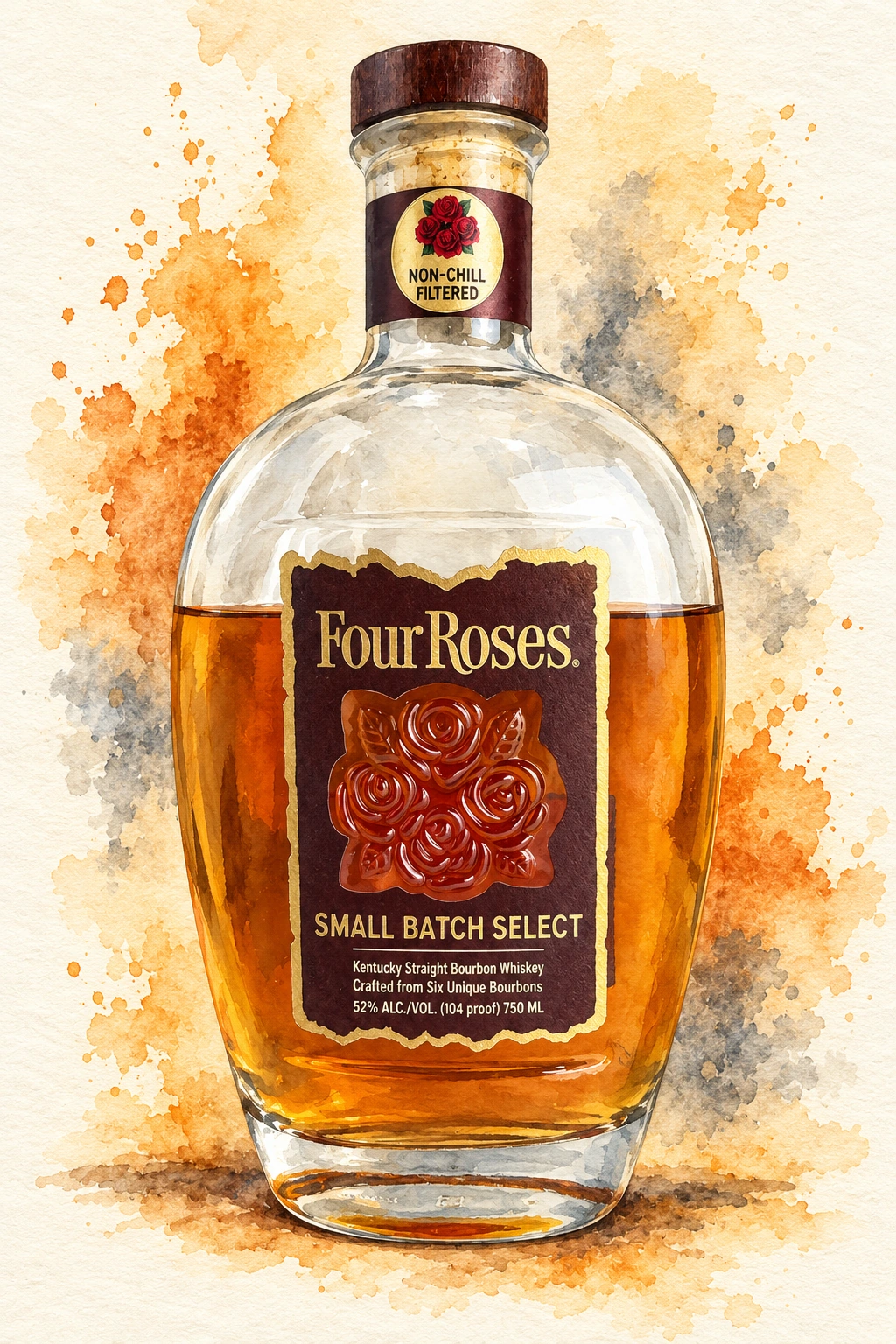
Approved watercolor of Four Roses Small Batch Select

Four Roses Small Batch Select

W0199 · 104 proof · Bottled / release detail Small Batch Select;Kentucky Straight Bourbon Whiskey;non-chill filtered;crafted from six unique bourbons;104proof/52%ABV;750mL. No numeric bottle age or release/bottling date printed.

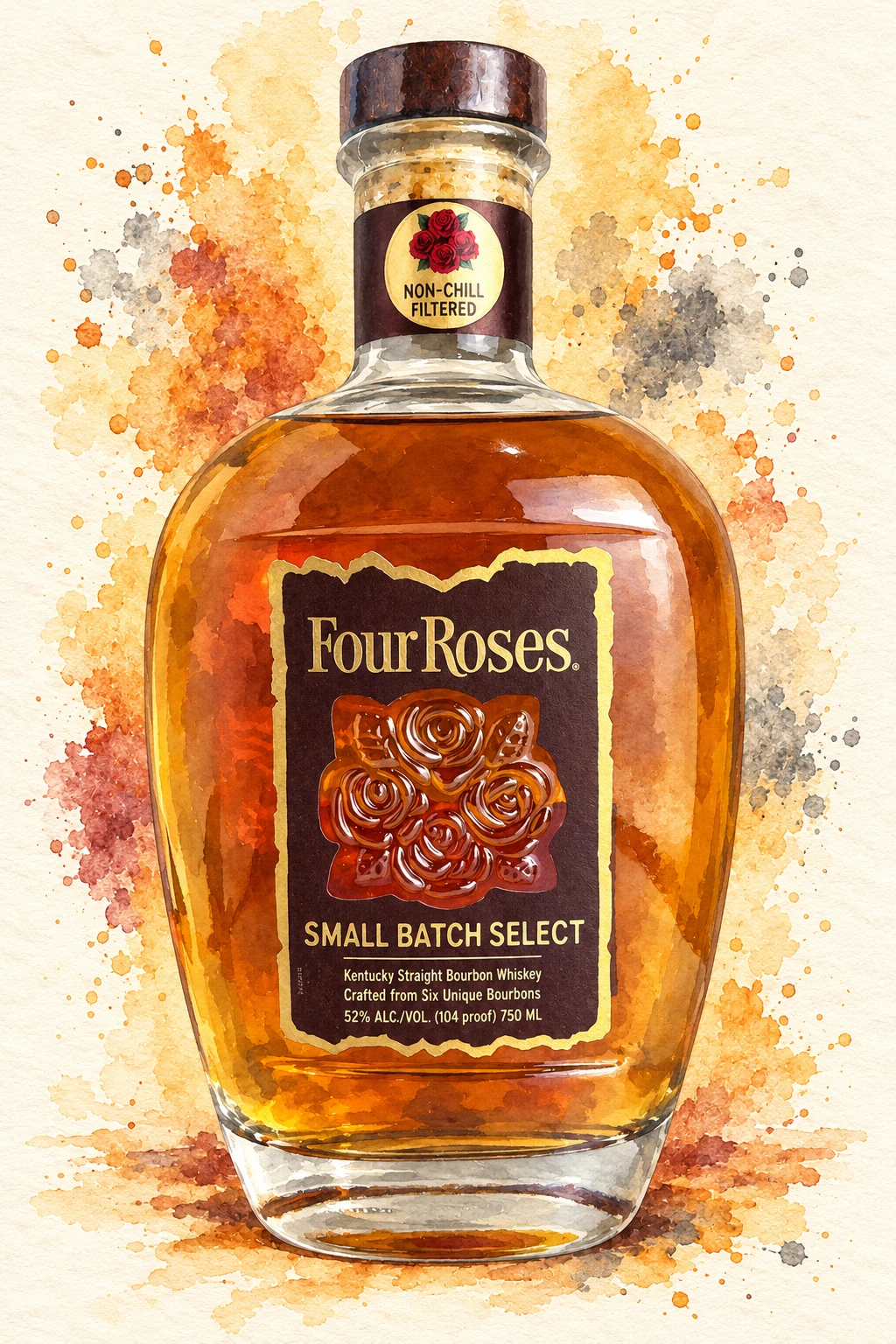
Approved watercolor of Four Roses Small Batch Select

Four Roses Small Batch Select

W0200 · 104 proof

Collection snapshot: October 23, 2026. These four physical records remain separate. The Single Barrel retains recorded barrel 15-10; the two Small Batch Select bottles retain their own identities.

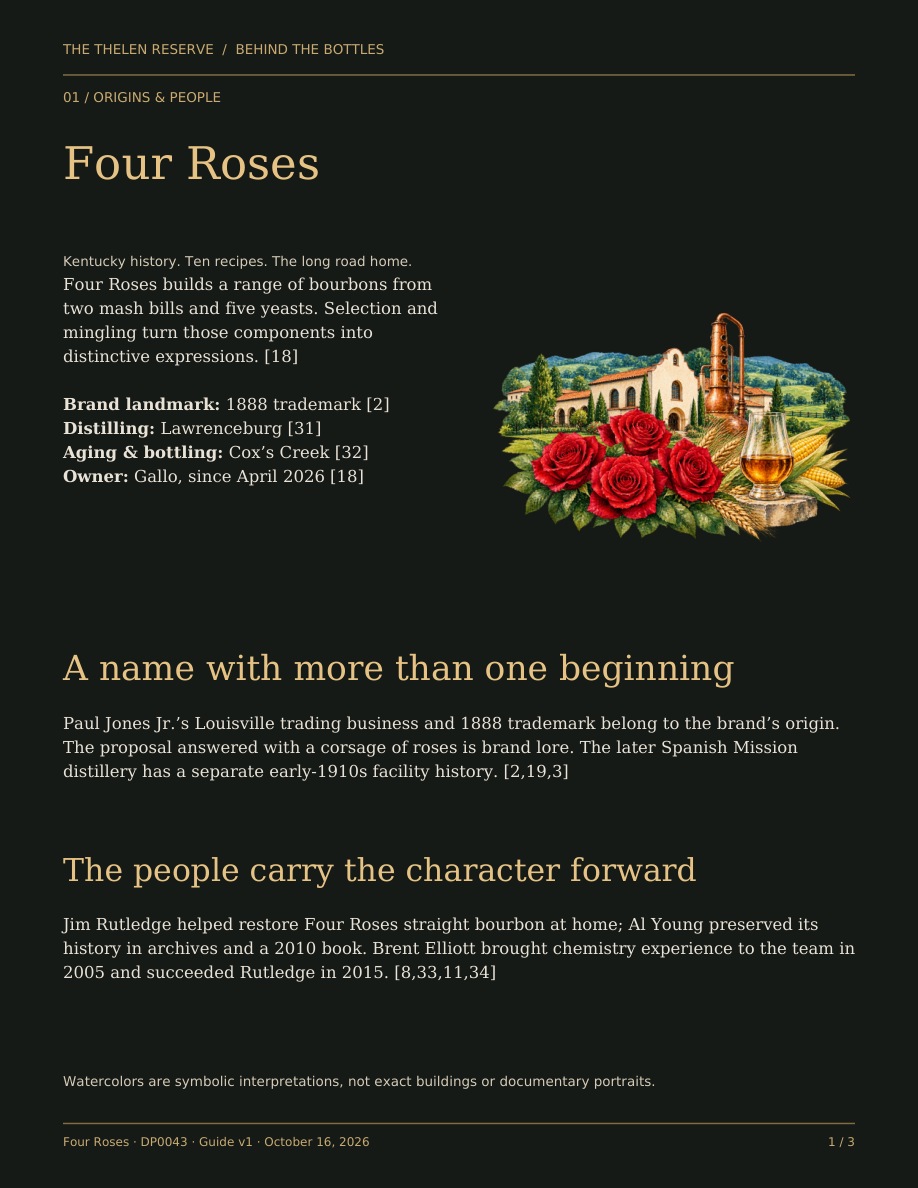
Four Roses three-page guide cover
The illustrated companion

Four Roses, in three pages.

Origins and people, history and places, whiskey and stories. A concise companion to this complete profile, with linked research sources.

Sources & research notes

Researched October 16, 2026. Official brand and company pages, dated announcements and clearly identified supporting sources are distinguished in the research. Product specifications are release- and market-specific.

Research qualifications

  • The proposal and corsage account is brand lore. The documented 1888 trademark, earlier commercial claims and early-1910s distillery buildings are separate historical strands.
  • The National Register nomination gives a 1910–12 period, 1912 erection and architect Leo Oberwarth. Modern brand accounts use 1910 and credit Joseph & Joseph. The profile uses an early-1910s range and does not resolve the architect conflict by assertion.
  • The brand’s 1990s retrospective places Rutledge in the master-distiller role in November 1994; Heritage uses 1995. His career milestone is presented as a period. Limited Kentucky bourbon sales predated the broader 2002 relaunch.
  • Dated brand posts give Al Young’s ambassador appointment as 2007; the Heritage timeline labels it 2008. The profile uses the dated archive account and a 2007–2010 ambassador/book milestone. His role is historical, not a current staff listing.
  • Gallo’s April 2, 2026 completion announcement supersedes older Kirin ownership text and February deal-announcement reports. Corporate acquisition does not relocate distilling or warehousing.
  • Anthology was called the oldest release by the producer in June 2026. Earlier limited blends contained older components, including a 25-year component in the 2023 anniversary blend. The claim is not expanded into “oldest whiskey ever used.”
  • 2026 product launch and cleanup statements are dated announcements. Scheduled release dates are preserved as such; the profile does not guarantee remaining retail stock or claim audited cleanup results.
  • Core proofs, current ages, filtration and recipe selections are expression- and edition-specific. They are not assigned to older physical bottles without label evidence. B and E are mash-bill codes; O is also a yeast code in the final position.
  • Original watercolor scenes are symbolic interpretations. Buildings and anonymous figures are not documentary reconstructions or portraits.

Full sources

  1. Four Roses: Heritage1884 Louisville move, 1888 trademark, 1922 Frankfort purchase, export era and 2015 succession. Note: Brand lore is attributed. The timeline labels Al Young’s appointment 2008, while dated archive posts say 2007; Rutledge appointment is 1995 here and November 1994 in the 1990s post.
  2. Through the Decades: 1888–1900Paul Jones, 136 East Main Street, gathering/distribution role and 1888 trademark. Note: Brand retrospective; the earlier claimed production date is not an independently verified founding date.
  3. National Register: Old Prentice nominationSpanish Mission architecture, 1910–12 period, Old Prentice site history. Note: 1987 nomination, not current operations. Names Leo Oberwarth and a 1912 erection; modern brand accounts name Joseph & Joseph and 1910. No architect is asserted in the story.
  4. Through the Decades: 1920–1930Medicinal sale, consolidation stocks and tamper-evident fiberboard packaging. Note: Do not equate medicinal sales with uninterrupted distilling at the current site.
  5. Through the Decades: 1930–1940Seagram acquisition in 1943 and 1938–45 Times Square advertising. Note: Brand retrospective; historical advertising anecdotes remain attributed.
  6. Through the Decades: 1940–1950Seagram-era distillery network, yeast ancestry and separate Old Prentice facility history. Note: Former Seagram facilities are historical links, not current Four Roses brand ownership. Building details conflict with the National Register nomination.
  7. Through the Decades: 1960–1970December 1960 Cox’s Creek completion, low warehouses and Al Young’s 1967 start. Note: Original campus numbers and exclusivity language are historical, not current totals or an industry-wide claim.
  8. Through the Decades: 1990–2000Rutledge’s career, 1992 festival tasting, limited Kentucky availability by end 1994. Note: November 1994 appointment here differs from 1995 on Heritage. Limited Kentucky return preceded the broader post-2002 revival.
  9. Through the Decades: 2000–presentKirin 2002, Single Barrel 2004, Small Batch 2006, quality leadership and Al Young. Note: Written in 2018. Its Kirin ownership and Al Young present-tense roles are historical, not current.
  10. The Story of Small BatchSeptember 2006 debut, recipe mingling and representative-sample evaluation. Note: 2019 process description; approximate batch size is not a legal definition or fixed current production count.
  11. Brent Elliott: first-person interviewChemistry background, 2005 application and tasting Single Barrel before interview. Note: 2016 interview, edited by publisher; anecdotes attributed to Elliott.
  12. Brent Elliott: 2020 awardIcons of Whisky America Master Distiller/Blender of the Year and team credit. Note: America award, not an unsupported global-title claim.
  13. 2019 Grand Reopening and Small Batch SelectCompletion of expansion, doubled capacity and six-recipe, 104-proof Small Batch Select. Note: Page publication and relative weekday wording differ; the profile uses April 2019 without inventing an exact event day.
  14. 2021 Visitor Center expansionExpanded hospitality design, tasting rooms, archives, patio and planned bar. Note: August 2021 announcement describes plans, not an exact completed-opening day. Current visitor page confirms present facilities.
  15. Four Roses: 2023 brand refresh announcementJune 20, 2023 labels, rose emblem, stopper and Ten Recipe Tasting Experience. Note: Company press release republished by Breaking Bourbon; not independent endorsement.
  16. Introducing Single Barrel CollectionNovember 2024 announcement for early 2025 recipe rotation. Note: Announcement year distinguished from the 2025 retail releases.
  17. Single Barrel Collection: current editionsOBSV flagship and 2025/2026 rotating 100-proof recipe selections. Note: Current 7–9-year range is not assigned to older owned bottles or every private barrel.
  18. Gallo completes Four Roses acquisitionApril 2, 2026 completion and commitment to existing team, production and ten recipes. Note: Supersedes older Kirin-owner descriptions and February announcement-stage reporting. Current operations remain Kentucky-based.
  19. Anthology: Chapter One announcementJune 2 announcement, July 10 planned launch, 21-year OBSF and proof up to 124.9. Note: Oldest release is a company description of this standalone bottling. Older components appeared in earlier blends; not a claim of the oldest barrel ever used.
  20. Experimental Series No. 001June announcement, July 30 launch plan, six-year OBSK and Mizunara finishing. Note: Finishing belongs to this release, not the whole core bourbon portfolio.
  21. Experimental Series No. 002Honey-seasoned barrels, OESQ/OBSK, 104 proof and September 18 planned availability. Note: URL slug is misleading; article title/body explicitly concern Honey Cask Finish. Honey is present via finishing barrels, not a generic flavored-whiskey claim.
  22. 2026 Salt River CleanupTenth annual event announced for September 17, Kentucky Waterway Alliance and OESQ charity barrel. Note: Announcement confirms plan and partnership, not an independently audited cleanup result or donation total.
  23. 2026 Limited Edition Small BatchSeptember 1 announcement, October 10 release schedule, 109.2 proof and 14–23-year components. Note: Four batches use three recipe codes. Retail stock/availability is not guaranteed.
  24. Four Roses: Our ProcessB/E mash bills, V/K/O/Q/F yeasts, ten recipe codes and meaning of O and S. Note: Producer flavor cues are guides, not guaranteed tasting outcomes. Recipe percentages do not identify an unverified bottle.
  25. Four Roses: Virtual TourFermentation, column and doubler distillation, transfer to Cox’s Creek and maturation. Note: 2020 process account. Avoid universal current proof, age or filtration claims from historical wording.
  26. Brent’s Pick: Small Batch versus SelectFour versus six recipes, O/K versus V/K/F roles and sensory blending. Note: 2020 first-person producer account; proportions described there are not asserted as fixed current batch formulas.
  27. From the Salt River to Four RosesWater reuse and 2019 cooling improvements, river as operational and community resource. Note: Specific historical operational improvements, not a claim of zero environmental impact.
  28. Four Roses Bourbon: current productTen recipes and current 80- and 100-proof options. Note: Proofs and current minimum age are product-specific and may vary by market/edition.
  29. Small Batch: current product90 proof, OBSK/OBSO/OESK/OESO and current age range. Note: Current product specifications do not establish an older owned bottle’s age or release.
  30. Small Batch Select: current product104 proof and six component recipes. Note: Non-chill-filtered status checked against dated launch account; not a universal statement about other expressions.
  31. Visit the Lawrenceburg Distillery1224 Bonds Mill Road, Bar 1888, current tours, archives and hospitality. Note: Do not hardcode hours or guarantee reservations/availability.
  32. Visit Cox’s Creek Warehouse & Bottling624 Lotus Road, warehouse and bottling roles and separate visitor center. Note: Current location information, not another distilling-facility claim.
  33. Al Young’s Archives2007 ambassador appointment, 2010 history book and preserved labels/advertising. Note: Historical 2017 account. Al Young is not described as a living current employee.
  34. Brent’s Pick: five years as Master DistillerTeam continuity, mentors, expansion and reflection on first five years. Note: 2020 first-person reflection; no claim of current staffing from this older post.
  35. 2023 Anniversary Limited Edition announcement2023 limited blend included a 25-year OBSV component, distinguishing blend components from Anthology’s standalone age. Note: Company press release republished by Breaking Bourbon. No universal “oldest whiskey” claim is made.
↑