TJ THELEN'S COLLECTION
The Thelen Reserve
Behind the Bottles / Memphis & beyond

B.R. Distilling Company

Last updated Last researched

A Memphis point of view.

Memphis gives B.R. Distilling its address, its musical vocabulary and a place for whiskey to mature. Blue Note carries that identity into bourbon and rye, while Riverset remembers the river in its name. The most revealing part of the story is the work between distillation and the finished bottle: choosing barrels, managing maturation, exploring wood and deciding which components belong together. Following those choices leads from straightforward bourbon to a remarkably detailed annual blending project.[2][13]

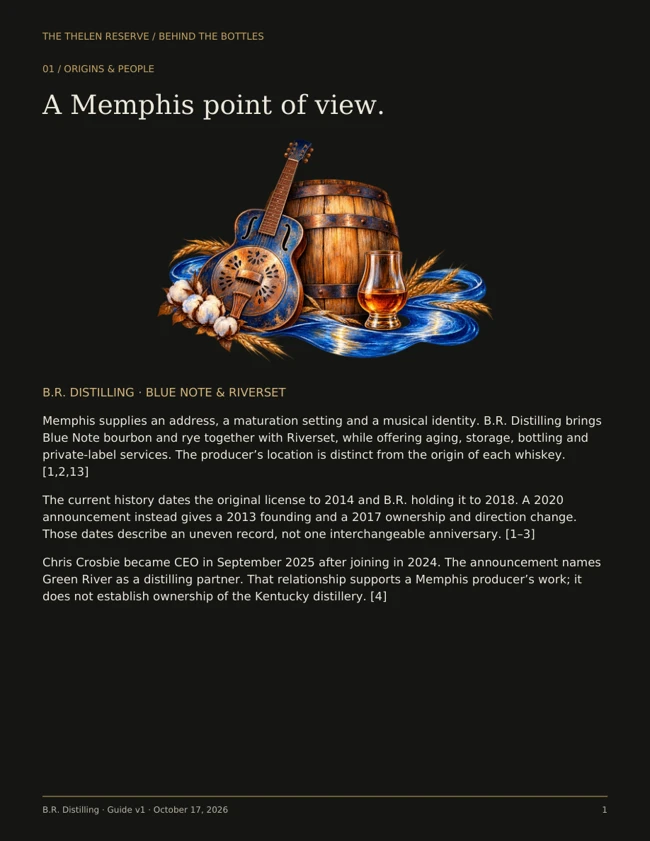
Interpretive watercolor of a blues guitar, bourbon barrel and river ribbon
License dated 2014

B.R. holder since 2018

Memphis producer

Aging, selection and bottling

Blue Note & Riverset

Distinct brands and releases

Partner distillation

Origin varies by release

01 / Origins & people

A legacy carried by people.

A license, a company and a new direction

The current Blue Note account dates the original distilling license to 2014 and says B.R. has held DSP-TN-21021 since 2018. B.R.’s company website also uses 2014 as its founding year. An older announcement instead says 2013 and dates a change of ownership and direction to 2017. These statements describe an imperfectly aligned record; they do not support one seamless founding date.[1][2][3]

Memphis in the name

Blue Note explicitly connects its identity to Memphis blues. That musical reference gives the brand a recognizable voice without establishing where every whiskey was distilled. Riverset’s name brings the river landscape into the family. Together the names express a local producer’s identity across different styles of whiskey.[2][13]

People at different moments

McCauley Williams was identified as president and CEO in the 2020 expansion announcement. Logan Welk appeared as president and COO in the 2024 Honey Rye release. These dated roles help explain the company’s development without presenting every historical executive as part of the current team.[3][18]

A new chief executive

B.R. announced Chris Crosbie’s promotion to CEO in September 2025, after he joined as vice president of sales in March 2024. The announcement said the CEO post had been vacant for two years and named Rob Del Priore as board chair. The current team page also lists Gregg Smith as CFO. Public leadership titles do not establish the complete ownership structure.[4][1]

02 / The illustrated history

The past has more than one date.

A chronology of the brand, its experiments and its reach. Each scene is an original interpretive watercolor.
license, symbolic watercolor illustration
2014

The license begins

The present company history dates the original Memphis license to 2014. This is the license’s origin, distinct from the later date when B.R. says it became the holder.[1]
direction, symbolic watercolor illustration
2017

A change of direction

A 2020 company announcement dates a change in ownership and business direction to 2017. The older account is retained as a dated source rather than silently substituted for the current licensing history.[3]
memphis, symbolic watercolor illustration
2018

B.R. holds the license

Blue Note’s current account says B.R. has held DSP-TN-21021 since 2018. The company describes it as Memphis’s oldest active distillery license; that superlative is the producer’s claim.[1]
storm, symbolic watercolor illustration
June 2019

A storm changes the barrels’ story

A warehouse collapse in Owensboro, Kentucky, becomes part of Blue Note’s later survivor-barrel narrative. The producer’s account connects those barrels to a 2022 release. The episode does not establish the provenance of every Uncut bottle.[5]
expansion, symbolic watercolor illustration
2020

Distribution broadens

The company reports adding eight states during 2020. The announcement captures a business moving beyond its home market, with Blue Note bourbon and Riverset rye carrying separate identities. Historical distribution figures are not current availability guarantees.[3]
seventeen, symbolic watercolor illustration
By 2021

Older Tennessee stock takes a bow

The company’s 2021 news archive discusses its seventeen-year bourbon. The product record identifies Tennessee straight bourbon, bottled at barrel proof without filtration. This is evidence of a mature-stock release, not proof that the Memphis company distilled it seventeen years earlier.[6][7]
uncut, symbolic watercolor illustration
2022

Uncut earns wider attention

Blue Note records Uncut at number seven in Whisky Advocate’s 2022 Top 20. Alongside the survivor-barrel story, recognition helps draw attention to cask-strength bourbon and the individuality of barrel selection.[5]
seven, symbolic watercolor illustration
2024

Seven components, one Special Reserve

The first annual Special Reserve brings together seven components spanning four to nineteen years, at 112.5 proof. Kentucky and Tennessee bourbon, several finishing paths and an unfinished component make blending the central subject.[14][16]
platinum, symbolic watercolor illustration
2024

Two flagships receive Platinum recognition

B.R.’s later corporate announcement records San Francisco World Spirits Competition Platinum recognition for Juke Joint and Crossroads, following three consecutive Double Gold awards. The recognition belongs to those named products and that award history.[4]
honey-rye, symbolic watercolor illustration
August 2024

Rye meets honey-seasoned wood

The Honey Rye launch describes American oak barrels seasoned through barrel-aged honey and returned to whiskey finishing. The release is specified as a 95% rye, 5% malted barley recipe at 117.2 proof.[18]
honey-bourbon, symbolic watercolor illustration
October 2024

Bourbon follows the honey path

Honey Bourbon applies the returned honey-seasoned barrel idea to bourbon. The October announcement specifies a minimum three-year bourbon and 115.7 proof for this edition. Later listings have different strengths.[19]
ten-casks, symbolic watercolor illustration
February 2025

The annual blend grows

The second annual Special Reserve is announced as a two-thousand-bottle edition. Ten components, four to nineteen years old, meet at 116.3 proof. Ten components do not mean ten distinct kinds of finishing vessel.[16][15]

leadership, symbolic watercolor illustration
September 2025

Leadership turns a page

Chris Crosbie becomes CEO. The announcement describes a Green River distilling partnership alongside Memphis aging, connecting the company’s leadership story with the division of work behind the whiskey.[4]
nine, symbolic watercolor illustration
2026

A new composition, not a repeat

The listed 2026 Special Reserve combines nine components at 119.9 proof, with ages from five to nineteen years. A large Vino Naranja component and a Winter Bock finish give this edition a different architecture from its predecessors.[17]
03 / Geography & roles

The places play different parts.

place, symbolic watercolor illustration

Memphis, Tennessee

B.R. lists its operation at 802 Royal Avenue. Aging, bottling, storage and private-label services are part of the company’s stated work. A Memphis business address identifies the producer’s operation; the bottle’s distilling origin remains a separate question.[2]

North of downtown, near the rivers

The company describes its maturation setting near the Mississippi and Wolf Rivers. Its account emphasizes long hot summers and cooler evenings as part of the interaction between whiskey and oak. This is the producer’s explanation of local maturation, not a controlled comparison proving one climate superior to another.[19]

Owensboro, Kentucky

The 2019 storm story belongs to Kentucky. Green River is separately named as a distilling partner in the 2025 corporate announcement. A source relationship and a historical warehouse event can intersect in the narrative without proving that every release shares the same route.[5][4]

Tennessee whiskey in the blend

The seventeen-year bourbon and several Special Reserve components are identified as Tennessee whiskey. Those disclosures matter: Blue Note’s portfolio cannot be reduced to one universal Kentucky mash bill or one source for all ages and editions. The publicly identified origin is retained without inventing an unnamed distiller.[7][14]

04 / The whiskey family

One producer. Several ways to explore.

B.R. Distilling Company

Producer and operating company

B.R. organizes the Memphis business, its flagship brands and private-label services. Public material identifies executives and business activities, but does not establish a complete current shareholder list or a verified acquisition by its whiskey supplier.[2][4]

Blue Note

Bourbon and rye brand

The Blue Note portfolio spans core bourbon, cask-strength releases, rye, toasted wood and limited finishing experiments. A product family is broader than one recipe. The release name and edition remain essential to understanding what is in a particular bottle.[21]

Riverset Rye

Separate company brand

B.R.’s company site identifies Riverset alongside Blue Note as a flagship. The historical Riverset identity should remain visible even though the current Blue Note website also lists a straight rye. A shared producer does not by itself establish that the two labels are interchangeable.[2][13]

Green River Distilling Company

Distilling partner

The 2025 CEO announcement names Green River as the portfolio’s distilling partner. Earlier releases refer to Bardstown Bourbon Company in relation to Green River. This is evidence of a production relationship, not evidence that B.R. owns Green River or that every historical barrel came from that source.[4][16]

Special Reserve

Annual blending series

Annual editions publish component-level information that makes comparison possible. The series connects age, state of origin and finishing choices in one bottle. Each year should be read as its own composition rather than a fixed formula with a new label.[14][15][17]

05 / Making & choosing

Origin, selection and the barrel.

Distillation, maturation, blending and finishing play separate roles. Each release carries its own recipe and history.

making, symbolic watercolor illustration

The work is divided

B.R.’s stated services include whiskey aging and bottling as well as storage and private-label work. The company’s branding and the location of those services should not be used as substitutes for a distillation statement. A profile can recognize substantial production work without inventing a Memphis still configuration or a universal in-house recipe.[2]

A recipe belongs to a release

The current Blue Note rye lists 95% rye and 5% malted barley at 93 proof, while Wheated Bourbon 101 lists 70% corn, 21% wheat and 9% malted barley. The wheat replaces rye’s role in that bourbon recipe; it does not turn the rye expression into a wheat whiskey.[12][11]

French oak as a second conversation

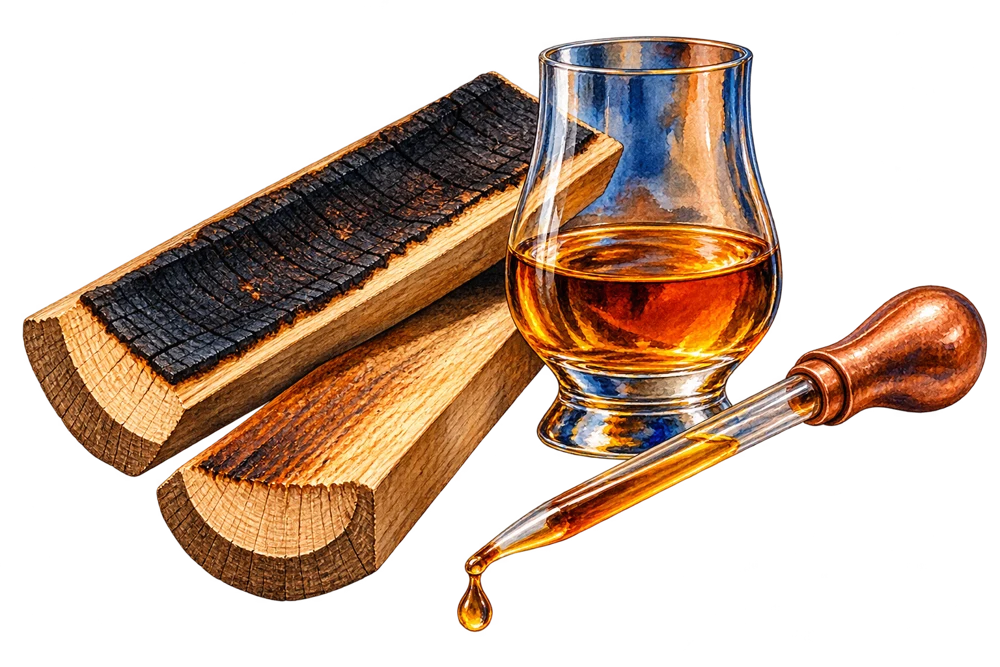
The current Toasted page describes two types of toasted French oak staves and a 100-proof, unfiltered bottling. Staves provide a different format of wood contact from moving whiskey into an entire finishing cask. The page’s lingering Crossroads recipe references help explain the relationship, but do not prove every historical Crossroads batch identical to today’s release.[10]

Cask strength preserves a different choice

The Uncut product page describes cask-strength, unfiltered bourbon and release-specific barrel information. Its four-year statement differs from the shop page’s minimum three-year description, which also allows single barrels or microblends. Those conflicting descriptions should not overwrite a physical label’s proof, age statement or single-barrel identity.[8][9]

Honey-seasoned barrels return

The 2024 Honey Bourbon announcement explains a round trip for the wood: whiskey barrels are used to age honey, then return for whiskey finishing. The sequence concerns a finishing vessel, not an instruction to assume that honey was simply mixed into the bottle. The precise edition still governs strength and specifications.[19]

Blending is more than counting finishes

Special Reserve exposes the difference between a component and a finishing category. The 2025 recipe includes more than one Madeira component. In 2026, Vino Naranja contributes 41% of the listed blend and Winter Bock contributes 10%. Component counts alone reveal neither the proportions nor the final balance.[15][17]

06 / The details worth knowing

The stories behind the specifications.

The storm is a chapter, not a universal origin

The survivor story is memorable because a destructive event became part of a release’s identity. It remains a bounded account of particular barrels. A present-day bottle named Uncut should not be assigned to the 2019 collapse simply because that story is prominent on an older brand page.[5]

Old whiskey predates a young producer

A seventeen-year Tennessee bourbon can be released by a company with a much shorter public history. The age describes the whiskey’s maturation, not the company’s existence. That distinction lets the mature release be appreciated without manufacturing an ancestral distillery story.[7]

The river is both image and workplace

Riverset gives the landscape a name, while the Memphis maturation account gives it an operational role. The two ideas sit together naturally, but a river-themed label is not evidence of water source, transportation route or distilling method. The supported story is the company’s local identity and aging setting.[13][19]

A changing product page needs a dated reading

The 2024 Honey Bourbon release was 115.7 proof; the current page lists 117.8 proof and expected October 2026 shipping. These can describe separate editions. Expected shipping language is not evidence of completed delivery, and today’s specifications should not be pasted onto an earlier bottle.[19][20]

A recipe can be a miniature archive

The 2024 Special Reserve’s combination of young Kentucky and older Tennessee bourbon preserves several whiskey histories inside one blend. Its disclosed components invite a more useful question than which finish sounds most unusual: how much of each whiskey was used, and what role could it play in the whole?[14]

Growth is visible in the experiments

The 2025 Special Reserve launch calls it the second annual edition and limits the release to two thousand bottles. The series shows a producer extending its identity through blending and finishing. A small release count describes the edition; it is not evidence of future availability, collectibility or financial value.[16]

07 / Selected expressions

A tasting path through the producer.

Juke Joint

The familiar Blue Note bourbon offers an entry into the house identity and its blues vocabulary. Read its own label alongside Uncut rather than assuming the cask-strength version is merely the same physical batch with less dilution. The two formats answer different questions about consistency and barrel individuality.[22][8]

Crossroads / Toasted French Oak

Crossroads remains the correct historical name for bottles carrying that label. The current Toasted listing describes the French-oak-stave approach at 100 proof. Comparing the names is useful; assigning a precise renaming date or universal batch equivalence is not supported by the material used here.[10]

Uncut

The cask-strength branch emphasizes the whiskey’s strength and individual release identity. Because the current product and shop descriptions differ on minimum age and format, this profile leaves those differences visible rather than selecting a convenient universal specification.[8][9]

Wheated Bourbon 101

The current Kentucky straight bourbon uses the disclosed 70/21/9 corn, wheat and malted-barley recipe and is bottled unfiltered at 101 proof. It adds a distinct recipe to the portfolio rather than a new name for the rye-grain bourbon.[11]

Straight Rye

The current Blue Note rye is listed as Kentucky straight rye, at least three years old and 93 proof. Its 95/5 rye-and-malted-barley recipe gives it a separate grain identity. These current specifications should not automatically be transferred to historical Riverset releases.[12]

Special Reserve, 2024–2026

The progression runs from seven components at 112.5 proof to ten at 116.3 and nine at 119.9. Age ranges and proportions also change. It is a tasting path through three blending decisions, not a simple ladder in which a larger component count or higher strength guarantees greater quality.[14][15][17]

08 / The Reserve connection

Continue from the story to the bottles.

B.R. Distilling Company in The Thelen Reserve

2 physical bottle records connect this story to the collection. Each keeps its own proof, barrel, batch, pick and release details.

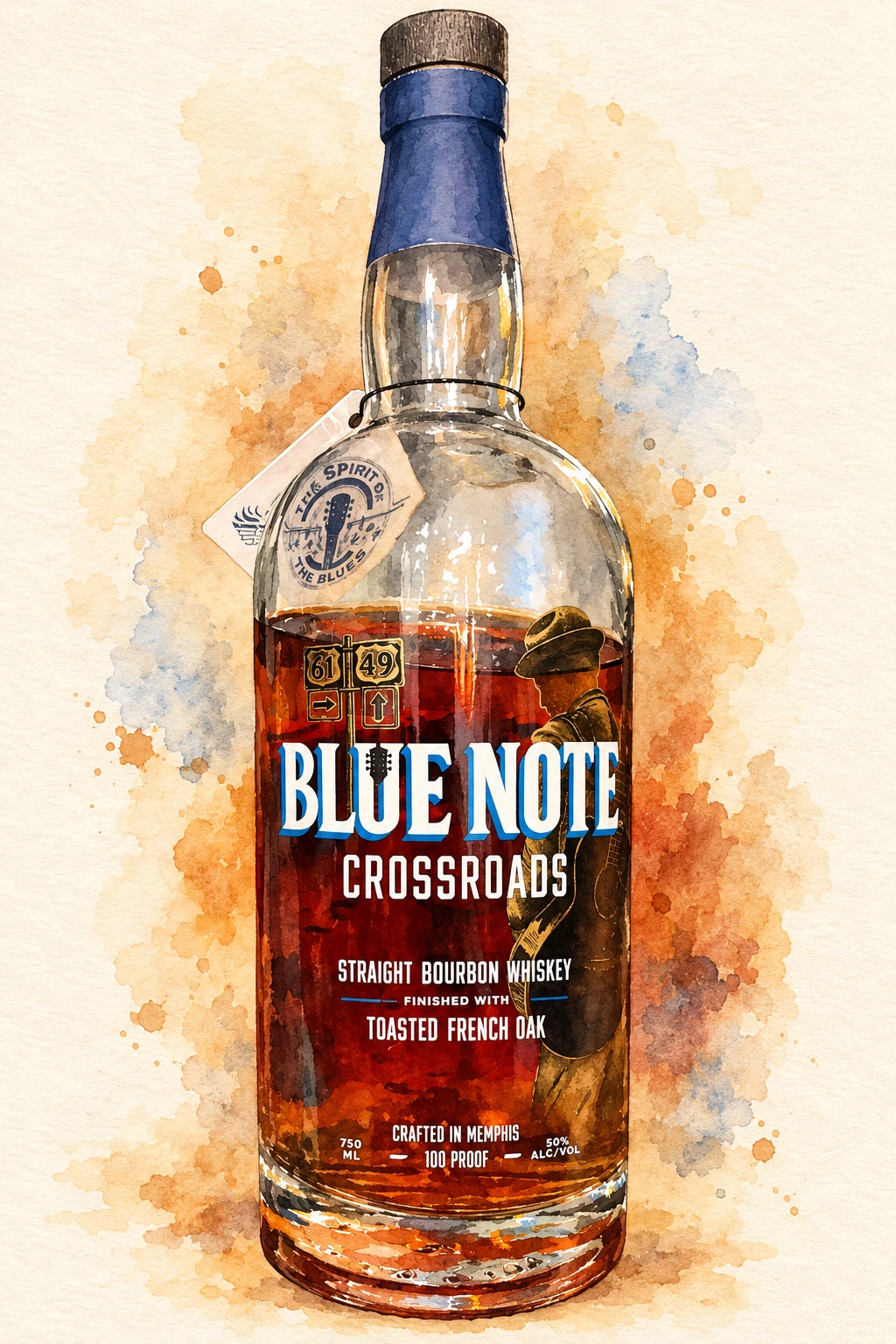
Blue Note Crossroads Finished in Toasted French Oak approved watercolor

Blue Note Crossroads Finished in Toasted French Oak

W0085 · 100 proof

Historical Crossroads label. No barrel, batch or pick recorded.

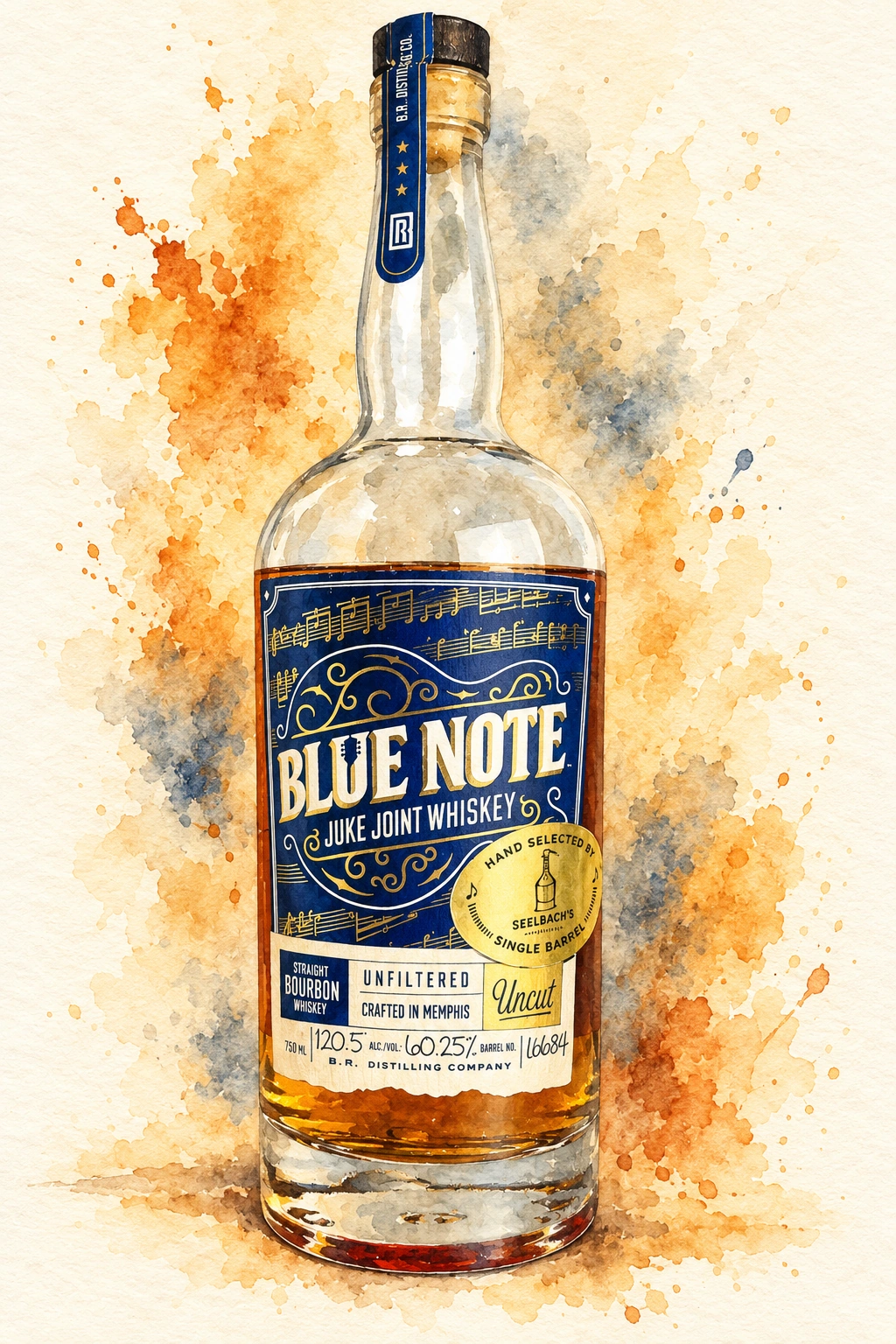
Approved watercolor of Blue Note Juke Joint Uncut Single Barrel

Blue Note Juke Joint Uncut Single Barrel

W0086 · 120.5 proof · Barrel 16684 · Pick Seelbach's

Physical label confirms the Seelbach’s single-barrel selection, barrel16684,120.5proof.

Collection snapshot: October 23, 2026. W0085 uses its exact approved watercolor, ART0217 v1. W0086, barrel 16684 at 120.5 proof, remains a text-only card because no exact approved artwork is recorded.

B.R. Distilling Company guide cover
The illustrated companion

B.R. Distilling Company, in three pages.

Origins and people, history and places, whiskey and stories. An illustrated companion with linked research sources.

Sources & research notes

Research qualifications

  • Research checked October 17, 2026 (America/Phoenix). Website v1 and Guide v1 approved October 18, 2026.
  • 2013 in the 2020 release conflicts with the company site’s 2014 founding date. The current site separately dates the license to 2014 and B.R. holding it to 2018. The 2017 ownership/direction change is attributed to the older announcement.
  • Green River is a distilling partner, not an established B.R.-owned facility. Public sources do not establish a complete current ownership structure or all historical source distillers.
  • Uncut descriptions differ: four years on the product page, minimum three years and single-barrel or microblend formats in the shop. The profile preserves that conflict.
  • Crossroads is retained for historical bottles; current Toasted naming does not establish an exact rename date or batch equivalence.
  • The Honey Rye press release has a stray reference to bourbon despite its rye title and 95/5 rye recipe. The profile uses the explicitly identified rye specification and flags the drafting error.
  • The current Honey Bourbon page carries expected October 2026 shipping. Actual delivery is not established. Distribution counts and historical visitor hours are not presented as current.
  • Illustrations are original symbolic watercolors, not photographs or verified architectural reconstructions. Awards are reported from producer sources. No personal tasting claims are implied.

Full sources

  1. Blue Note: company and team
  2. B.R. Distilling: company and services
  3. 2020 company expansion announcement
  4. September 2025: new CEO
  5. Blue Note: storm barrels and recognition
  6. Blue Note news archive
  7. Seventeen-year Tennessee bourbon
  8. Uncut: current product specification
  9. Uncut: differing shop description
  10. Toasted French Oak
  11. Wheated Bourbon 101
  12. Blue Note Straight Rye
  13. Riverset Rye: brand identity
  14. 2024 Special Reserve composition
  15. 2025 Special Reserve composition
  16. February 2025 Special Reserve launch
  17. 2026 Special Reserve composition
  18. August 2024 Honey Rye launch
  19. October 2024 Honey Bourbon launch
  20. Honey Bourbon: current edition
  21. Blue Note: present and past releases
  22. Juke Joint bourbon
↑